When We Police Ourselves
The Cruelest Cut: How We Become Enforcers of Our Own Oppression
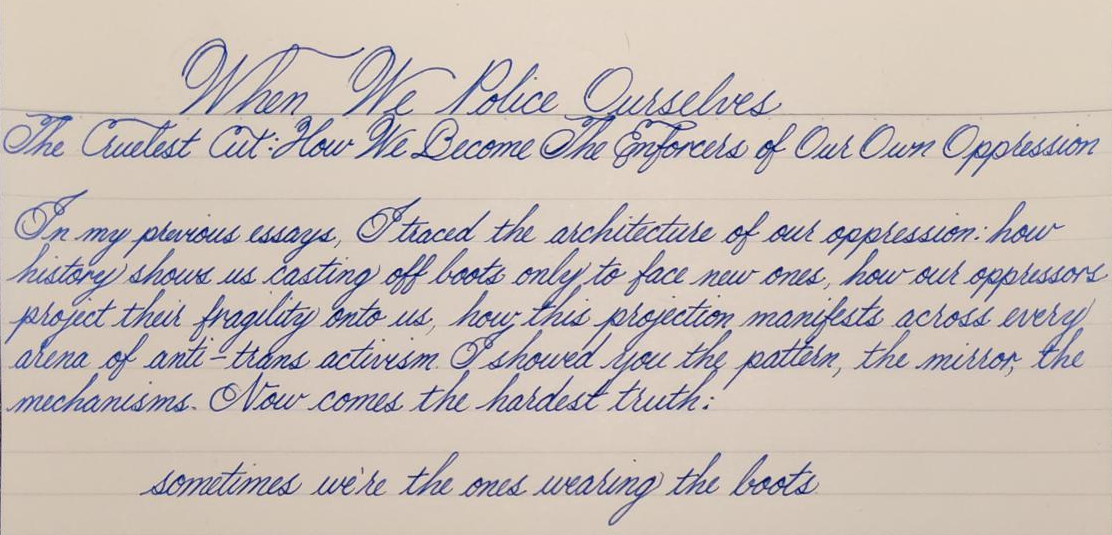
In my previous essays, I traced the architecture of our oppression: how history shows us casting off boots only to face new ones, how our oppressors project their fragility onto us, how this projection manifests across every arena of anti-trans activism. I showed you the pattern, the mirror, the mechanisms.
Now comes the hardest truth: sometimes we're the ones wearing the boots.
There exists a peculiar alchemy that transforms the oppressed into oppressors of their own - a transmutation so complete, so insidious, that we often fail to recognize when we've become what we once fought against. Watch how quickly "they'll never accept us if" becomes "we shouldn't accept those who." Observe how "I suffered through gatekeeping" morphs into "everyone must suffer as I did." Notice the tragic arithmetic where we subtract our most vulnerable to sum up to a respectability that never arrives, a mathematical impossibility where division creates only less than what we began with.
One does not become free by accepting the terms of one's imprisonment, yet this is precisely what we do when we internalize the logic of our oppression. We mistake the familiar weight of chains for the comfort of belonging, confuse the echo of our oppressors' voices for our own thoughts, transform survival mechanisms into weapons we wield against each other.
This isn't about casting blame. This is about recognizing how the boot we once fought against becomes the boot we wear, how the mirror we held up to our oppressors becomes the mirror we turn on ourselves, how we mistake familiar cruelty for necessary rigor. How the external pressure and prejudice is then turned inward and practiced on our own, by our own hand.
The Anatomy of Abandonment
"We need to be more strategic." The words hang in the air like a diagnosis, clinical and final. But strategic for whom? Strategic toward what end?
And then, the inevitable follow-up: "It's not about respectability politics, it's about optics." As if changing the word changes the meaning. As if "optics" weren't simply respectability politics dressed in marketing terminology, the same demand for palatability wrapped in the language of public relations.
"We can't ignore the optics," they insist, as if the way we're perceived by those who hate us should determine how we exist. But whose gaze are we privileging when we worry about optics? Whose comfort are we centering when we police our own for being too visible, too authentic, too themselves?
Listen carefully to these conversations in our community spaces, these councils of war where we debate not how to fight our oppression but how to manage our image. "We can't afford to be so visible." Cannot afford - as if visibility were a luxury item, as if existing authentically were an indulgence we must price out of our struggle. "Those people are making us all look bad." Those people. Always those people. Never us, never the speakers, always some Other within the Other, some subset whose sin is refusing to perform palatability.
The language of concern masks the logic of abandonment - strategic thinking that strategically thinks away our most vulnerable, tactical considerations that tactically consider some of us expendable. As if our liberation could be purchased by sacrificing those deemed too much, too loud, too visible, too themselves.
But who decides what's strategic? Almost without exception, those whose privilege - passing, class, connections, the thousand small insurances against total catastrophe - insulates them from the worst consequences of visibility. From comfortable positions, it's easy to counsel patience. When your job is secure, your healthcare accessible, your safety assured by the very respectability you demand from others, you can afford to theorize about "optics" and "messaging." You can afford to forget that for some of us, visibility isn't a choice but a condition of existence.
We've seen trans voices go to right-wing publications - those very platforms that daily advocate for our elimination - to explain why the movement has "lost its way." They sit across from our executioners and offer helpful notes on the scaffold's construction. Not because of coordinated attacks, millions in opposition funding, or legislative warfare - no, in their telling, we suffer because some trans people dare to be visible, dare to be young, dare to use pronouns that challenge binary thinking, dare to exist without apology.
The diagnosis is always the same: other trans people are the problem. The solution is always the same: we should separate ourselves from those others, and perhaps we'll be granted the grace of conditional existence.
This isn't strategy. It's the alchemy of fear transformed into policy, the desperate hunger for acceptance dressed in tactical language, collaboration costumed as concern. We mistake the cruelty we know for wisdom, transform our trauma into strategy, convince ourselves that if we police each other hard enough, maybe they'll stop policing us.
The Respectability Trap
"If we just present better, act better, look better, they'll accept us."
How many times have we heard this refrain? How many times have we, perhaps, said it ourselves? It emerges from our mouths like inherited wisdom, but whose wisdom is it? Not ours. This is the voice of our oppression speaking through us, the internalized demand that we audition for our own humanity.
This myth has haunted every marginalized community, a ghost that whispers of acceptance just beyond the next compromise, just past the next exclusion. And we've learned its lesson poorly. We hear trans voices arguing for more gatekeeping, higher barriers, fewer rights for those who don't meet certain standards - medical, social, aesthetic. As if the boot cares about our internally imposed hierarchies. As if oppression were a negotiation where we could offer up the "wrong" kind of trans person as a sacrifice to save the "right" ones.
But what is this "right" kind? Always, it seems, someone who looks like success within the current system, who threatens nothing, challenges nothing, demands nothing but the right to disappear into assimilation. Always someone who has already won the lottery of passing, of class, of a dozen other privileges dressed up as virtues.
History mocks this logic with the bitter laughter of the excluded. The civil rights movement didn't succeed through respectability - it succeeded through sit-ins deemed disruptive, freedom rides called provocative, protests labeled as going too far. Every single tactic that moved the needle was condemned as excessive by those who counseled patience, including - especially - by those within the community who had achieved a measure of comfort.
Stonewall wasn't sparked by polite requests but by those society deemed least respectable: the drag queens, the street youth, the ones who couldn't or wouldn't hide. Marsha P. Johnson didn't throw that first brick (or shot glass, or stone - the mythology matters less than the act) wondering if her presentation was respectable enough. Sylvia Rivera didn't storm police lines concerned about whether her existence might make the movement "look bad."
Yet we hear voices in our community dismissing those who refuse compromise as childish, as if demanding dignity were a mark of immaturity. They speak of activists who won't 'listen to reason' - but whose reason? The reason that says wait, be patient, accept less? The reason that has always counseled the oppressed to seek smaller freedoms?
This isn't about age but about approach. Those who refuse to shrink their demands, who won't accept conditional humanity, who insist on all rather than some - they're labeled naive, told they don't understand how the 'real world' works. But perhaps they understand all too well. Perhaps they've learned what we forgot: that partial freedom is not freedom, that conditional acceptance is not acceptance, that you cannot negotiate your way to humanity.
The Good Trans Delusion
We know this figure intimately - perhaps we have been this figure, perhaps we fear becoming them, perhaps we see them in the mirror on our worst days. The "reasonable" trans person who distances themselves from the "unreasonable" ones. The one who transitioned quietly, who "passes," who doesn't make waves. "I'm not like those other trans people," they say, and in saying so, they drive the knife a little deeper into all our backs.
They dress professionally. They adopt the aesthetics of the class they aspire to join. They speak in measured tones about measured progress. They have "concerns" about the direction of the movement. They find the youth too radical, the non-binary too confusing, the visible too threatening to the acceptance they've worked so hard to achieve.
But conditional acceptance is not acceptance - it's a leash. And leashes can always be shortened, can always be yanked, can always become nooses.
We hear some argue that there are "everyday trans people" living quiet lives, as opposed to those seeking attention. This division - the good trans versus the bad trans, the reasonable versus the radical, the invisible versus the visible - serves only our oppressors. It provides them with willing testimony that yes, some of us deserve fewer rights, deserve less protection, deserve to be excluded from the category of the human.
But this division runs deeper than presentation - it cuts along the lines of who can pass and who cannot, who fits the binary and who transcends it. We become the gender police we claim to oppose, checking each other's presentations at the door, measuring authenticity against standards we didn't create but now enforce. We hear it in the whispered judgments: "If only they would try harder to pass." "If they would just do the voice training." "If they would just get facial feminization surgery, or electrolysis, or learn to walk differently, sit differently, exist differently."
For non-binary folks, the demands become even more contradictory: "Why wear makeup and dresses while keeping a beard?" As if gender expression must be coherent by binary standards, as if authenticity means choosing one side or the other rather than existing in the infinite space between.
This isn't just prejudice - it's survival instinct corrupted into weapon. The fear is real: association with the "wrong" kind of trans person might threaten the conditional acceptance we've fought to achieve. But this fear makes us enforcers of the very standards used against us all.
Some go further, weaponizing the very terms our oppressors use against us. Trans women calling other trans women 'AGP' - autogynephiles - adopting the pathologizing language of those who would pathologize us all. As if there were a 'right' way to be trans, a 'real' reason for transition, a 'valid' experience that excludes others. We become diagnosticians of each other's authenticity, gender police with badges we printed ourselves.
We forget that in our own struggles to cast off the chains of those who would define us, we begin defining others. We start making value-laden statements that invariably flow from the haves to the have-nots - those who have surgeries judging those who don't or can't, those with supportive families questioning the choices of those without, those with passing privilege determining the authenticity of those without it. We replicate the very hierarchies we fought to escape, creating new chains from the metal of our broken ones.
When we go to their platforms to explain how other trans people are "hurting the cause," we don't build bridges - we burn them. And we burn them from both ends, leaving ourselves stranded on an island of our own making. We provide ammunition for the next bathroom bill, the next healthcare ban, the next attempt to legislate us out of existence. We become collaborators in our own oppression, and we call it strategy.
When Wounds Become Wisdom
We know this voice too - the battle-worn veteran who mistakes their armor for wisdom. "I've been misgendered a thousand times and lived to tell the tale," they say, as if survival were the goal rather than the starting point. They preach resilience but mean resignation, counsel strength but teach surrender.
Watch how quickly "I survived this" becomes "you should endure this too." The logic is seductive: I made it through discrimination by developing thick skin, therefore thick skin is the answer. But this transforms our coping mechanisms into curriculum, our trauma responses into required reading for the next generation. As if learning how to take such behavior with good grace, a milquetoast response, will keep us being the “respectable and acceptable trans.”
It teaches cisgender folks that this is acceptable, if bothersome to us.
They call demanding dignity "weakness" and accepting abuse "strength." They've confused their calluses for achievements, their scars as medals, their endurance for victory. Most perversely, they now guard the very gates that bloodied them, ensuring each generation must develop the same "resilience" to the same violence.
But resilience to oppression is not liberation from it. The capacity to endure discrimination is not the same as ending it. When we wax romantic about and glorify our scars rather than preventing others from being scarred, we become trustees of our own oppression, passing down not wisdom but wounds, not resilience, but resignation - not living, just surviving.
We deserve more than just surviving.
The Myth of Strategic Sacrifice
"We need to focus on what's achievable." The reasonable voice, the adult in the room, the one who understands how politics really works. "We can't fight every battle." Of course not - so let's choose which of our people to abandon. "Some compromises are necessary." Necessary for whom?
Listen to how quickly "strategic thinking" becomes strategic abandonment. These voices never seem to notice that it's always the same people being strategically abandoned: the poor, the non-passing, the non-binary, the youth, the ones who can't or won't contort themselves into acceptability.
But here's what gets lost in all this strategic thinking: this isn't about determining who is 'properly' trans versus who isn't. This is about bridging the divide between cisgender and transgender experiences, about expanding understanding rather than narrowing definitions.
I have only ever been trans. I don't understand cisgender people who say they don't have a gender identity. To me, that simply means they've never had to examine or struggle with theirs. Their body and identity aligned from day one, a harmony so complete they mistake it for absence. They've never had to think about gender because theirs has never been questioned - an absence of struggle they mistake for an absence of identity.
But here's the crucial part: their unconscious comfort with gender doesn't invalidate our conscious relationship with it. And our consciousness of gender - earned through struggle, shaped by questioning - gives us insights they lack. We know gender as both performance and truth, as both construction and core. We understand its weight because we've carried it differently.
But this lack of examination on their part doesn't mean we should police ourselves into narrower and narrower definitions. It shouldn't matter what we look like, what we wear, whether we have facial hair or not, whether our voices match their expectations. The bridge we need to build isn't constructed by making ourselves smaller - it's built by helping them see that gender, like humanity, is vast and various.
We hear voices arguing that defending youth healthcare was doomed from the start, that we should have accepted more restrictions, more gatekeeping, more barriers. "If we'd just compromised on puberty blockers," they say, "we could have saved hormones." But they forget, or choose to forget, that our opponents have told us explicitly, repeatedly, in every forum and every fundraising letter, that their goal is our elimination. There is no compromise with annihilation. There is no middle ground with those who deny our right to exist.
The same voices that counsel compromise never seem to notice that our opponents don't compromise. While we debate which rights to sacrifice for respectability, they work methodically to take them all. While we police ourselves for being "too radical," they radical themselves into power, they radical themselves into our medical offices, our schools, our bathrooms, our existence.
We cannot win by becoming smaller. We cannot purchase safety by sacrificing our siblings. Every right we've won came from those who refused to be respectable, refused to be patient, refused to throw others under the bus for conditional acceptance.
Yet still we hear it: "If we just focused on the reasonable cases..." But who determines reasonableness? "If we didn't push so hard..." But who decides what constitutes pushing? Always, it seems, those who have already gotten theirs, who have already crossed the bridge and now counsel burning it for the safety of those on the other side.
The Class Comfort Problem
Notice who can afford to demand "toning it down": invariably, those whose privilege provides buffers against discrimination. We hear accomplished professionals lecture about "optics" from positions where they can lie about menopause to get HRT, where they can navigate systems closed to those without their resources, where they can afford to fly to Thailand if local healthcare fails them.
"I'll be fine," they say, explaining why others should accept restrictions. The confession is unwitting but complete. Yes, you'll be fine. Your class position, your connections, your ability to navigate systems designed to exclude - these will save you. But what about those who won't be fine?
What about the trans woman who can't afford to "dress professionally" because she can't get hired? What about the non-binary person whose pronouns mark them as a target? What about the youth whose authenticity reads as provocation to those who demand invisibility? What about those without sympathetic doctors, secure employment, the social capital to navigate hostile systems?
Their struggles become acceptable casualties in someone else's war for respectability. "I'll be fine" becomes "I'll be fine with throwing you under the bus." This isn't solidarity - it's pulling up ladders. It's the "I got mine" politics that fracture movements and doom the vulnerable, that transform survival into a zero-sum game where another's visibility threatens my invisibility.
The Historical Amnesia
We hear voices claiming that gay acceptance came from becoming "less messy," that today's typical gay person, what they call the "modal gay" in their sanitized sociology, is no longer provocative. This rewriting of history would be amusing if it weren't so dangerous. It erases ACT UP's die-ins, where people lay down in the streets to represent those dying of AIDS while the government looked away. It erases leather pride, drag visibility, the camp sensibility that refused shame. It erases everything that actually moved the needle, replacing it with a sanitized fantasy where rights were won through good behavior.
The same voices now argue for a "modal trans person" - properly gendered, professionally dressed, quietly integrated. They've forgotten that every "respectable" gay person today stands on ground cleared by those deemed too flamboyant, too angry, too visible in their time. They've forgotten that acceptance never came from being acceptable, but from refusing the terms of acceptability itself.
Most crucially, they've forgotten the fundamental truth of all liberation movements: none of us are free until all of us are free. This isn't sentiment - it's strategy. Every exclusion creates a precedent, every abandonment establishes a principle, every sacrifice of the 'unrespectable' provides a blueprint for the next restriction.
When we argue that youth activists are "too radical," that visible trans people are "hurting the cause," we repeat the same mistakes. We become the conservative force we once fought against, the voice of "slow down" and "not yet" that has always served oppression. We become our parents, our grandparents, everyone who ever told us to hide ourselves for our own good.
But here's what this amnesia conceals: the radical never became respectable. Society simply moved its boundaries to include what it once excluded, and immediately began excluding those still outside. The leather daddy became acceptable only when the drag queen could be marked as excessive. The married gay couple became respectable only when the polyamorous could be marked as deviant. And now, the binary trans person who passes becomes acceptable only when the non-binary person can be marked as unreasonable.
The False Promise of Patience
"Be realistic," we're told by those who've made peace with crumbs. "Change takes time." But whose timeline?
Take a look around. While we counseled patience and respectability, states banned our healthcare. While we worried about moving too fast, they outlawed our participation in sports. While we policed ourselves for better "optics," they criminalized our bathroom use, our very existence in public life.
We're experiencing the backlash anyway. What exactly did respectability and patience buy us? What precisely did we gain by counseling moderation while our opponents pursued extremism?
The youth who refuse to hide, who demand recognition now, who won't sand down their edges for palatability - they're not naive. They've learned from our failures. They've seen that respectability politics purchased nothing but the illusion of progress, that patience meant watching their rights disappear while we counseled strategy.
They've learned what we should have known: that power never yields to patience, only to pressure.
The Liberation in Refusal
So what do we do with these hard truths? How do we stop wearing the boot we once fought against? How do we break this cycle of becoming what we feared?
First, we recognize the pattern. When we catch ourselves saying "those trans people are too visible," we must stop and ask: visible to whom? When we feel the urge to distance ourselves for respectability, we must examine that urge: respectable by whose standards? When we're tempted to sacrifice others for our own comfort, we must remember who benefits from our division.
Second, we choose solidarity over strategy. Not uncritical acceptance, not the pretense that all tactics are equal, but recognition that our liberation is collective or it is nothing. The same forces that target the most visible among us will eventually target us all. There is no safety in sacrifice, only temporary reprieve that grows shorter with each exclusion.
Third, we remember our history accurately. Every right we have came from those who refused respectability, who wouldn't police themselves or others, who understood that liberation requires defiance, not compliance. We honor those who came before not by sanitizing their memory but by carrying forward their refusal to be anything less than themselves.
All of Us or None
In "We Are Its Gravity," I wrote about casting off boots and the historical pattern of liberation. In "The Mirror of Offense," I showed how projection becomes a weapon. In "The Fragility of the Offended Offenders," I revealed the mechanisms of our oppression.
Now we see the cruelest mechanism: how we sometimes become the boot-wearers ourselves.
They want us divided, categorizing ourselves into "good" and "bad," "reasonable" and "radical," "respectable" and "embarrassing." They want us to police ourselves because it's more efficient than policing us themselves. When external enforcement fails, internal enforcement succeeds. They want us to believe that that freedom can be won by narrowing its definition until only the already-free fit inside.
But the truth we must face, the truth that sits like stones in our stomachs: respectability politics is not a strategy, it's a surrender. It accepts the premise that some of us deserve less, that some ways of being trans are wrong, that liberation can be purchased through exclusion. It transforms us from freedom fighters into border guards, from liberators into police.
But we know better. We know from history - our own and others' - that every excluded group today becomes the justification for excluding more tomorrow. We know that conditional acceptance is a lie, that the conditions always expand, that the price always rises, that the boot always demands more necks to stand on.
We are its gravity - all of us, not just the ones deemed respectable. Our power comes not from being acceptable but from being undeniable. Not from shrinking but from expanding. Not from sacrifice but from solidarity. Not from becoming what they want but from insisting they accept what we are.
The boot-wearers among us believe they're being strategic, protecting the movement, ensuring survival. But survival isn't living. Survival isn't liberation. Survival isn't worth purchasing with our siblings' lives. What good is a freedom that requires us to become our own oppressors? What value is acceptance that demands we reject our own?
Our greatest act of resistance is refusal. Refusing to police each other's presentations, pronouns, or visibility. Refusing to sacrifice the vulnerable for the promise of acceptance. Refusing to mistake their conditional tolerance for liberation. Refusing to become the enforcers they couldn't hire, the police they couldn't deploy, the oppression they couldn't maintain without our cooperation.
So we cast off this boot too - the one we've put on ourselves. We choose solidarity over respectability, authenticity over assimilation, all of us over some of us. We choose the difficult truth over the comfortable lie.
The youth with neopronouns, the visible activists, the ones who won't hide or apologize - they're not our problem. They're our promise. They demand the world expand rather than demanding they shrink. They understand what we sometimes forget: that dignity isn't negotiable, that humanity isn't conditional, that freedom isn't freedom if it requires others to remain chained.
Because in the end, that's the only strategy that's ever worked. Not patience, not respectability, not sacrifice - but the unwavering insistence that we all deserve dignity, that we all deserve freedom, that we all deserve to exist as ourselves. The insistence that we will not purchase our humanity by denying others theirs.
They handed us the tools of our own oppression, taught us to use them on each other, convinced us this was wisdom. They made us apprentices in our own subjugation, students of our own denial. It's time we handed them back. It's time we refused our enrollment in this education of erasure.
All of us, or none of us. That's not naive idealism - that's the lesson history teaches those willing to learn. That's the mathematics of liberation, where the only sum that matters includes every variable, where no one is expendable, where our freedom is indivisible because our humanity is indivisible.
We are its gravity. And gravity, eventually, always wins. Not because it compromises, not because it negotiates, not because it sacrifices parts of itself - but because it insists, with patient certainty, on pulling everything toward truth.
The truth is this: we all deserve to exist. Fully. Visibly. Authentically. Without apology, without audition, without having to earn through suffering what should be ours by right of being.
That's the gravity we must be. That's the force we must exert. Not pulling each other down, but pulling the world forward. Together. All of us.
Or none of us.