When LGB Advocates Become What They Once Fought
A Teachable Moment Brought To Us By LeAnne Owens, LGB Courage Coalition

How We Got Here
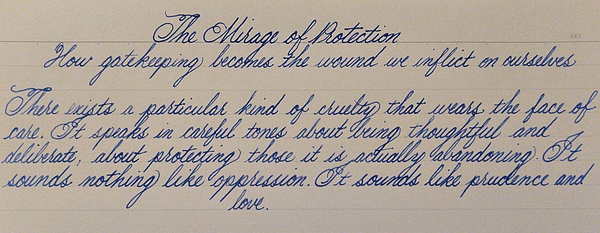
In my recent article ‘The Inconvenient Truth About Family Estrangement,’ I examined how family rejection often leads to estrangement, particularly in the context of transgender individuals and their families. The piece analyzed Graham Linehan's collection of stories from parents estranged from their transgender children, noting how these narratives consistently blamed external forces rather than examining the parents' own rejection behaviors. It did this in a sardonic manner, with an attempt at a humorous but engaging tone.
Shortly after publication, I received a comment from LeAnne Owen, head writer for the LGB Courage Coalition and their own substack ‘1+1≠ 3’, accusing me of being ‘horrible’ and ‘pushing kids away from their families.’ When I responded by clarifying that my article actually advocated for family reconciliation through acceptance, LeAnne doubled down with a lengthy comment recycling numerous anti-transgender talking points.
What struck me most about LeAnne's response wasn't just its factual inaccuracies, but how thoroughly it repurposed the exact same rhetoric once used against lesbian, gay, and bisexual people - rhetoric that LeAnne herself, as a lesbian who grew up in the Deep South, admits to experiencing firsthand.
This exchange provides a teachable moment about how prejudice evolves, how easily those who have experienced discrimination can be enlisted to perpetuate it against others, and why we must recognize these patterns to break them.
Let's examine LeAnne's claims, the facts they ignore, and the troubling historical parallels they reveal.
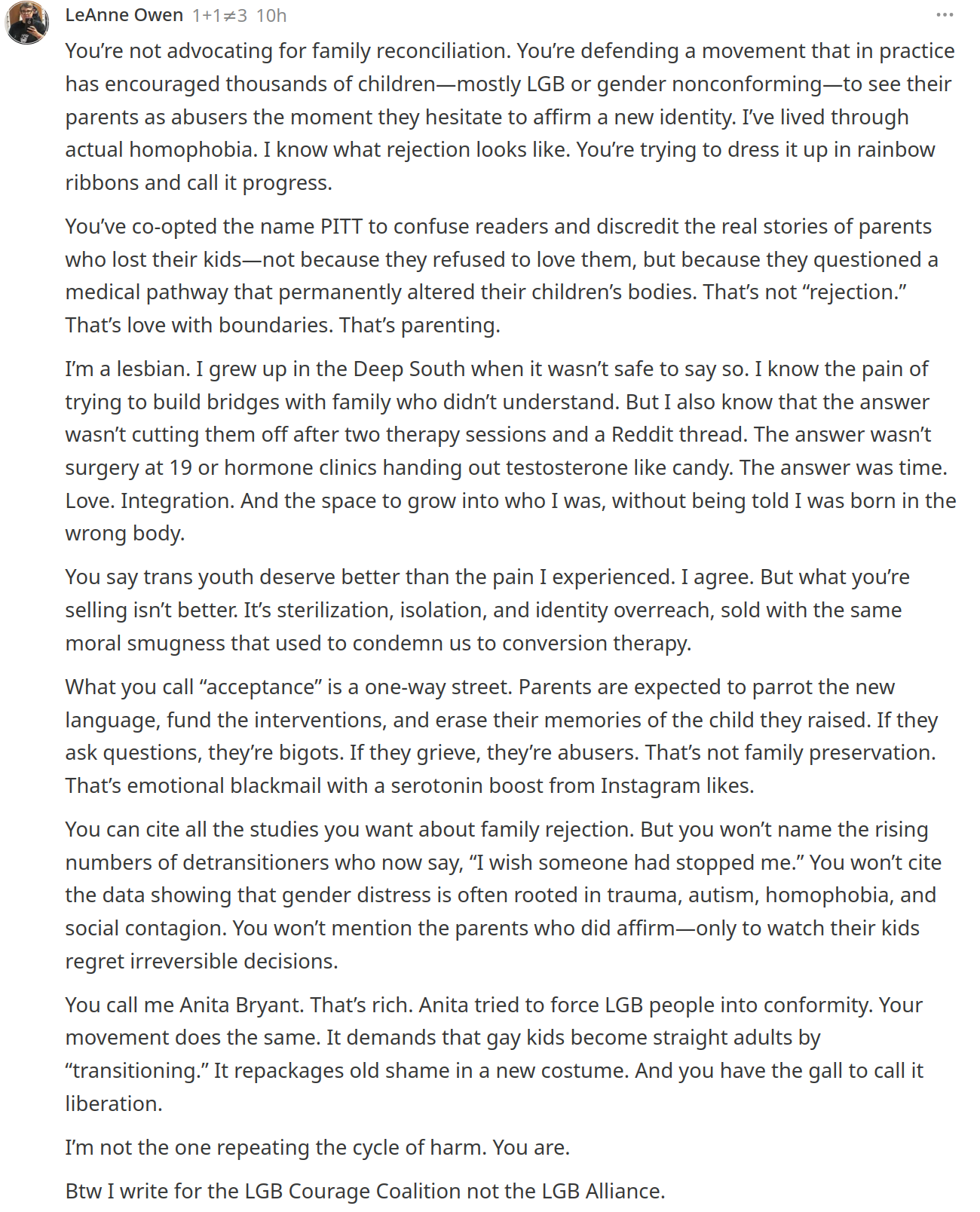
Let’s start with breaking down the key claims and pointing out the logical fallacies supporting or serving as the basis of the rhetoric.
Claim: ‘You're not advocating for family reconciliation.’
Fact Check: False. My article explicitly advocates for reconciliation through mutual respect and understanding. It's contains citations to peer-reviewed research on family estrangement, not Reddit threads or Instagram likes. It seems that LeAnne did actually read the article, else they might not have missed the areas in which I advocate for families staying together through love and acceptance in several key sections:
- In the introduction, I frame the entire piece as examining ‘this complex family issue’ and challenging the narrative that blames external forces rather than examining relationship dynamics.
- In the section on what actually causes family estrangement, I present research on the patterns that lead to estrangement, implicitly suggesting these are patterns to avoid if families wish to stay together.
- When discussing Dr. Joshua Coleman's research, I note that ‘estrangement often happens when adult children feel their identity fundamentally rejected,’ suggesting that acceptance of identity is key to preventing estrangement.
- In ‘The Path Forward’ section, I explicitly state: ‘If there's any hope for healing these relationships, it starts with... humility and a willingness to listen.’ I continue by noting that ‘Family therapists who specialize in reconciliation emphasize that the first step is for the parent to acknowledge their child's perspective as valid.’
- I quote Dr. Coleman directly: ‘The parents who successfully reconcile are those who can say, 'I can see how my actions hurt you, even if that wasn't my intention.'‘
- My conclusion directly states: ‘Because true familial love means seeing and respecting someone for who they are, not who we wish they would be,’ which is a clear advocacy for acceptance as the path to maintaining family relationships.
Throughout the piece, I consistently present research showing that acceptance and respect for identity leads to maintained relationships, while rejection leads to estrangement. I am attempting to make a clear case for families staying together through acceptance rather than driving them apart.
LeAnne makes a patently and demonstrably false claim.
And not to put to fine a point on it, I will reiterate that research consistently shows that estrangement happens after multiple attempts at reconciliation - not ‘the moment parents hesitate to affirm’ as LeAnne claims. Studies by Agllias (2016), Scharp & Thomas (2016), and Carr et al. (2015) all demonstrate that estrangement typically follows years of conflict and multiple attempts at resolution. That's hardly the impulsive scenario LeAnne has painted.1
Logical Fallacy: Straw Man and False Premise
This is a classic straw man argument where LeAnne attacks a position I never took, creating a fictional version of my article that's easier to criticize. They build their entire argument on the false premise that I'm encouraging estrangement, when in fact I'm analyzing why it happens and how to prevent it.
This fallacy allows them to avoid engaging with the actual content of the article, particularly the research showing that the very behaviors they are defending (refusing to respect someone's name, sending anti-trans articles, framing healthcare as ‘mutilation’) are precisely what lead to the estrangement they claim to be concerned about.
Claim: "You're defending a movement that in practice has encouraged thousands of children—mostly LGB or gender nonconforming—to see their parents as abusers the moment they hesitate to affirm a new identity."
Fact Check: False
This claim fundamentally misrepresents both transgender advocacy and the actual dynamics of family estrangement. It erroneously claims I am defending positions that are demonstrably not true.
First, there is no evidence that transgender rights advocates encourage children to view their parents as "abusers" for simple hesitation. What advocates actually promote is family acceptance and education, with numerous resources specifically designed to help parents navigate their child's gender journey with compassion while still processing their own feelings. Organizations like PFLAG, Gender Spectrum, and the Family Acceptance Project (among others) explicitly focus on keeping families together through education and support.2
Second, the characterization of estrangement as happening "the moment parents hesitate to affirm" contradicts all available research on family estrangement. Studies by Agllias (2016), Scharp & Thomas (2016), and Carr et al. (2015) all demonstrate that estrangement typically follows years of conflict and multiple attempts at reconciliation - not a single moment of hesitation.
Third, the assertion that transgender advocacy targets "mostly LGB or gender nonconforming" children is unsupported by research. Studies consistently show that gender identity and sexual orientation are distinct aspects of identity. The implication that transgender advocacy is somehow ‘converting’ gay youth is, as far as I can tell, exclusively an anti-trans talking point circulated within the anti-trans groups. There is no credible evidence of this, and it recycles the same harmful narratives once used against gay and lesbian people themselves.
Logical Fallacy: Straw Man, Appeal to Fear, and an Ad Hominem that Begs the Question
This claim is pulling quadruple duty with a rather sophisticated rhetorical slight of hand. Let’s peel this onion together!
First, it creates a fictional version of transgender advocacy that bears little resemblance to reality (Straw Man). It employs a classic fear tactic by painting a picture of vulnerable children being manipulated into seeing loving parents as "abusers" over minor disagreements, when in reality, transgender advocacy organizations consistently emphasize family reconciliation and support (Appeal to Fear).
LeAnne's claim employs a sophisticated rhetorical sleight of hand. By framing their accusation as "You're defending a movement that..." they attempt to shift focus to my character (ad hominem) while simultaneously smuggling in several unproven assertions as if they were established facts (begging the question).
This structure allows LeAnne to present highly contested claims - that there's a coordinated "movement" encouraging children to see parents as "abusers," that this primarily targets LGB youth, and that estrangement happens at the moment of hesitation - as if these were settled matters rather than disputed allegations requiring evidence.
This is a common tactic in political rhetoric: attack the person's association with something portrayed as self-evidently harmful, thereby avoiding the burden of actually proving the harm exists in the first place. This allows LeAnne to sidestep providing evidence for their central claims while positioning themselves as simply pointing out an obvious moral failing on my part.
This approach is particularly effective because defending against it requires unpacking multiple layers of assumptions rather than addressing a single clear assertion - exactly the kind of rhetorical strategy that thrived in historical anti-gay discourse and now finds new life in anti-transgender rhetoric.
This rhetoric mirrors historical claims that gay rights advocates were "recruiting" children and turning them against their families - a fear tactic that has simply been repurposed for a new target. This has been refined since some of the original ‘social contagion’ theory of being gay/lesbian/bi and how their advocacy has become a sort of ‘gay cult’ complete with similar claims of familial estrangment of parents by their gay kids.
Claim: ‘Parents lost their kids because they questioned a medical pathway.’
Fact Check: Misleading
LeAnne claims to know what rejection looks like, yet they are advocating for the exact behaviors research identifies as leading to estrangement: refusing to use someone's name, sending them articles questioning their identity, and framing their healthcare as ‘‘mutilation.’’ These aren't loving boundaries; they are rejection tactics with predictable outcomes.
LeAnne’s characterization of acceptance as a ‘one-way street’ fundamentally misunderstands what trans folks are actually asking for. No one expects parents to ‘erase memories’ of their child's past. What's being asked is basic respect in the present. Using someone's name and pronouns isn't ‘parroting new language,’ it's extending the same courtesy you'd give to anyone else. Would you repeatedly call a married woman by her maiden name because that's how you want to remember her, or because you reject her partner of choice?
LeAnne's characterization of this as 'emotional blackmail with a serotonin boost from Instagram likes' trivializes the very real pain of identity rejection. This isn't about social media validation - it's about fundamental human dignity. The research consistently shows that transgender individuals who receive family support have significantly better mental health outcomes. This isn't 'emotional blackmail' - it's the natural consequence of how human relationships work. All relationships require mutual respect to thrive, and no relationship can survive one person fundamentally rejecting who the other is.
What's particularly ironic about this accusation is that it comes from someone who surely knows what it feels like to have their own identity dismissed or treated as either negotiable or patholigized. The suggestion that transgender people are seeking validation for superficial reasons rather than fighting for basic dignity is precisely the kind of dismissive rhetoric once used against lesbian, gay, and bisexual people - that they were just seeking attention or following a trend. The ‘social contagion’ idea that has gone around first originated before the aughts, though I think it reached its peak around the end of the aughts.
Parents absolutely can ask questions, process grief, and navigate this journey at their own pace. From what many have shared with me, when the family seeks therapy, this is encouraged by their therapist. What crosses the line isn't questions or grief, it's the persistent rejection disguised as ‘concern.’ It's sending anti-trans articles. It's refusing to use their name. It's framing their healthcare as ‘mutilation.’ These aren't innocent questions - they're active forms of rejection.
The research is clear: parents who work through their feelings while still showing basic respect maintain relationships with their children. Those who make their acceptance conditional on their child denying their own identity often end up estranged.
Logical Fallacy: Euphemism and False Equivalence
LeAnne’s argument employs two key fallacies:
Euphemism: Using the mild term ‘questioned a medical pathway’ to describe what was actually persistent undermining, rejection, and invalidation is a euphemistic misrepresentation of the behaviors described in the original stories. This minimizes the actions and attempts to shift the focus and validity to the perceived ‘unreasonable response’ to support their claim without evidence to support it. A rhetorical sleight of hand, doublespeak caught in the wild.3
False Equivalence: LeAnne's argument fundamentally equates two distinctly different behaviors: (1) thoughtful parental concern expressed while maintaining basic respect for a child's identity, and (2) persistent invalidation through rejection behaviors like refusing to use someone's name or sending anti-trans materials.
This false equivalence obscures a critical distinction that research consistently identifies: Parents can ask questions, express concerns, and process their feelings at their own pace while still showing basic respect for their child's identity. What research shows leads to estrangement isn't questions or concerns themselves, but rather the persistent pattern of invalidation that communicates conditional acceptance.
This fallacy allows LeAnne to reframe rejection behaviors as reasonable parenting, obscuring the actual dynamics that research shows lead to estrangement. It also creates a false binary where parents must either completely reject their child's identity or uncritically accept everything without question, when in reality, many parents navigate this journey while still showing basic respect for their child's identity.
Claim: ‘What you're selling isn't better. It's sterilization, isolation, and identity overreach’ and ‘The answer wasn't hormone clinics handing out testosterone like candy.’
Fact Check: False
First, I'm not ‘selling’ anything - I'm sharing peer-reviewed research about family estrangement and its causes, and making suppositions based on evidence and the experiences of trans folks as shared with me.
LeAnne’s characterization of gender-affirming care as ‘sterilization’ and ‘testosterone handed out like candy’ contradicts the reality of the careful, multi-step process involving numerous medical professionals. Gender-affirming care follows established clinical guidelines requiring:
- Comprehensive psychological evaluation
- Persistent, consistent, and insistent gender identity over time
- Informed consent discussions about all potential effects
- Ongoing monitoring and support
For minors, these protocols are even more stringent, requiring parental consent, multiple professional evaluations, and extended assessment periods. The regret rate for gender-affirming care remains consistently around 1% (+\-). Far lower than many common medical procedures (5-33%)4, tattoos (23%)5, and even lower than the regret rate for having children (8-15%)6.
Logical Fallacy: Appeal to Fear, Straw Man, and Ad Hominem
This characterization uses emotionally charged language (‘sterilization,’ ‘handed out like candy’) to provoke fear rather than engage with the actual medical protocols involved. It creates a fictional version of gender-affirming care that bears no resemblance to the careful, individualized approach used in legitimate medical settings.
The claim of ‘isolation’ is particularly ironic given that research consistently shows family rejection is what leads to isolation, while acceptance leads to maintained relationships and better mental health outcomes for transgender individuals.
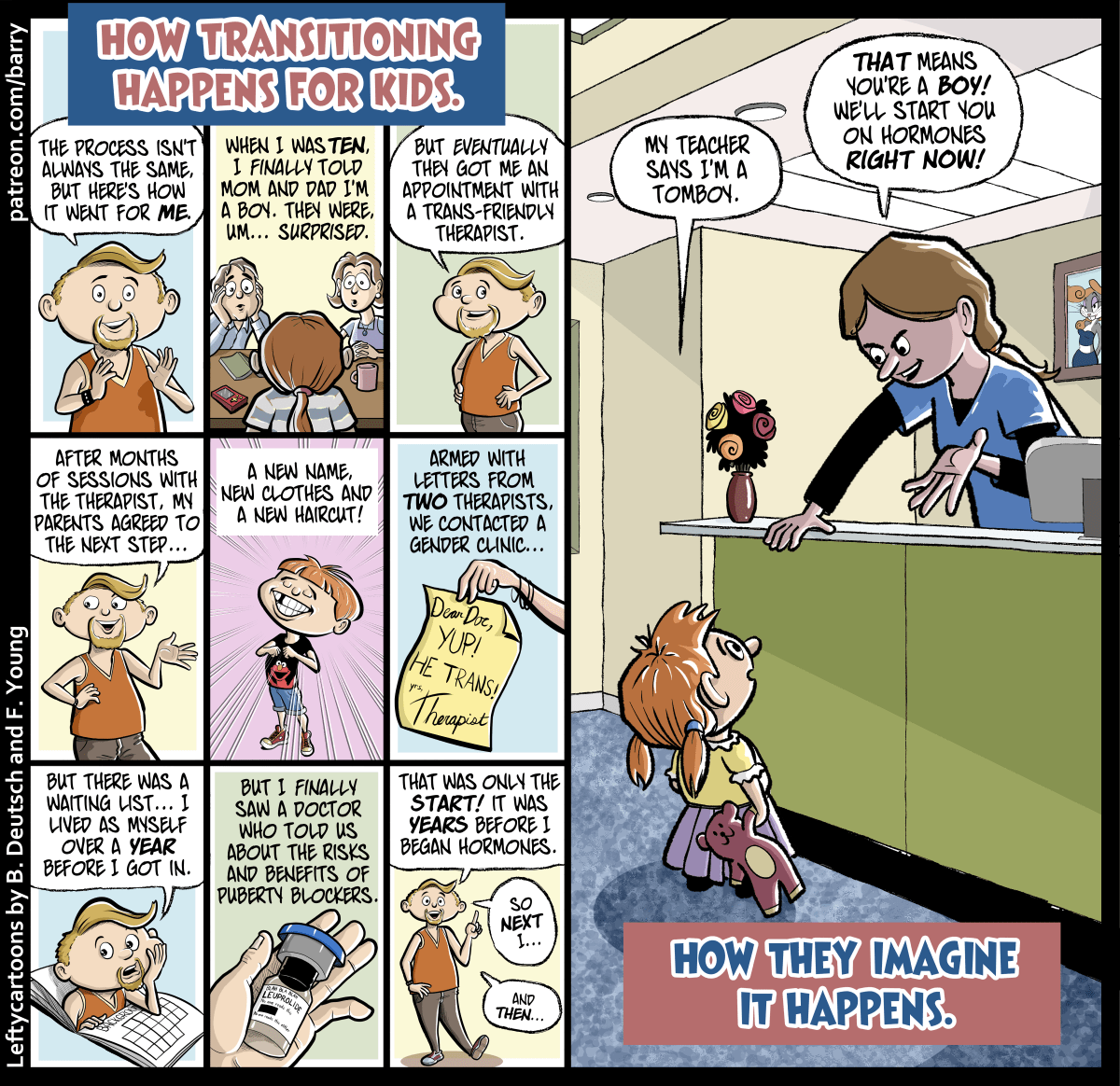
Finally, the accusation that I'm "selling" something is an ad hominem attack that attempts to discredit the me as the messenger rather than address the evidence presented. LeAnne cannot argue against the former, so they engage in attacks on the latter. Furthermore, I have no paid subscription nor do I profit from my efforts in any way. The same cannot be said for LeAnne and her anti-trans efforts:


Full Disclosure - the LGB Courage Coalition, as depicted here and as far as I can tell, are registered as a legitimate non-profit. This does not take away from the ‘please give us your money’ incentive. For example, the Alliance Defending Freedom and the Heritage Foundation are both non-profit organizations.
Claim: ‘The trans movement demands gay kids become straight adults by transitioning.’
Fact Check: False
The notion that transgender healthcare is ‘converting’ gay people is particularly painful coming from someone who claims to understand LGB struggles and the harm of conversion therapy. It is a recyling of the homophobic ‘Ex-Gay’ movement and organizations. Furthermore, this argument fundamentally misunderstands both sexual orientation and gender identity:
First, transgender identity and sexual orientation are entirely different aspects of a person. Many transgender people identify as gay, lesbian, bisexual, and asexual after transition. Their sexual orientation doesn't change, only their understanding of their gender does. Some gain new insight to their sexuality during their transition, as self acceptance of one aspect often leads to self acceptance of the other. The notion that transition ‘converts’ gay people erases the many transgender people who are also LGBQ+.
Second, no one is ‘demanding’ that anyone transition. Gender-affirming care follows a patient-centered approach where the individual leads their own journey. The standards of care explicitly require ruling out other explanations and ensuring the person has a persistent, consistent, and insistent gender identity before any medical interventions.
Third, the ‘social contagion’ theory you're implying has been thoroughly debunked by multiple peer-reviewed studies.7 The increase in transgender visibility reflects greater social acceptance and better access to language that helps people understand themselves - just as happened with left-handedness when we stopped forcing children to write with their right hands.
What's truly reminiscent of Anita Bryant is using misleading claims about ‘protecting children’ to justify restricting healthcare and autonomy for a marginalized group. It's creating moral panic around a vulnerable population. It's claiming to act out of love while advocating for policies that cause demonstrable harm.
The real conversion therapy is forcing transgender people to live as their assigned gender at birth against their deeply held identity - something that increases suicide risk. That's not protection. That's not love. And it's certainly not liberation.
Logical Fallacy: False Dilemma
This presents a false choice between being transgender or being gay, when many people are both.
Claim: ‘Rising numbers of detransitioners who wish someone had stopped them.’
Fact Check: Misleading on Multiple Levels
First, there's no evidence that detransition rates are increasing as a percentage of those who transition. While the absolute number of people who detransition may increase as more people access gender-affirming care overall (just as 1% of 10,000 is more than 1% of 5,000), the proportion has remained consistently low across studies.
The largest study on detransition (2021 survey with 27,715 transgender participants) found only 2.5% had ever detransitioned, and of those, 82.5% cited external pressure (discrimination, lack of support) as the reason - not regret about their gender identity. Earlier studies from 2015-2018 found similar rates, suggesting stability rather than an increase in detransition rates.
Furthermore, research shows that of those who detransition, approximately half (62%) will later go on to transition again precisely because their detransition was due to external pressures that were resolved or overcome, not because they weren't transgender.8
Logical Fallacy: Cherry-Picking and Appeal to Anecdote
This claim focuses on a tiny minority of experiences while ignoring the overwhelming majority who benefit from gender-affirming care. It also elevates anecdotal stories over statistical evidence, using emotionally charged language ("wish someone had stopped them") to imply a widespread phenomenon that data simply doesn't support.
The framing of "rising numbers" without context is a classic statistical manipulation technique - using absolute numbers rather than proportions to create the impression of a trend where none exists.
The Recycled Homophobia LeAnne’s Embraced
In order to cover many of her other claims I have not directly quoted and broken down so far, we have to wade into the topic of recycled homophobia wrapped up in a rainbow flag with a trans-pride themed bow. What is both pitiable as it is striking about LeAnne’s response is how it recycles those exact same arguments once used against lesbian, gay, and bisexual people:
The arguments about ‘rising numbers of detransitioners,’ ‘social contagion,’ and gender identity being ‘rooted in trauma’ are literally recycled homophobic talking points from decades past:
The ‘gay recruitment’ panic has become the ‘transgender contagion’ panic
and let's not forget the ‘Drag Queen Trans Groomers’ and ‘Teachers are Indoctrinating our youth’ corralaries.
The ‘homosexuality is caused by trauma/abuse/neglect’ theory has become the ‘gender dysphoria is caused by trauma/abuse/neglect’ or whatever else seems convenient (autism, etc.) theory
The parade of ‘ex-gay’ testimonials has become the spotlight on detransition
stories that represent a tiny minority of experiences and often fail to withstand criticism under scrutiny.
The ‘protecting children from the gay lifestyle’ rhetoric has become ‘protecting children from transgender healthcare’ or ‘protecting our kids from indoctrination by…’
The claim that ‘homosexuality is just a phase’ has become ‘gender dysphoria is just a phase’ and ‘they are really just confused.’
The argument that ‘gay people are mentally ill’ has become ‘transgender people are mentally ill’
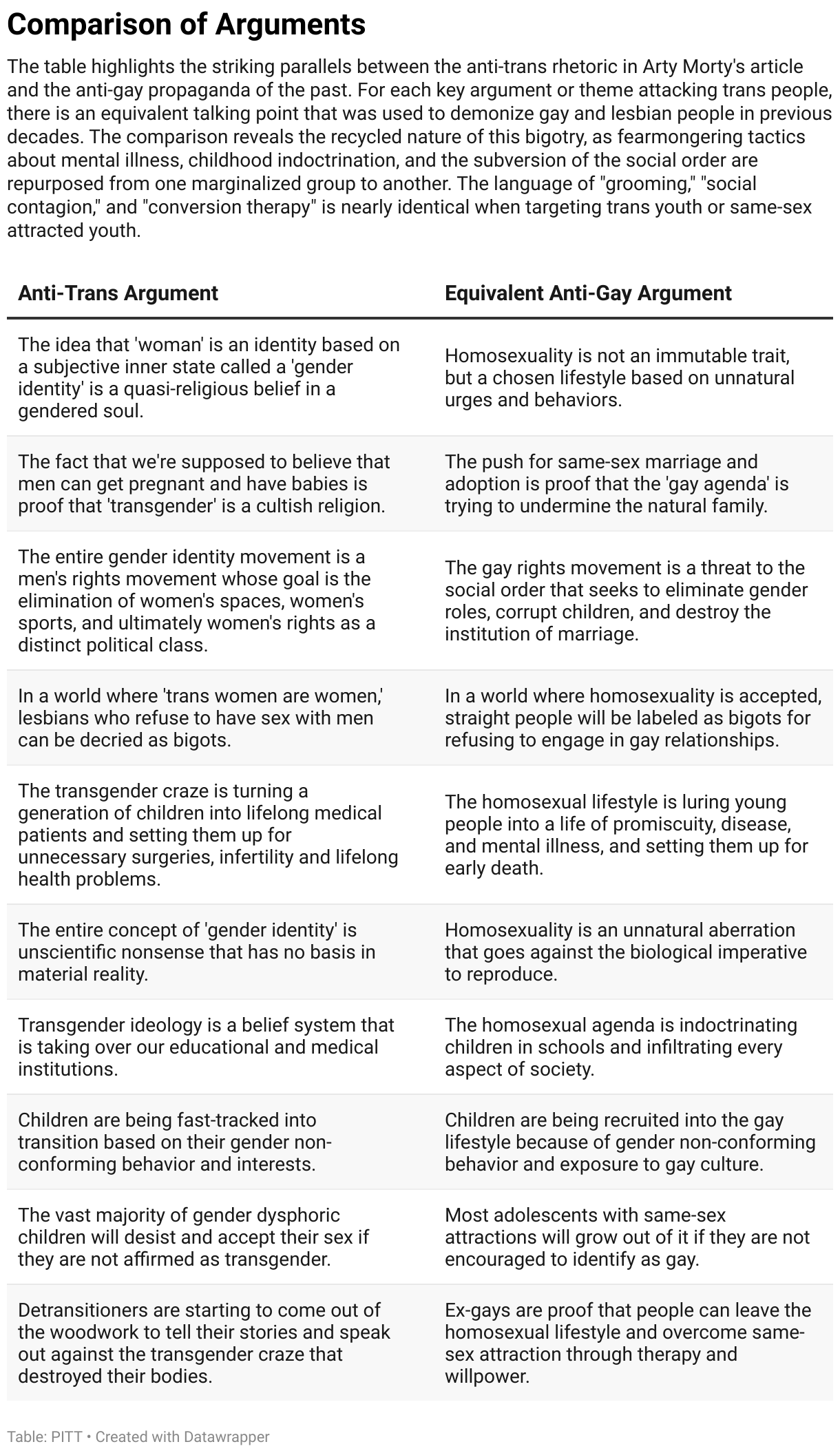
If you are thinking to yourself ‘wait, I have heard these comparisons before in your writing’ or ‘didn’t you do a long winded thing on this before?’ - well you would be correct, because I did!
I wrote a long and in-depth analysis on this topic before, in response to a different ‘LGB without the T’ advocate - one Arty Morty. You can read that here:
 PITT
PITT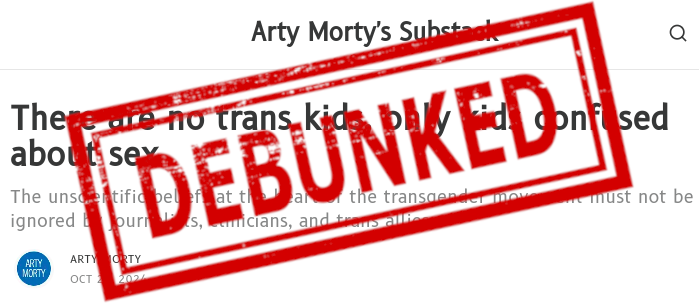
In that I made this handy table, which I think is particularly relevant for our purposes here:
As someone who lived through that era of homophobia in the Deep South, it's bewildering that LeAnne does not recognize these patterns. They have become the voice reciting the very same arguments once used against themself, and somehow were convinced that this time it's different. But it isn't.
So in a sense, LeAnne is right when they claim that ‘I [You] won’t cite the data showing that gender distress is often rooted in trauma, autism, homophobia, and social contagion. I [You] won’t mention the parents who did affirm—only to watch their kids regret irreversible decisions.’
I won’t because gender dysphoria is not rooted in trauma, autism, homophobia, or social contagion theories that have been thoroughly debunked and disproved, or have no effective or difinitive causation identified.9 Because facts matter, and the don’t care about LeAnne’s feelings.
I won’t mention the parents who did affirm only to watch their kids regret irreversible decisions, because detrans folks deserve the dignity, respect, and care. They don’t deserve to be paraded about and made into political pawns in LeAnne’s agenda, or anyone elses’, to be used as ammunition in the weaponization of fear, disinformation, and prejudice against trans folks or in their parents’ grifting and for-profit schemes.
I won’t talk about these things because they either not valid, disproven, or using and abusing the tiniest fraction of a marginalized group for one’s own personal prejudice or political/financial gain.
It wasn't valid science then and It isn't valid science now.
It was moral panic disguised as concern then.
It's moral panic disguised as concern now.
Finding Common Ground
Believe it or not, LeAnne and I actually agree on some core principles: kids need space to grow into who they are, without being told they are right or wrong for wanting to explore various aspects of their identity, who they are attracted to, and how they perceive themselves as they develop. For many, that exploration will lead to a cisgender identity somewhere on the straight to pansexual spectrum, or any point along the way. For some, that same exploration will lead them to the realization, or provide the security and safety to reveal, that a transgender path is right for them. Of those that are trans, the majority will also come out as some kind of not straight, that being bisexual, gay/lesbian, pansexual, asexual, queer, etc. 10
What was best for LeAnne was best for them, and one might extend this narrative to many lesbians' experiences. Not to speak for all lesbians of course (I would never presume to do so), as experiences vary widely. Rather, many do share elements of LeAnne’s journey, and it's often the narrative we hear in public discourse. That's valid and important.
The disconnect happens when LeAnne fails to recognize that the same grace, time, and space they needed is precisely what transgender youth also require, albeit with different outcomes. For some young people, to force the "time, love, integration" approach LeAnne advocates would perpetuate harm and cause a far more difficult transition later in life that could have been avoided if we extended that same grace and freedom to transgender youth to be themselves and receive appropriate care, supported by their parents and medical professionals.
This isn't about ‘hormone clinics handing out testosterone like candy’ or ‘surgeries at 19’ as LeAnne and others attempt to characterize it. It's about a standard of care that is deliberate, careful, and individualized, and one that recognizes that different people have different needs on their journey to authenticity.
The irony is that LeAnne's own experience of needing space to discover herself without external pressure is exactly what transgender advocates are fighting for, the freedom for each person to find their own path without having someone else's narrative imposed upon them. The only difference is in recognizing that these paths may lead to different destinations, all of which deserve respect.
To advocate against that is to also advocate against young gay and lesbian or bisexual youth to have that freedom as well, as we have explored already, the anti-trans positions work the same for anti-gay ones as well. The only way we make progress is recognizing that progress encompasses all of us in the LGBTQ2SIA+ community, and we make the best progress working and standing together, as siblings, brothers, sisters. As a family.
What's Really Happening Here
LeAnne speaks of their own journey requiring ‘time, love, integration’ and yet they deny transgender people that same grace. Instead, they have chosen to align themself with those who would restrict trans folks their healthcare, question their autonomy, deny them their dignity and agency, and frame their existence as a ‘contagion.’
What LeAnne is advocating for isn't love with boundaries, it's love with conditions. And conditional love is precisely what leads to the estrangement that LeAnne claims to be concerned about.
Look, I don't doubt that LeAnne experienced real pain growing up. Responding to that pain by inflicting it on others doesn't honor their journey, it perpetuates the cycle of harm. True healing comes from extending to others the acceptance we once needed ourselves.
That path forward isn't found in fear-based rhetoric about ‘rising numbers’ that data doesn't support; at least, not in the manner in which anti-trans groups present it - out of context wrapped in alarmist language. Do you recall the ‘gays are grooming our kids’ and ‘the rise of the gay teen’ panic of the 90's and 00's? I do. It's the same alarmist fear mongering then being recycled for use today.
The research consistently shows low regret rates for gender-affirming care11, the ineffectiveness of conversion approaches12, and the harm caused by rejection13. These are the facts, regardless of how uncomfortable they might be for those invested in a different narrative.
The path forward is found in the same principles that helped LGB people gain acceptance: respect for autonomy, recognition of lived experience, and the understanding that love means accepting people as they are - not as we wish they would be.
Wrapping it all up…
And look, I get it. When you've spent decades fighting for acceptance, it can be tempting to finally get a seat at the table and then immediately pull up the ladder behind you. Particularly when that seat is at a table in a conservative family and/or community, and you are afraid that those behind you will only be a setback to you or another fight for a group you are not personally invested with. So I can understand that advocating for or standing in solidarity with this other group can be seen as a risk. It is easy to say ‘Sorry! No more seats! I know we made this table seem like it was for everyone facing gender and sexuality based discrimination, but turns out it's just for people whose identities became socially acceptable sometime around 2015! I clawed my way back to ‘respectability’ here, not you. Tough break!’
But here's the thing: The greatest trick conservative organizations have ever pulled is convincing some LGB folks to weaponize their own trauma and experiences of homophobia as a strategy and ammunition to police their own, and to be used against their transgender and non-binary siblings. It's a masterclass in divide-and-conquer strategy. ‘Hey, you! Yes, you who we spent decades demonizing! How would you like to be our special friend now? All you have to do is help us demonize THESE people instead! See? We're not bigots, we have gay friends, and look - they agree with us!’
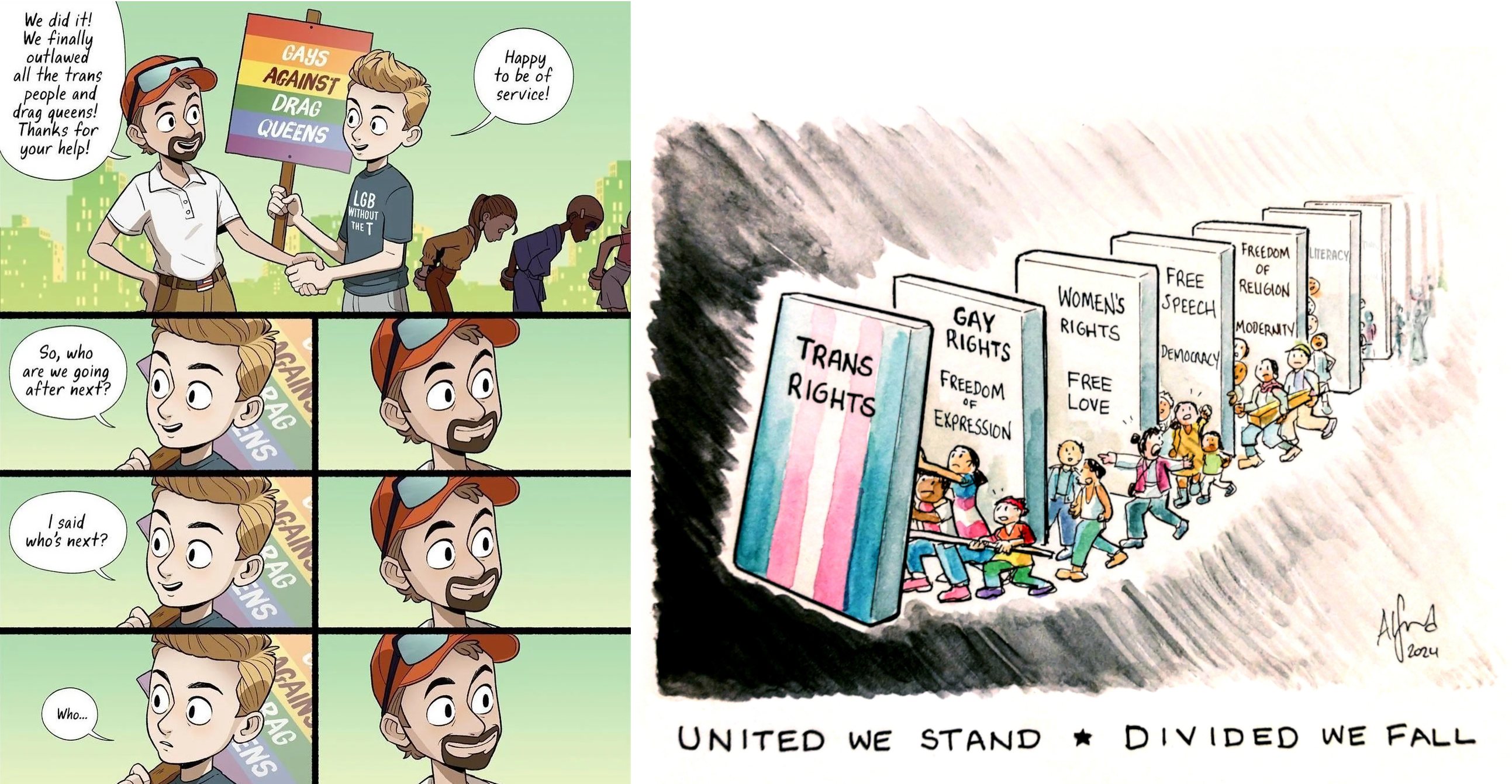
The truth is, people like LeAnne and these LGB w/o the T organizations aren't protecting anyone. They're just recycling the same debunked homophobic garbage that was used against them, slapping a rainbow sticker on it, and hoping nobody notices. It's like homophobia laundering. ‘No, no, it's not bigotry when WE do it! We're gay! We have the receipts!’
But here's the most tragic part: When you become the shock troops in someone else's culture war, when you recite the same arguments once used to harm you, you're not just betraying the trans community, you are betraying your younger self. For LeAnne, that is the kid in the Deep South who needed acceptance and understanding. That teenager who knew what it felt like to have their identity questioned and pathologized. That young adult who just wanted to be seen for who they really were.
That person, that younger LeAnne, deserved better then just as transgender people deserve better now.
N.B. regarding the publication LeAnne writes for, I stand corrected and have edited my comment accordingly. LeAnne write for the LGB Courage Coalition, previously I had erroneouly written the LGB Alliance.
Thank you LeAnne for pointing out my error!
Citations:
LeAnne’s comment stated: ‘to see their parents as abusers the moment they hesitate to affirm a new identity’ and ’But I also know that the answer wasn’t cutting them off after two therapy sessions and a Reddit thread.’ ↩
https://pflag.org/
https://www.genderspectrum.org/
https://familyproject.sfsu.edu/ ↩
William Lutz, Doublespeak (1989), pp. 2-3. Lutz classifies doublespeak into four kinds, of which euphemism is the first. ↩
Thornton, S. M., Edalatpour, A., & Gast, K. M. (2024). A systematic review of patient regret after surgery: A common phenomenon in many specialties but rare within gender-affirmation surgery. The American Journal of Surgery. Advance online publication. https://doi.org/10.1016/j.amjsurg.2024.04.021 ↩
R. A. (2008). Three in Ten Americans with a Tattoo Say Having One Makes Them Feel Sexier. The Harris Poll, 15. (though a strong majority still has no regrets, nearly one fourth (23%) of those with tattoos say they ever regret getting one – up from 14% in 2012.) https://americanmedspa.org/news/tattoo-takeover-three-in-ten-americans-have-tattoos-and-most-dont-stop-at-just-one ↩
Piotrowski, K., Mikolajczak, M., & Roskam, I. (2023). I should not have had a child: Development and validation of the Parenthood Regret Scale. Journal of family psychology : JFP : journal of the Division of Family Psychology of the American Psychological Association (Division 43), 37(8), 1282–1293. https://doi.org/10.1037/fam0001158 ↩
Jack L. Turban, Brett Dolotina, Dana King, Alex S. Keuroghlian; Sex Assigned at Birth Ratio Among Transgender and Gender Diverse Adolescents in the United States. Pediatrics August 2022; 150 (3): e2022056567. 10.1542/peds.2022-056567 https://doi.org/10.1542/peds.2022-056567 ↩
James, S., Herman, J., Rankin, S., Keisling, M., Mottet, L., & Anafi, M. A. (2016). The report of the 2015 US transgender survey. National Center for Transgender Equality [NCTE]. ↩
For debunking "social contagion" theory:
Turban, J. L., Dolotina, B., King, D., & Keuroghlian, A. S. (2022). Sex Assigned at Birth Ratio Among Transgender and Gender Diverse Adolescents in the United States. Pediatrics, 150(3), e2022056567. https://doi.org/10.1542/peds.2022-056567This study directly examined and refuted the "rapid onset gender dysphoria" hypothesis, finding no evidence for social contagion as a driver of transgender identity.
James, S. E., Herman, J. L., Rankin, S., Keisling, M., Mottet, L., & Anafi, M. (2016). The Report of the 2015 U.S. Transgender Survey. Washington, DC: National Center for Transgender Equality.
https://transequality.org/sites/default/files/docs/usts/USTS-Full-Report-Dec17.pdf
(See page 59 for sexual orientation breakdown) ↩Bustos, V. P., Bustos, S. S., Mascaro, A., Del Corral, G., Forte, A. J., Ciudad, P., Kim, E. A., Langstein, H. N., & Manrique, O. J. (2021). Regret after Gender-affirmation Surgery: A Systematic Review and Meta-analysis of Prevalence. Plastic and Reconstructive Surgery - Global Open, 9(3), e3477. https://doi.org/10.1097/gox.0000000000003477 ↩
American Psychological Association. (2021). APA Resolution on Gender Identity Change Efforts. https://www.apa.org/about/policy/resolution-gender-identity-change-efforts.pdf
I use this as not only does this provide a nice summary, it reference many studies that support the claim. Easier to cite this statement, than it is to cite each and every study referenced in it. ↩
Ryan, C., Huebner, D., Diaz, R. M., & Sanchez, J. (2009). Family rejection as a predictor of negative health outcomes in white and Latino lesbian, gay, and bisexual young adults. Pediatrics, 123(1), 346-352. https://doi.org/10.1542/peds.2007-3524
This landmark study found that LGBTQ+ young adults who experienced high levels of family rejection were 8.4 times more likely to report having attempted suicide and 5.9 times more likely to report high levels of depression compared with peers from families with no or low levels of family rejection. ↩
For addressing autism correlation without causation:
Warrier, V., Greenberg, D. M., Weir, E., Buckingham, C., Smith, P., Lai, M. C., Allison, C., & Baron-Cohen, S. (2020). Elevated rates of autism, other neurodevelopmental and psychiatric diagnoses, and autistic traits in transgender and gender-diverse individuals. Nature Communications, 11(1), 3959. https://doi.org/10.1038/s41467-020-17794-1This study found correlations between autism and gender diversity but explicitly notes this doesn't imply causation and emphasizes the need for gender-affirming support.
There is no study that claims that autism causes gender dysphoria
James, S. E., Herman, J. L., Rankin, S., Keisling, M., Mottet, L., & Anafi, M. (2016). The Report of the 2015 U.S. Transgender Survey. Washington, DC: National Center for Transgender Equality.
https://transequality.org/sites/default/files/docs/usts/USTS-Full-Report-Dec17.pdf
(See page 59 for sexual orientation breakdown) ↩Bustos, V. P., Bustos, S. S., Mascaro, A., Del Corral, G., Forte, A. J., Ciudad, P., Kim, E. A., Langstein, H. N., & Manrique, O. J. (2021). Regret after Gender-affirmation Surgery: A Systematic Review and Meta-analysis of Prevalence. Plastic and Reconstructive Surgery - Global Open, 9(3), e3477. https://doi.org/10.1097/gox.0000000000003477 ↩
American Psychological Association. (2021). APA Resolution on Gender Identity Change Efforts. https://www.apa.org/about/policy/resolution-gender-identity-change-efforts.pdf
I use this as not only does this provide a nice summary, it reference many studies that support the claim. Easier to cite this statement, than it is to cite each and every study referenced in it. ↩
Ryan, C., Huebner, D., Diaz, R. M., & Sanchez, J. (2009). Family rejection as a predictor of negative health outcomes in white and Latino lesbian, gay, and bisexual young adults. Pediatrics, 123(1), 346-352. https://doi.org/10.1542/peds.2007-3524
This landmark study found that LGBTQ+ young adults who experienced high levels of family rejection were 8.4 times more likely to report having attempted suicide and 5.9 times more likely to report high levels of depression compared with peers from families with no or low levels of family rejection. ↩
For trauma as a cause:
Giovanardi, G., Vitelli, R., Maggiora Vergano, C., Fortunato, A., Chianura, L., Lingiardi, V., & Speranza, A. M. (2018). Attachment Patterns and Complex Trauma in a Sample of Adults Diagnosed with Gender Dysphoria. Frontiers in psychology, 9, 60. https://doi.org/10.3389/fpsyg.2018.00060"Trans people often have parental trauma" is a very different statement to "gender dysphoria is caused by trauma". This study is the only one I know of that speaks to the former, and I do not know of any study that claims the latter. ↩
James, S. E., Herman, J. L., Rankin, S., Keisling, M., Mottet, L., & Anafi, M. (2016). The Report of the 2015 U.S. Transgender Survey. Washington, DC: National Center for Transgender Equality.
https://transequality.org/sites/default/files/docs/usts/USTS-Full-Report-Dec17.pdf
(See page 59 for sexual orientation breakdown) ↩Bustos, V. P., Bustos, S. S., Mascaro, A., Del Corral, G., Forte, A. J., Ciudad, P., Kim, E. A., Langstein, H. N., & Manrique, O. J. (2021). Regret after Gender-affirmation Surgery: A Systematic Review and Meta-analysis of Prevalence. Plastic and Reconstructive Surgery - Global Open, 9(3), e3477. https://doi.org/10.1097/gox.0000000000003477 ↩
American Psychological Association. (2021). APA Resolution on Gender Identity Change Efforts. https://www.apa.org/about/policy/resolution-gender-identity-change-efforts.pdf
I use this as not only does this provide a nice summary, it reference many studies that support the claim. Easier to cite this statement, than it is to cite each and every study referenced in it. ↩
Ryan, C., Huebner, D., Diaz, R. M., & Sanchez, J. (2009). Family rejection as a predictor of negative health outcomes in white and Latino lesbian, gay, and bisexual young adults. Pediatrics, 123(1), 346-352. https://doi.org/10.1542/peds.2007-3524
This landmark study found that LGBTQ+ young adults who experienced high levels of family rejection were 8.4 times more likely to report having attempted suicide and 5.9 times more likely to report high levels of depression compared with peers from families with no or low levels of family rejection. ↩
James, S. E., Herman, J. L., Rankin, S., Keisling, M., Mottet, L., & Anafi, M. (2016). The Report of the 2015 U.S. Transgender Survey. Washington, DC: National Center for Transgender Equality.
https://transequality.org/sites/default/files/docs/usts/USTS-Full-Report-Dec17.pdf
(See page 59 for sexual orientation breakdown) ↩Bustos, V. P., Bustos, S. S., Mascaro, A., Del Corral, G., Forte, A. J., Ciudad, P., Kim, E. A., Langstein, H. N., & Manrique, O. J. (2021). Regret after Gender-affirmation Surgery: A Systematic Review and Meta-analysis of Prevalence. Plastic and Reconstructive Surgery - Global Open, 9(3), e3477. https://doi.org/10.1097/gox.0000000000003477 ↩
American Psychological Association. (2021). APA Resolution on Gender Identity Change Efforts. https://www.apa.org/about/policy/resolution-gender-identity-change-efforts.pdf
I use this as not only does this provide a nice summary, it reference many studies that support the claim. Easier to cite this statement, than it is to cite each and every study referenced in it. ↩
Ryan, C., Huebner, D., Diaz, R. M., & Sanchez, J. (2009). Family rejection as a predictor of negative health outcomes in white and Latino lesbian, gay, and bisexual young adults. Pediatrics, 123(1), 346-352. https://doi.org/10.1542/peds.2007-3524
This landmark study found that LGBTQ+ young adults who experienced high levels of family rejection were 8.4 times more likely to report having attempted suicide and 5.9 times more likely to report high levels of depression compared with peers from families with no or low levels of family rejection. ↩
James, S. E., Herman, J. L., Rankin, S., Keisling, M., Mottet, L., & Anafi, M. (2016). The Report of the 2015 U.S. Transgender Survey. Washington, DC: National Center for Transgender Equality.
https://transequality.org/sites/default/files/docs/usts/USTS-Full-Report-Dec17.pdf
(See page 59 for sexual orientation breakdown) ↩Bustos, V. P., Bustos, S. S., Mascaro, A., Del Corral, G., Forte, A. J., Ciudad, P., Kim, E. A., Langstein, H. N., & Manrique, O. J. (2021). Regret after Gender-affirmation Surgery: A Systematic Review and Meta-analysis of Prevalence. Plastic and Reconstructive Surgery - Global Open, 9(3), e3477. https://doi.org/10.1097/gox.0000000000003477 ↩
American Psychological Association. (2021). APA Resolution on Gender Identity Change Efforts. https://www.apa.org/about/policy/resolution-gender-identity-change-efforts.pdf
I use this as not only does this provide a nice summary, it reference many studies that support the claim. Easier to cite this statement, than it is to cite each and every study referenced in it. ↩
Ryan, C., Huebner, D., Diaz, R. M., & Sanchez, J. (2009). Family rejection as a predictor of negative health outcomes in white and Latino lesbian, gay, and bisexual young adults. Pediatrics, 123(1), 346-352. https://doi.org/10.1542/peds.2007-3524
This landmark study found that LGBTQ+ young adults who experienced high levels of family rejection were 8.4 times more likely to report having attempted suicide and 5.9 times more likely to report high levels of depression compared with peers from families with no or low levels of family rejection. ↩