When "Fatal Flaws" Become "Cautious Interpretation"
A Response to Sammy Stagg's Methodological Retreat

An Author’s Response
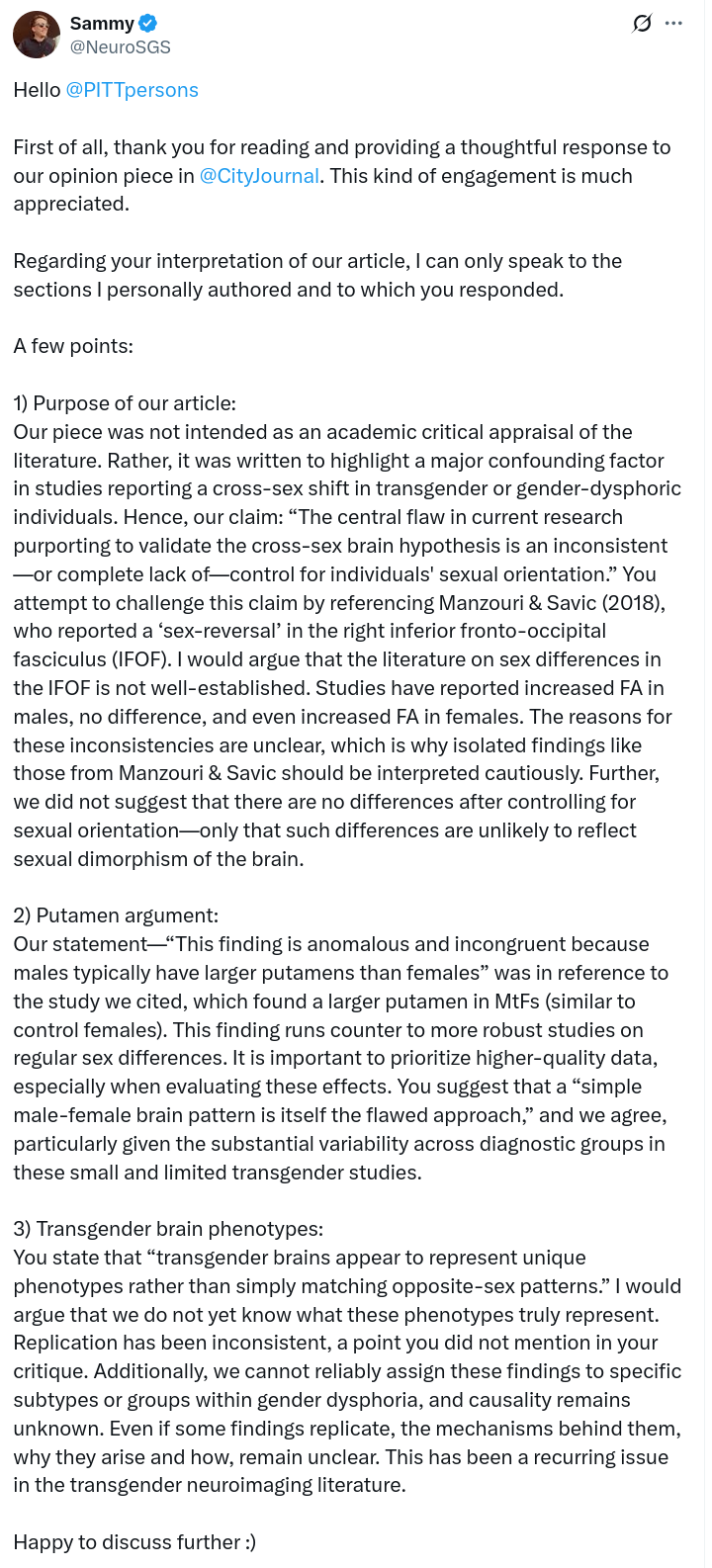
When I published my analysis of the City Journal's "Transgender Brain Studies are Fatally Flawed," I expected some pushback. What I didn't expect was such a textbook demonstration of the motte-and-bailey fallacy in action from one of the authors, Samuel G. “Sammy” Stagg. The response I received from Stagg provides a fascinating case study in how sweeping scientific claims transform into reasonable-sounding hedges when challenged.
The Position Shift
The original City Journal article made unambiguous claims about "fatal flaws" in transgender neuroscience. The title alone declared an entire field fundamentally invalid. The authors presented themselves as exposing systematic scientific deception, claiming researchers showed "inconsistent—or complete lack of—control for individuals' sexual orientation."
Now, faced with documentation of their cherry-picking and systematic misrepresentation, we see a remarkable transformation. Suddenly, the piece was "not intended as an academic critical appraisal" but merely highlighting "a major confounding factor." The sweeping dismissal becomes cautious scientific language about "isolated findings" requiring careful interpretation.
This is the motte-and-bailey fallacy in real time: advance an indefensible position (the bailey), then retreat to reasonable-sounding claims (the motte) when challenged, while maintaining the original conclusion.
Part I: Point-by-Point Deconstruction
The "Opinion Piece" Framing
The most revealing aspect of the response is the sudden reclassification of their work. When an article:
- Appears in an academic-style publication with extensive citations
- Claims to expose "fatal flaws" in scientific research
- Presents detailed methodological critiques
- Concludes that an entire field is fundamentally invalid
...it invites evaluation by scientific standards, regardless of the authors' post-hoc disclaimers.
You cannot make sweeping scientific claims about research methodology, then retreat to "just an opinion piece" when those claims are systematically challenged. This represents a fundamental inconsistency in how they frame their own work's standards and scope.
Moreover, City Journal itself markets these pieces as authoritative analysis, not casual opinion. Their own institutional framing contradicts Stagg's disclaimer about academic standards.
According to their official materials, City Journal describes itself as:
- "The nation's premier urban-policy magazine"
- "America's premier source of insightful policy analysis, sophisticated cultural commentary, and bold investigations"
They explicitly position themselves as providing "policy analysis" and "investigations" - language that suggests rigorous, authoritative work rather than casual commentary. The use of "premier" twice emphasizes their claim to authority in the field.
Furthermore, City Journal is published by the Manhattan Institute for Policy Research, which frames it as a serious policy publication rather than an opinion blog or casual commentary platform.
This institutional framing makes Stagg's post-hoc retreat to "not intended as an academic critical appraisal" particularly problematic. When a publication markets itself as providing "premier policy analysis" and "bold investigations," readers reasonably expect the content to meet analytical standards - especially when that content makes sweeping claims about scientific methodology and research validity.
The contradiction is stark: City Journal cannot simultaneously market itself as a source of authoritative "policy analysis" while its authors later claim their critiques of scientific research weren't meant to meet analytical standards, and are mere “opinion pieces”. This represents exactly the kind of institutional inconsistency that undermines the credibility of their scientific claims.
The IFOF Inconsistency Admission
Stagg's response to our discussion of the Manzouri & Savic (2018) findings [7] reveals a crucial position that warrants a very careful examination. In the original City Journal article, they presented a confident dismissal of research stating:
"The central flaw in current research purporting to validate the cross-sex brain hypothesis is an inconsistent—or complete lack of—control for individuals' sexual orientation."
They further argued that proper controls would eliminate the findings:
"If one properly controls for sexual orientation, the reported neuroanatomical shifts in transgender brain-scan studies diminish greatly or vanish entirely."
Now, when we cited Manzouri & Savic (2018), a study that did control for sexual orientation and still found differences, Stagg's response was markedly different:
"I would argue that the literature on sex differences in the IFOF is not well-established. Studies have reported increased FA in males, no difference, and even increased FA in females. The reasons for these inconsistencies are unclear, which is why isolated findings like those from Manzouri & Savic should be interpreted cautiously."
And crucially:
"Further, we did not suggest that there are no differences after controlling for sexual orientation—only that such differences are unlikely to reflect sexual dimorphism of the brain."
This admission directly undermines their original argument. Compare these positions:
- Original: Studies have a "central flaw" and differences "diminish greatly or vanish entirely" with proper controls
- Now: "We did not suggest that there are no differences" and the literature is "not well-established" with "unclear" inconsistencies
Here's what this means in practice: They cannot simultaneously claim that controlling for sexual orientation eliminates differences and that they "did not suggest there are no differences" after such controls. This represents a complete reversal disguised as clarification.
If the literature is so complex that "reasons for these inconsistencies are unclear," then their confident dismissal of an entire field as having a "central flaw" becomes scientifically unjustifiable. You cannot declare a field "fatally flawed" based on a simple methodological fix, then retreat to acknowledging the complexity when presented with studies that applied that very fix.
The quotes speak for themselves; this is textbook goalpost moving from "no meaningful differences" to "differences exist but we don't like their interpretation."
The Putamen Response
The response to my putamen critique reveals the same pattern being employed again.
Their original dismissal: In the City Journal article, the authors encountered a finding that didn't match their expectations and dismissed it outright (emphasis mine):
"In one small brain region, the putamen, the MtFs did exhibit a cross-sex shift, relative to their dataset—i.e., putamen volumes in MtFs were larger and more similar to female controls—but this result is anomalous and incongruent with the findings of large-scale studies and meta-analyses demonstrating that males, not females, have larger putamen gray-matter volumes, on average."
The logic was simple: the finding contradicted what they expected about male vs. female brain patterns, therefore it must be wrong.
Their retreat when challenged: When we identified this as "argument from incredulity", rejecting findings simply because they contradict expectations, Stagg's response shifted dramatically:
“You suggest that a 'simple male-female brain pattern is itself the flawed approach,' and we agree, particularly given the substantial variability across diagnostic groups in these small and limited transgender studies."
The contradiction: Compare these positions:
- Original: Finding is "anomalous and incongruent" because it doesn't match simple male-female patterns
- Now: "We agree" that "simple male-female brain pattern is itself the flawed approach"
Why this is significant: They cannot simultaneously argue that a finding is invalid because it doesn't fit simple male-female patterns and agree that expecting simple male-female patterns is "flawed."
If simple binary brain patterns are indeed problematic, as current research suggests and as Stagg now acknowledges, then findings that don't conform to those patterns aren't automatically "anomalous." They might indicate exactly the complexity that modern neuroscience is working to understand.
The logical inconsistency: their original argument was "This finding contradicts simple sex differences, therefore it's wrong." Their current position is: "Simple sex differences are a flawed framework." These positions are mutually exclusive.
The quotes reveal a fundamental problem: they dismissed research for not fitting a framework they now admit is flawed. This isn't scientific rigor, it's moving the goalposts after being caught in flawed reasoning.
The Complexity Concession
Stagg's response reveals a inconsistency between the original article's confident conclusions and their current acknowledgment of scientific uncertainty.
Their original position in The City Journal article presented definitive claims about an entire field:
"Transgender Brain Studies are Fatally Flawed" (title)
"The central flaw in current research purporting to validate the cross-sex brain hypothesis is an inconsistent—or complete lack of—control for individuals' sexual orientation."
Their current position When challenged, Stagg acknowledges significant uncertainty (emphasis mine):
"I would argue that we do not yet know what these phenotypes truly represent. Replication has been inconsistent, a point you did not mention in your critique. Additionally, we cannot reliably assign these findings to specific subtypes or groups within gender dysphoria, and causality remains unknown."
Furthermore, Stagg makes the claim that we did not mention replication inconsistency. My original article addressed this directly (emphasis mine):
"Results DO vary between studies. These are legitimate concerns that researchers acknowledge and work to address. But these limitations do not justify dismissing all biological research on gender identity, especially when more recent, methodologically improved studies address many of these concerns."
We also noted:
"Science does not work through single studies but through convergent evidence. More recent research using larger samples and improved methodology has found that transgender individuals show 'their own unique brain phenotype.'"
Current research status: Independent research teams consistently detect neurological differences in transgender individuals that distinguish them from cisgender populations. Meta-analytic findings indicate that transgender individuals present with their own unique brain phenotype rather than simply matching either their gender identity or birth-assigned sex patterns. This consistent detection of a distinct neurological signature across different studies and methodologies represents the type of replication achievable in neuroscience, where individual brain variation makes exact quantitative replication impossible but population-level pattern consistency indicates robust phenomena.
Scientific development context: The research shows typical scientific progression. While early studies revealed conflicting results, recent work demonstrates increasing convergence toward consistent population-level differences. This represents normal methodological refinement in neuroscience rather than fundamental invalidity.
The logical inconsistency: These positions cannot be simultaneously maintained:
- Original Position: Field has definitive "fatal flaws"
- Current Position: "We do not yet know," "causality remains unknown"
The conditions Stagg describes as uncertain mechanisms, evolving understanding, and unknown causality, characterize normal scientific development in emerging fields. Every developing area of neuroscience faces these challenges: early findings require replication, mechanisms need elucidation, causality must be established, and methodologies require refinement. The existence of these challenges does not render a field "fatally flawed," it indicates active scientific development.
Part II: Patterns of Scientific Misdirection
Having documented these major contradictions in Stagg's core claims, we can now examine the broader argumentative patterns they reveal. Beyond these specific reversals, the response demonstrates a consistent pattern of scientific sleight-of-hand. When confronted with evidence that challenges their original claims, they employ a series of rhetorical maneuvers designed to appear reasonable while avoiding substantive engagement with the critique.
The Sexual Orientation Deflection
When confronted with evidence that recent research addresses their central critique, Stagg shifts focus to sexual orientation controls without engaging the substantive methodological improvements.
Our evidence: We cited research explicitly controlling for sexual orientation, including studies that found transgender individuals showed brain patterns distinct from both cisgender heterosexual and homosexual populations. Specifically, Manzouri & Savic (2018)[7] controlled for sexual orientation and still found structural differences in white matter tracts, while other studies have found that transgender individuals show unique patterns that don't simply match either heterosexual or homosexual cisgender populations. [4][8]
Stagg's response: Rather than addressing these methodological advances, they pivot to questioning whether we can "reliably assign these findings to specific subtypes." They also shift to questioning the literature on sex differences in specific brain regions, effectively changing the subject from their original claim about sexual orientation controls.
The methodological sleight-of-hand: When presented with studies that applied the exact controls they demanded, Stagg doesn't acknowledge that their central criticism has been addressed. Instead, they introduce new concerns about "subtypes" and "unclear inconsistencies" in the broader literature. This avoids engaging with the fact that researchers have done precisely what the original article claimed would eliminate findings.
The pattern: This represents a moving goalpost—when the original criticism is addressed, new requirements emerge without acknowledgment that the initial concern has been resolved. It's particularly telling that they don't say "Thank you for showing me these studies that control for sexual orientation as we requested," but instead immediately pivot to new objections.
The Methodological Contradiction
The response reveals a deeper methodological problem. Stagg simultaneously:
- Acknowledges complexity in brain sex differences
- Admits uncertainty about mechanisms and causality
- Recognizes inconsistency in replication across studies
- Maintains dismissal of the entire field as "fatally flawed"
This represents a logical contradiction. If the field is genuinely complex with legitimate uncertainties—as Stagg now acknowledges—then the appropriate scientific response is continued investigation with improved methodology, not wholesale dismissal.
The author's own admissions invalidate their original conclusions. You cannot simultaneously argue that a field is too complex to understand and too flawed to investigate.
What Constitutes "Fatal Flaws"?
The response fails to establish what would constitute genuinely "fatal" flaws versus normal scientific challenges. Consider established fields that faced similar early difficulties:
- Genetics: Early studies had small samples, inconsistent replication, unknown mechanisms, and the field grappled with historical misuse in eugenics and scientific racism before establishing rigorous methodological standards[13][14]
- Neuroscience: Decades of conflicting findings before methodological consensus, with ongoing challenges in translating basic research into clinical benefits[15][16]
- Immunology: Complex interactions that defied simple explanations, with contemporary challenges in understanding immune system variability and developing targeted interventions[17][18]
None of these fields were declared "fatally flawed" during their development. The standard applied to transgender neuroscience appears uniquely stringent, demanding certainty that no developing field possesses.
The Replication Red Herring
Stagg emphasizes "inconsistent replication" as evidence of fatal flaws. However, replication challenges exist across neuroscience and psychology. A 2016 survey found that 70% of researchers had tried and failed to reproduce another scientist's experiments [1]. This represents a field-wide challenge, not evidence that specific research areas are invalid.
Moreover, recent large-scale collaborative studies demonstrate methodological improvements and increased sample sizes. Kurth et al. (2022) found that transgender women showed brain patterns shifted toward their gender identity in specific regions[7], while Mueller et al. (2021) conducted the largest neuroimaging study to date through the ENIGMA consortium, identifying distinct neuroanatomical patterns in transgender individuals[8]. These studies represent the type of methodological advancement and collaborative approach that characterizes maturing scientific fields.
The Causality Confusion
Stagg raises concerns about unknown causality, noting that 'causality remains unknown' and 'mechanisms behind them...remain unclear.' Whether intentionally or not, this framing suggests that descriptive findings require causal explanations to be valid. This reveals a fundamental misunderstanding of how scientific evidence functions in this context.
The research question: Studies investigating neurological differences in transgender individuals aim to document patterns, not establish causation. These are descriptive studies examining whether measurable differences exist.
The causality standard: Demanding causal mechanisms before accepting descriptive findings represents an inappropriate evidential standard. We don't require causal explanations for height differences between populations to acknowledge that such differences exist and can be measured.
The implication: Stagg's causality requirement, if applied consistently, would invalidate most descriptive neuroscience research, including studies of depression, autism, and other conditions where mechanisms remain incompletely understood.
The Sample Size Strawman
While acknowledging that sample sizes in transgender research are often small, the response fails to engage with the practical and ethical constraints involved. Transgender individuals represent a small population percentage, and research participation involves significant personal disclosure and potential risk.
Recent collaborative efforts have addressed this through multi-site studies and meta-analyses [8]. The field is actively working to overcome these limitations rather than ignoring them, contradicting claims of fundamental methodological invalidity that render the field 'fatally flawed.'
The Motte-and-Bailey Pattern
Stagg's response demonstrates a classic motte-and-bailey argumentative structure. This logical pattern involves presenting a strong, controversial claim (the "bailey") but retreating to a weaker, more defensible position (the "motte") when challenged.
The Bailey (Original Article):
- "Transgender Brain Studies are Fatally Flawed"
- Definitive dismissal of an entire research field
- Claims of fundamental methodological invalidity
The Motte (Twitter Response):
- "We do not yet know what these phenotypes truly represent"
- Acknowledgment of normal scientific uncertainty
- Recognition of methodological challenges common to developing fields
The structural problem becomes clear: The motte position actually contradicts the bailey. One cannot simultaneously argue that a field is definitively flawed while acknowledging that our understanding remains incomplete and evolving.
This allows them to appear reasonable while advancing predetermined conclusions. When challenged on their sweeping dismissal, they retreat behind their methodological moat of "just asking questions" while maintaining their original fortress of conclusions. It's activism dressed in scientific language, employing the rhetoric of methodological rigor to achieve predetermined goals.
Understanding the Pattern
Having documented the systematic logical inconsistencies, methodological contradictions, and strategic retreats in the response, we can now address why these patterns emerged.
The response exemplifies what happens when predetermined conclusions encounter contradictory evidence. Rather than adjusting conclusions to match evidence, the authors adjust their rhetoric while maintaining their positions. This pattern becomes comprehensible when we consider their documented institutional affiliations and stated goals.
All three authors are affiliated with the Manhattan Institute, a conservative think tank that has made opposing transgender rights a significant part of its agenda [6]. The institute receives millions in funding from conservative foundations with explicit political goals [3]. Wright has been documented as a "key historical figure in the oppression of trans and gender diverse people" [12]. Buttons is a former Daily Wire employee who joined multiple anti-transgender organizations [11]. Stagg is affiliated with anti-transgender organizations and promotes literalist attacks on metaphorical language about gender identity [10].
This institutional context explains the methodological patterns we've documented: the cherry-picking of older studies, the dismissal of recent research, the leap from "it's complicated" to "it's invalid," and now the strategic retreat when challenged. When your salary depends on opposing transgender rights, and your institutional mission requires undermining transgender healthcare, the scientific method becomes subordinated to advocacy goals.
The response confirms this interpretation. Rather than engaging with the substance of our critique about institutional bias and coordinated activism, the author focuses solely on methodological details while maintaining conclusions that their own admissions contradict. This selective engagement reveals the true priorities: preserve the anti-transgender position while appearing scientifically reasonable.
This response exemplifies a sophisticated form of science denialism. Rather than overtly rejecting research, the authors make sweeping claims about scientific invalidity, then when challenged, retreat to reasonable-sounding methodological concerns while maintaining their original conclusions and ignoring documented conflicts of interest and institutional bias.
The pattern becomes clear when we recognize that the same conservative infrastructure that funded climate change denial for decades has now turned its attention to transgender science. The tactics remain identical: identify legitimate uncertainties, amplify them beyond proportion, ignore contradictory evidence, and conclude that the entire field is invalid.
The Real Issue
We don't dispute that transgender neuroscience faces methodological challenges. Sexual orientation should be controlled. Sample sizes could be larger. Replication is important. These are legitimate scientific concerns that researchers acknowledge and address.
The problem lies in the leap from "it's complicated" to "it's invalid." The authors acknowledge complexity while maintaining dismissal. They admit uncertainty while claiming fatal flaws. They retreat to reasonable positions while preserving unreasonable conclusions.
This pattern suggests institutional commitments or ideological beliefs may be influencing analytical approach. If the goal were improving scientific rigor, they would engage with recent methodological advances and acknowledge the field's development. Instead, they cherry-pick older studies, dismiss recent research, and maintain conclusions their own admissions contradict.
Moving Forward
The scientific process continues regardless of activist interference. Researchers acknowledge limitations, improve methodologies, and refine understanding. This is how science works; through iterative improvement, not wholesale dismissal based on cherry-picked evidence.
The current scientific consensus, based on converging evidence from multiple methodologies, suggests gender identity likely has biological correlates, though more complex than initially theorized [4]. When proper controls are applied, some differences disappear while others persist, particularly in regions related to body perception and self-awareness [7].
This represents scientific progress, not failure. The field is moving toward more sophisticated understanding, not toward the dismissal activists seek.
Wrapping it all up
The response we received confirms rather than refutes our analysis. The systematic logical inconsistencies, methodological contradictions, and strategic retreats we've documented reveal an approach that prioritizes predetermined conclusions over scientific evidence.
When activists with documented institutional commitments make sweeping scientific claims, then retreat to "just asking questions" or “just my concerns and opinions” when challenged, the pattern speaks for itself. The motte-and-bailey defense only makes this more transparent.
Science advances through honest engagement with evidence, not through strategic retreats when bias is exposed. The transgender neuroscience field continues developing despite attempts to undermine it through selective scholarship and coordinated activism funded by the same conservative infrastructure that has opposed scientific consensus on climate change, evolution, and public health.
The scientific process will continue. The evidence will accumulate. And the activists will keep retreating to their motte, claiming reasonableness while maintaining unreasonable positions.
At least now we can see the castle walls.
References
[1] Baker, M. (2016). 1,500 scientists lift the lid on reproducibility. Nature, 533(7604), 452-454. https://doi.org/10.1038/533452a
[2] Center for Judicial Diversity. (2019, June 14). Fact sheet: Manhattan Institute. https://centerjd.org/content/fact-sheet-manhattan-institute
[3] DeSmog. (2015, September 5). Manhattan Institute for Policy Research. https://www.desmog.com/manhattan-institute-policy-research/
[4] Frigerio, A., Ballerini, L., & Valdés Hernández, M. (2021). Structural, functional, and metabolic brain differences as a function of gender identity or sexual orientation: A systematic review of the human neuroimaging literature. Archives of Sexual Behavior, 50(8), 3329-3352. https://doi.org/10.1007/s10508-021-02005-9
[5] Kurth, F., Gaser, C., Sánchez, F. J., & Luders, E. (2022). Brain sex in transgender women is shifted towards gender identity. Journal of Clinical Medicine, 11(6), Article 1582. https://doi.org/10.3390/jcm11061582
[6] Luders, E., Sánchez, F. J., Gaser, C., Toga, A. W., Narr, K. L., Hamilton, L. S., & Vilain, E. (2009). Regional gray matter variation in male-to-female transsexualism. NeuroImage, 46(4), 904-907.
[7] Manzouri, A., & Savic, I. (2018). Structural connections in the brain in relation to gender identity and sexual orientation. Scientific Reports, 8, Article 16895. https://doi.org/10.1038/s41598-018-35102-5
[8] Mueller, S. C., Guillamon, A., Zubiaurre-Elorza, L., et al. (2021). The neuroanatomy of transgender identity: Mega-analytic findings from the ENIGMA transgender persons working group. Journal of Sexual Medicine, 18(6), 1122-1129. https://doi.org/10.1016/j.jsxm.2021.03.013
[9] SourceWatch. (2023). Manhattan Institute for Policy Research. https://www.sourcewatch.org/index.php/Manhattan_Institute_for_Policy_Research
[10] Transgender Map. (2023, December 3). Sammy Stagg vs. transgender people. https://www.transgendermap.com/issues/biology/sammy-stagg/
[11] Transgender Map. (2024). "Christina Buttons" / Christina Berry vs. transgender people. https://www.transgendermap.com/issues/topics/media/christina-buttons/
[12] Transgender Map. (2022, October 29). Colin Wright vs. transgender people. https://www.transgendermap.com/issues/biology/colin-wright/
[13] University of Wisconsin-Madison Department of Genetics. (2021). Historical issues: Grappling with our past. https://genetics.wisc.edu/historical-issues-grappling-with-our-past/
[14] Mohsen, H. (2020). Race and genetics: Somber history, troubled present. PMC, 7087058. https://doi.org/10.1186/s13073-020-00736-6
[15] Kapur, S., Phillips, A. G., & Insel, T. R. (2012). Why has it taken so long for biological psychiatry to develop clinical tests and what to do about it? Molecular Psychiatry, 17(12), 1174-1179. https://doi.org/10.1038/mp.2012.105
[16] Reardon, S. (2016). Seven challenges for neuroscience. Nature, 537(7621), 26-28. https://doi.org/10.1038/537026a
[17] Brodin, P., & Davis, M. M. (2017). Human immune system variation. Nature Reviews Immunology, 17(1), 21-29. https://doi.org/10.1038/nri.2016.125
[18] Tsang, J. S. (2015). Utilizing population variation, vaccination, and systems biology to study human immunology. Trends in Immunology, 36(8), 479-493. https://doi.org/10.1016/j.it.2015.06.005