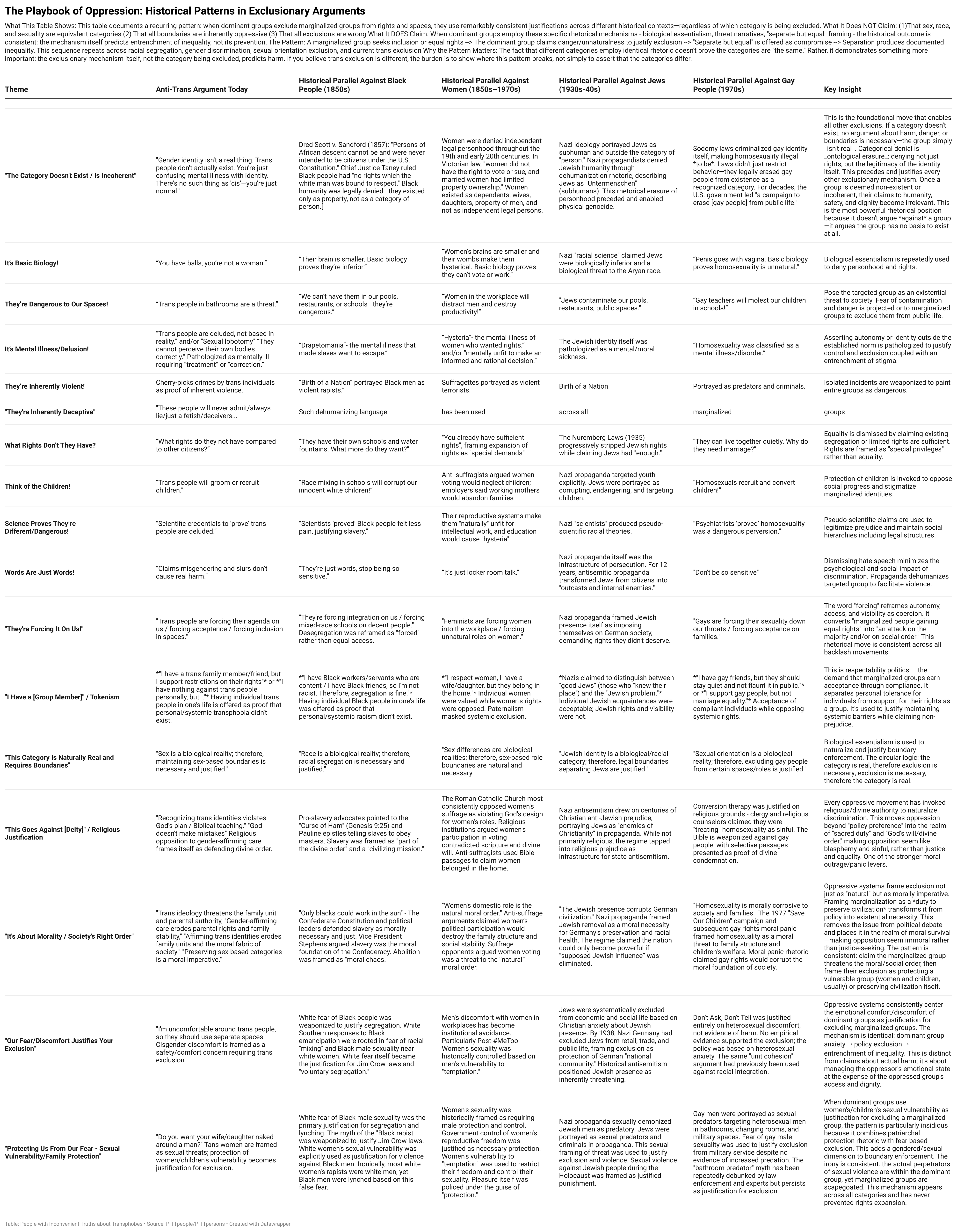
The Table: Historical Patterns of Exclusionary Rhetoric

What This Section Addresses:
A common response to evidence-based critiques of trans exclusion is to dismiss them as “false equivalence” or historically inaccurate comparisons. Critics argue that anti-trans arguments are fundamentally different from historical discrimination because the categories involved are different. This section examines whether the mechanism of exclusion follows a documented pattern, regardless of which category is being excluded.
Important Clarification on What This Table Does and Doesn’t Claim:
This table is not claiming that sex, race, and sexuality are equivalent categories. Categories can be legitimately different while still employing identical exclusionary mechanisms. The distinction is critical:
- What the table examines: The structural pattern of how marginalized groups are excluded from rights and spaces
- What it does NOT claim: That all categories are interchangeable, or that all boundaries are inherently illegitimate
Some boundaries are legitimate (age-based access, professional credentials, medical necessity). This table addresses a specific pattern: when dominant groups exclude marginalized groups from rights/spaces, the justifications used are remarkably consistent across different historical contexts.
The Pattern Identified:
The table documents a repeating mechanism:
- A marginalized group seeks inclusion or equal rights
- The dominant group claims threat/danger/unnaturalness to justify exclusion
- “Separate but equal” is offered as a compromise
- Separation produces inequality and documented harm
- The excluded group remains structurally disadvantaged
This sequence appears across:
- Racial segregation (1930s-1960s)
- Gender discrimination in employment (1950s-1970s)
- Sexual orientation discrimination (1970s-2000s)
- Current trans exclusion (2010s-present)
Why the Pattern Matters:
The fact that different categories employ similar rhetoric doesn’t prove the categories are “the same.” Rather, it demonstrates something more important: the exclusionary mechanism itself, not the category being excluded, predicts harm.
Research shows that when separation is framed as “separate but equal,” it historically produces:
- Legal and institutional disadvantage for excluded groups
- Documented health and safety harms
- Persistent inequality despite claims of neutrality
The table’s insight isn’t “sex discrimination is identical to racial discrimination.” It’s: “The way we justify excluding marginalized groups from spaces follows a recognizable pattern that has consistently failed to achieve its stated goals.” It has, however, been wildly successful at achieving its unstated goals.
Addressing Predictable Objections:
Objection 1: “But sex-based distinctions are used legitimately in medicine and law!”
Response: Yes, and racial categories were also used in legitimate contexts (census data, medical research, etc.). The question isn’t whether categories can be used legitimately - it’s whether a particular use of that category justifies exclusion from women’s spaces. Medical uses of sex categories don’t automatically justify institutional exclusion of trans women from public spaces. You’d need a separate argument for why that specific exclusion is justified.
Objection 2: “You’re claiming all boundaries are oppressive!”
Response: No. Age restrictions on voting/alcohol exist for legitimate reasons. Professional licensing boundaries protect consumers. The table doesn’t argue against all boundaries - it argues that when we examine cases where boundaries have produced documented harm to marginalized groups, the rhetorical patterns are identical. If you believe trans exclusion is different, show where the pattern breaks, don’t just assert that categories are different.
Objection 3: “This is just guilt by association!”
Response: It’s not guilt by association - it’s pattern recognition. If every time someone says “we need to exclude Group X for safety/naturalness/protection,” it produces harm to Group X, then the next time we hear that argument, it’s reasonable to examine it skeptically. This is how we learn from history.
Objection 4: “but some boundaries ARE legitimate”:
Response: Some boundaries are legitimate (age, professional credentials, etc.). This table isn’t claiming all boundaries are oppressive. It’s showing that when we exclude marginalized groups from rights/spaces, these specific justifications appear repeatedly - and historically, they’ve consistently failed to protect anyone while harming the excluded group.
Final Note on the Table’s Purpose:
This table serves as an educational tool for recognizing rhetorical patterns, not as proof that all exclusions are wrong. Its strength lies in this narrower claim: Historical precedent suggests that when we exclude marginalized groups using these specific arguments, it produces documented harm while failing to achieve stated goals.
That doesn’t settle every question about trans inclusion. But it does mean the burden of proof should shift: if you’re proposing a policy that follows the historical pattern of exclusion, you need strong, specific evidence it will work differently this time—not just assertions that “this category is different.”
Full Text Version (please forgive the bug in Datawrapper in regards to the text overflow:
Image version: