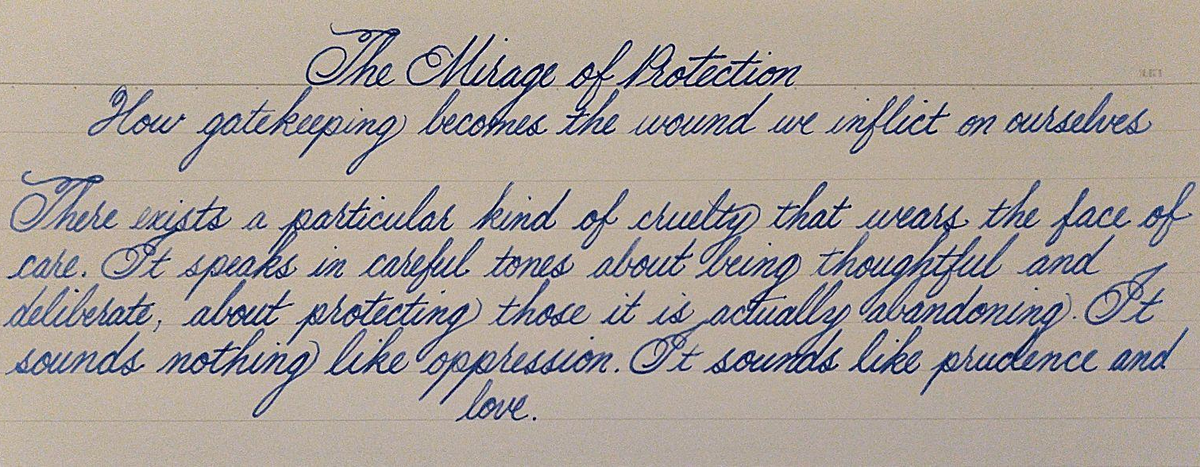
The Mirage of Protection
How Gatekeeping Becomes the Wound We Inflict on Ourselves
Hello my lovely readers! It is Transgender Awareness Week, so I am happy to share this essay with you all. As a bit of a personal update, I am still working through quite a bit right now, so I am not yet back to a regular writing schedule. I do have some progress to report, in that I have two essays complete in draft and the skeleton of a third - so the work continues. I even wrote a submission piece for the first time! I am hoping I will be back to a regular rhythm once the holidays are behind us.
There exists a particular kind of cruelty that wears the face of care. It speaks in careful tones about being thoughtful and deliberate, about protecting those it is actually abandoning. It sounds nothing like oppression. It sounds like prudence and love.
“We just need to be careful,” the voices say. “Not everyone who thinks they’re trans really is. We need gatekeeping to filter out those who aren’t serious, those following trends, those who will regret it.” The words carry the weight of concern, of hard-won wisdom from those who have already passed through the gates themselves. They sound reasonable. They sound protective. They sound, above all, necessary. After all, won’t somebody think of the children?
This essay is addressed to multiple audiences. To those within the trans community examining our own complicity in enforcing the systems that harm us. To allies trying to understand why gatekeeping, even when framed as protective, functions as oppression. And to those skeptical of this analysis, who genuinely believe incremental compromise is strategically necessary. I ask you all to consider: what if the careful gatekeeping we have internalized and now enforce on each other is not a filter for authenticity but a machinery for something far more insidious: a system that teaches us our personhood is conditional, purchasable only through the complete diminishment of ourselves?
What if we have learned to file ourselves down; to remove, piece by piece, every rough edge, every area of friction, every part of ourselves that might be too visible, too authentic, too much, until we are smooth enough, small enough, acceptable enough to pass through the gates? And what if, having done this to ourselves, we now demand others do the same?
Consider first what the concern actually rests on: the idea of social contagion, the worry that some young people explore their gender identity in peer groups, and that this exploration is somehow inauthentic, a trend to be outgrown rather than a genuine identity to be honored. It is a worry that sounds reasonable on its surface. Young people do influence each other. That is how humans develop. But reasonable worry and accurate diagnosis are not the same thing.
When we examine what actually happens when social pressure changes, when young people who transition face rejection instead of support, discrimination instead of acceptance, the evidence tells us something stark. The most common reasons people detransition are not regret at having been wrong about themselves. They are external pressures: family rejection, loss of employment, harassment, discrimination, the simple unbearable weight of living in a hostile world.[1] The vast majority of those who detransition do so temporarily.[2] Temporary. They move back into their authentic identity once the external pressure eases. This is not social contagion being filtered out. This is authenticity being crushed by the boot heel of a society that refuses to make room. Sadly, this has costs measured in real lives lost.
If social contagion were real and significant, if some portion of young trans people were genuinely mistaken about their identity, then gatekeeping would theoretically filter them out, right? Make transition require more proof, more jumping through hoops, more waiting, more suffering, and the “trend-followers” would fall away, unable to maintain commitment. But that is not what happens. What happens instead is that gatekeeping increases the weight of external pressure. It adds institutional barriers on top of social rejection. It makes the path harder not because it filters out the inauthentic, but because it punishes the authentic for not being able to prove their authenticity to the satisfaction of those who set the standards.
The worry about social contagion, when you examine it carefully, is really a worry about something else entirely: the fear that if we stop gatekeeping, we will have to accept that transness is not a pathology requiring curing but a variation of human existence requiring acceptance. And acceptance, actual unconditional acceptance, would require something many are not willing to give.
But here is where the true cruelty reveals itself. Because gatekeeping does not just control access to medical care. It controls the entire architecture of personhood.
The most visible site of gatekeeping is the medical one. A young person knows they are trans. They seek care. And instead of receiving it, they are asked to prove it: wait periods, diagnostic assessments, letters from therapists, demonstrations of “real life experience,” and increasingly, court orders. The logic sounds reasonable to some: we need to ensure people are truly trans before allowing irreversible medical intervention. But here is what this actually accomplishes. It teaches that body and self are not aligned; that the person themselves is not the authority on their own identity; that strangers get to decide whether their self-knowledge is valid. It creates a relationship of profound distrust between the trans person and the institutions supposedly meant to serve them.
And the harms are concrete. A young person who waits years for access to medical care during critical developmental windows may never fully achieve the physical alignment they could have achieved with earlier intervention. Someone who loses insurance coverage, who cannot afford the gatekeeping process, who lives in a jurisdiction hostile to transition, is left in a state of permanent incompleteness. The institutional gatekeeping on medical access is not a safety measure. It is a form of medical neglect dressed in the language of caution.
Once you have successfully navigated medical gatekeeping, once you have jumped through all the institutional hoops, you are told: but now you must navigate social gatekeeping. Because the work of restricting trans life does not end with medical systems. It continues in workplaces, in schools, in bathrooms, in sports, in the simple act of existing in public. The medical gates are only the beginning. And it is here, in the social realm, where the logic of gatekeeping becomes most insidious, because it transforms into respectability politics. It becomes something that looks like community care.
Watch what happens when a trans woman transitions. She takes hormones, perhaps has surgery. And yet, she can never be one hundred percent complete by the standards society measures her against. The transition is never finished. There is always something: the wrong pelvis, the wrong bone structure, the hands that betray her, the voice that requires constant calibration, the history of a body that was not always aligned with her self. The incomplete physical reality becomes a permanent remainder of her status: not-quite, never-enough, always slightly wrong, forever marked by what she lacks.
So she learns to edit herself socially. She does not talk about her transition the way other women might talk about their bodies, their experiences, their histories. In conversation about menstruation, about relationships, about the ordinary texture of womanhood, she must calculate: How much can I say? What will give me away? What parts of my lived experience are too risky to mention? She becomes an editor of herself, removing scenes, redacting paragraphs, revising events, until her own story is unrecognizable to her. And when you do this constantly, when you watch your own words, monitor your own history, practice the art of strategic silence, you begin to internalize the judgment. You police yourself before they can police you.
Mentally, you abandon parts of yourself preemptively. You notice an interest, a way of moving, a particular sense of humor, and immediately you assess: Would this read as too trans? Too visible? Too much? You soften these things. You modulate your expression. You become your own censor, your own gatekeeper, your own enforcer of the standards society has set for you.
Trans men face a particular configuration of this hell, one that gatekeeping has made uniquely their own. Medically “incomplete” by standards that measure manhood through anatomy, they can never stop proving themselves to those who would diminish and other them. Like other trans people, the incompleteness is permanent. Thus, the obligation to perform manhood to others is permanent as well.
Many trans men spent their pre-transition lives rejecting patriarchy. They watched men exploit, diminish, and control, and they said: I will not be that. I will not participate in that. They rejected toxic masculinity on principle, long before they understood themselves to be men. And then transition asked them to inhabit a world that rewards the very behaviors they spent years rejecting. A world that measures manhood through dominance, through strength performed as indifference, through a careful cultivation of emotional distance. A world that says: to be a man is to take up space, to speak loudly, to center yourself, to not apologize for existing.
So now they navigate an impossible terrain. They are supposed to be men in a world that rewards patriarchal performance. But they cannot authentically embrace those performances without betraying their own values. They split themselves: publicly conforming, privately dismayed. They accept jokes they find abhorrent to avoid being flagged as “not one of the guys.” They stay silent when they want to speak because speaking up marks them as other. They must maintain a constant surveillance of their own behavior; not enough to be noticed as different, but enough to not participate in the cruelty they witness.
But the surveillance goes deeper than behavior. It becomes spatial, embodied, neurotic. They must relearn how to move through the world around women. They cannot walk directly behind a woman at night; cross the street, create distance, don’t stare, don’t be anything that could read as threatening. And here is the particular cruelty: they cannot even be nice, because niceness reads as creepy from a man. So they become ghosts to women. Present but unthreatening, kind but distant, supportive but invisible.
And all those past conversations, all those lived experiences from early life: the periods, the cramps, the pregnancy scares, the feminist rage built from actual embodied knowledge; all of that must be silenced. They cannot speak to these things without women questioning their authenticity, without marking themselves as other. So they learn a particular form of erasure. They suppress their entire history, their entire way of knowing the world, their entire embodied past. This creates a particular paralysis. The impulse to live their values, to push back against toxic masculinity, is always in conflict with what is expected of them. They must be thoughtful, principled, kind, but at great personal cost, invisibly and privately, in ways that do not threaten their conditional acceptance among other men.
And underneath all of this sits the deepest terror: that the moment they are outed, the moment their trans status becomes known, all of this conditional acceptance evaporates. The manhood they have fought to secure, the space they have claimed, the relationships they have built; it all becomes suspect. They become the infiltrator, the imposter, the one who was never actually part of the club. The anatomy they do not have becomes the proof they were never real.
Non-binary people face a gatekeeping mechanism that is uniquely unsolvable. Unlike trans men and trans women, who can potentially achieve a form of social passing, non-binary people navigate a world with no off-ramp. There is no finish line.
For those who do not pursue medical transition, for those who cannot access it or do not want it, there is no way to visibly mark their transness to the world at all. They are read as cisgender. And in being read as cisgender, they are instantly rejected from the trans community itself; marked as not trans enough, not committed enough, possibly not even trans at all. But to mark their non-binariness externally, to wear a they/them pin or other visible identifier, is to out themselves constantly, everywhere they go. That outing is a hazard, a vulnerability, a choice to make oneself visible as other in spaces that may not be safe.
So they face a grotesque choice: pass as cis and be rejected by the community they belong to, or refuse to pass and live in constant, exhausting visibility. There is no way to simply exist as non-binary without either invisibility or danger.
For those who do pursue medical transition, or who achieve a more visibly androgynous presentation, the gatekeeping takes a different but equally cruel form. They face demands that they perform certainty: pick a box, any box. Just to make others comfortable. But the moment they deviate from perfect androgyny, they are questioned: are you really non-binary? Or are you just a trans man who hasn’t committed? Just a trans woman in denial? The internal contradiction is built in. No matter how they present, someone will use that presentation as proof they are not what they claim to be.
And crucially, this gatekeeping comes not just from cisgender people. It comes from within the trans community itself. From trans men who see non-binary people as wavering, uncommitted. From trans women who see non-binariness as a refusal to fully transition. From gatekeepers within gatekeeping, policing those they see as less legitimate than themselves. The trans community that should be sanctuary becomes another space where non-binary people must prove themselves, must perform the correct version of non-binariness, must force themselves to fit into the narrow box that was supposed to liberate them from narrow boxes.
For some, this leads to a kind of frozen performance of androgyny; not chosen but compelled, a necessary costume to maintain a precarious claim to validity. Still others move fluidly through different presentations, not as deception but as genuine expression, only to find themselves constantly defending why they look different than they did last month, last week, yesterday. The filing down of one’s self here is not just physical or social; it is the constant mental negotiation of what one is allowed to want for oneself versus what one is allowed to be.
This filing happens in three areas simultaneously, across all of these experiences, and each one reinforces the others. The physical incompleteness requires social invisibility, which demands mental self-policing. The external gatekeeping becomes internal. The boot we wear becomes the boot we pass to others.
But notice what happens next. Those of us who survived gatekeeping, who have endured the barriers, who proved ourselves, who filed ourselves down enough to pass through, have learned a particular lesson. We have learned that our personhood was contingent on suffering and conformity. We have learned that the price of being believed was the price of being diminished. And having paid that price, having survived that way, we are now positioned to make a choice. Many of us choose to defend the gates.
Not consciously, perhaps, but structurally. We have been taught that gatekeeping is love, that barriers are protection, that suffering proves authenticity. So we ask: if I had to jump through these hoops to be legitimate, why should you get to skip them? If I had to file myself down to conform and prove I was real, why should you get to be whole?
Some of us believe this genuinely. Some of us have absorbed the logic that incremental compromise, that careful gatekeeping, is how we secure rights in an incrementally-accepting world. We believe that by being more acceptable, less visible, less threatening, we protect those who come after us. We believe that trans women who decline awards are showing solidarity. That trans men who stay silent are showing wisdom. That non-binary people who perform certainty are showing maturity. We believe this because we have been shaped to believe that our own worth is contingent on acceptable performance.
And those same people, whether they believe in strategic necessity or in punitive gatekeeping, rarely ask themselves: who are they protecting? Trans people or cis people’s comfort?
And here is where gatekeeping transforms into something more insidious: respectability politics. Because now it is no longer just institutional barriers. It is moral pressure. It is the language of community care used to enforce community compliance.
Consider what we have begun to ask of each other. A trans woman who cannot access surgery but has medically transitioned through hormone therapy should, some say, stay out of women’s spaces, out of women’s events. Or better yet; all trans women should voluntarily exclude themselves from women-specific spaces, from women’s sports, from women’s awards. And if a woman’s organization wants to give a trans woman an award for her work advancing women’s rights? No. She must self-select to decline it. She must recognize that she is not “woman enough” to deserve such recognition. Not because she didn’t earn it, but because it might be “bad optics” and give oppositional voices a new brick to throw at trans rights and progress.
The same happens for trans men. Pushed to assert themselves, they are then blamed for asserting themselves. Told their very visibility harms the community. Asked to participate less fully in the liberation movements they have always supported. Told that their existence in certain spaces; men’s spaces, leadership roles, public visibility; is actually damaging to the cause.
And for non-binary people, the pressure is even more abstract: your refusal to choose is making us all look unstable. If you just picked a box, any box, you would be easier to defend. Your ambiguity is our liability. Please, for the good of the community, perform certainty, even if it is a lie.
Notice what this mechanism accomplishes. It takes gatekeeping and reframes it as moral duty. It tells trans people that self-exclusion is not oppression; it is solidarity. That stepping back is not erasure, it is community care. That diminishing yourself is not damage, it is necessary sacrifice. Those of us who have been shaped by gatekeeping, who have learned that our worth is contingent, are perfectly positioned to enforce this logic on others.
This is how gatekeeping and respectability politics become intertwined, feeding each other, strengthening each other. Gatekeeping teaches us that personhood is conditional. Respectability politics says: prove your worth by making yourself smaller, less visible, less demanding. We, having been shaped by both, become their enforcers.
So the argument goes: “The path to securing our rights as trans people will only come through compromise.” “Cis folk will feel more comfortable and accept us if we jump through these hoops, give up these rights, accept a second or third class citizenship.” “See how gatekeeping will keep us and the cis folk safe and comfortable?”
This argument often comes from those who have already cleared the system, who had early access or financial means, who can assume these compromises will never impact their own lives. They are often the same ones who do not want to play sports competitively, who will not have to hold their pee all the way home, who will be able to use a locker room because no one can tell. Their compromises cost them nothing.
But they are fine with expecting other trans people to accept these terms so long as it secures their own rights to live as they do. They do not want others to be too visible, too loud, too queer because it risks their losing their anonymity, their ability to blend and pass, their privilege they feel owed for having passed through all the gates. Everyone else? They should try harder, or go back into the closet before they ruin it for the rest of us.
The worst part is that it works. People do self-select. People do make themselves smaller. They do decline opportunities. They do step back. And every time someone does this; every time a trans woman declines an award because she is “not woman enough,” every time a trans man stays silent because he fears being seen as predatory, every time a non-binary person performs a certainty they do not feel; it reinforces the message that gatekeeping was right. That barriers are necessary. That some of us are more legitimately trans than others. That we are not supposed to have these things, and selfish of us to earn them or accept them.
We have made ourselves complicit in our own oppression. We have transformed the wound into the weapon. And we have taught the next generation that this is how trans life works: you survive gatekeeping, and then you enforce it on others. You prove your worth by diminishing yourself and demanding others do the same.
And here is the thing that terrifies those who defend gatekeeping: they have no answer for what actually works. What actually works is the opposite of gatekeeping. Young people with gender dysphoria who receive support and acceptance show improved psychological outcomes and a higher quality of life. When external pressure eases, when acceptance replaces rejection, people do not suddenly detransition en masse. They live their lives. They become the full, complicated, whole human beings they were always meant to be. They excel, they grow, and they achieve.
Gatekeeping does not filter out the inauthentic. It participates in the creation of the very harm it claims to prevent.
Consider what happens when someone detransitions. Under a system built on gatekeeping, they are marked as a cautionary tale, as proof that gatekeeping was necessary. But consider what happens under a system of acceptance and support. They receive the same care they were offered as a trans person. They are supported in their journey, wherever it leads. In this context; in a context of acceptance rather than gatekeeping; detransition becomes what it always should have been: a legitimate exploration of identity, not a failure of diagnosis, not a justification for barriers.
But gatekeeping cannot allow this. Because if detransition is not a failure of gatekeeping, if it is simply another valid way of exploring identity, then gatekeeping loses its justification entirely. The whole system collapses. The gates fall. And suddenly, trans people are no longer proving their worth through suffering, they are no longer validated through a series of third parties, they are simply existing. So to the gatekeepers, detransitioners must be a failure that the system must be protected against. To the trans community? They are our siblings, just trying to figure things out, and so we support them just the same because we all want the same thing in the end: to exist in a state of congruence.
This upsets those invested in gatekeeping. Not because they hate trans people, necessarily, but because they have built their identity on having survived gatekeeping. Their personhood has been purchased through suffering, their identity validated and proved through each gate, verified at each milestone. To suggest that process and suffering was not necessary is to suggest that they endured for nothing. The thing they believe that proves to the world they are real becomes unnecessary, or worse, invalidated. It is to suggest that they gave up parts of themselves unnecessarily. And that is a pain many are not willing to feel, a fear that worms its way into their biases.
But then they encounter someone who has cleared fewer gates, or different gates, or refused to clear them at all. That person is not just living differently. They have become a threat. Because if that person is legitimately trans without having endured what they endured, then what does that say about whether their suffering proved anything? If someone can transition without the letters, without the waiting periods, without filing themselves down to acceptable proportions, then the whole structure that validates them—that proves to them they are real—begins to crack. And they cannot afford for it to crack, because upon the exit of the maze of gates and hurdles, rests their sense of self.
So they defend the gates. Not consciously, perhaps, nor out of malice, but out of a desperate need to defend the mechanism that makes them feel legitimate to themselves and to the world they move in. They defend gatekeeping as necessary, as protective, as loving. And they ask others to do the same. And slowly, we become the gatekeepers. We become the ones who police. We become the ones who ask each other to make ourselves smaller, less visible, less demanding. They make sure that anyone who tries to slip through without clearing these gates, who refuse this bargain, is marked as inauthentic, selfish, a threat to the movement.
This is how the wound becomes the weapon.
But what if we refused this bargain? What if we stopped accepting the premise that personhood must be earned through conformity? What if we believed, really believed, that young people deserve the space to explore their identity without proving it to gatekeepers first? That transition is not something to be restricted but something to be supported? That a person’s authenticity is not something to be filtered or proven, but something to be trusted?
What if we stopped filing ourselves (or each other) down and instead demanded that the world expand? This is not naive. This is not reckless. This is what the evidence shows us works.
But here is what those who profit from trans elimination understand and we sometimes forget: they will not compromise with us, and every time we compromise with ourselves, we have already lost.
Stop compromising with those who will not compromise with you. Stop policing each other. Every time a trans woman with access declines an award to appease critics, she teaches the world that trans women should not have awards. Every time trans folks accept “well maybe 18 is reasonable for transition care,” they have ceded the entire premise. The line moves. It always moves. From eighteen to twenty-five. From twenty-five to never. From “limited access” to “no access.” While every other front is pushed back as well. While bathroom bills multiply. While sports bans expand. While the architecture of exclusion builds itself brick by brick, and we have helped lay them.
Every compromise is a surrender of principle in exchange for a ceasefire that was never agreed to. Every time we ask ourselves to be smaller, quieter, less threatening, we are not protecting the movement—we are fracturing it. We are turning the vulnerable into acceptable losses. We are trading futures for the temporary comfort of those who have already made it through.
This is not strategy. This is collaboration disguised as survival.
Every liberation movement has eventually learned the same thing: the price of freedom is not conformity. Dignity is not negotiable. We do not earn our humanity by becoming less ourselves.
We have worn this particular boot long enough. It is time we took it off. The one they gave us and the one we have been wearing on ourselves. It is time we stopped asking permission to exist. It is time we stopped teaching each other that personhood is conditional.
Because here is the truth they cannot bear to acknowledge: we do not need their gatekeeping to be authentic. We do not need their approval to be real. We do not need to file ourselves down to deserve to exist.
We just need to stop accepting the terms.
We can refuse gatekeeping. We can refuse to trade our humanity for conditional acceptance. We can reject it all. That refusal is the beginning. There is a better choice we can make.
What does it look like to choose each other? It looks like believing each other without proof. It looks like stepping back from the gates we have been asked to guard. It looks like this conversation, happening now, between us. It looks like the next person you meet, the one who is finding their way, and deciding that they deserve your support not because they have proven themselves but because they are here, asking for your hand.
We can choose each other.
Citations
[1] Gliske, K., Testa, R. J., & Bariola, E. (2021). Factors leading to detransition among transgender and gender diverse people in the United States. LGBT Health. [Secondary analysis of 2015 U.S. Transgender Survey found 82.5% of those who detransitioned cited external factors]
[2] Turban, J. L., Loo, S. S., Almazan, A. N., & Keuroghlian, A. S. (2021). Factors leading to “detransition” among transgender and gender diverse people in the United States: A mixed-methods analysis. LGBT Health, 8(4)