The Fragility of the Offended Offenders
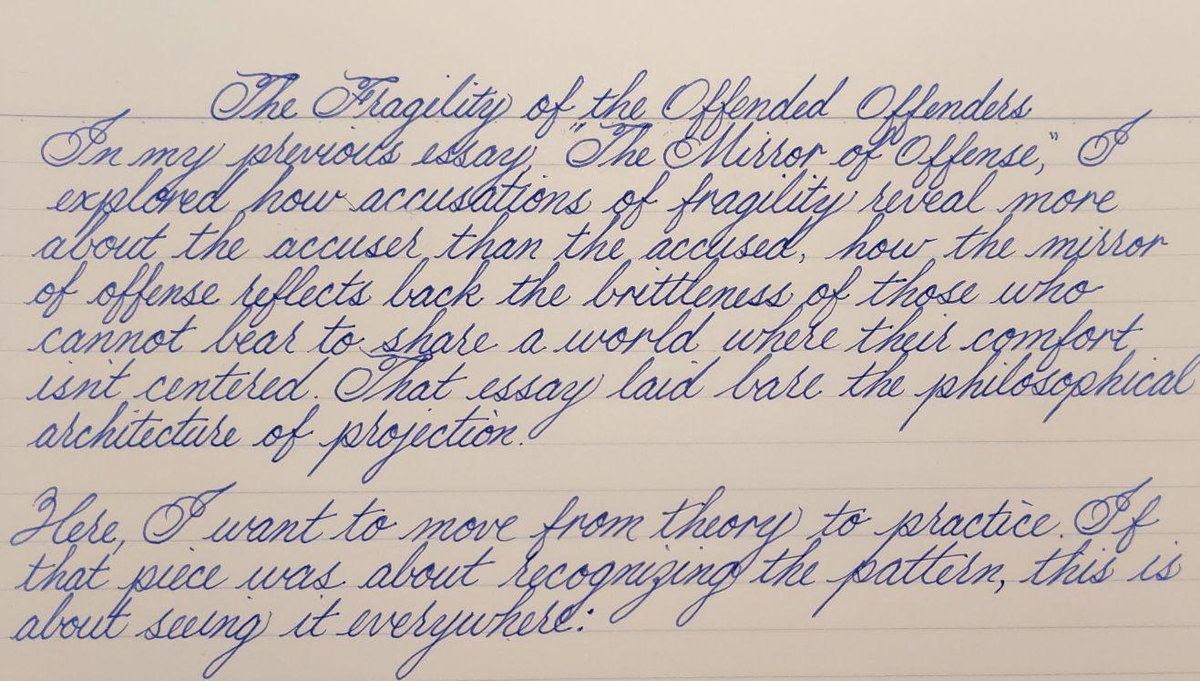
In my previous essay,"The Mirror of Offense," I explored how accusations of fragility reveal more about the accuser than the accused, how the mirror of offense reflects back the brittleness of those who cannot bear to share a world where their comfort isn't centered. That essay laid bare the philosophical architecture of projection.
Here, I want to move from theory to practice. If that piece was about recognizing the pattern, this is about seeing it everywhere: in the singular detransitioners1 who weaponize their stories, in the "LGB without T(Q+)" movements, in the panic over non-binary folks or over neopronouns, in every "sex realist" or "gender critical" ideologue, in every "free speech warrior" who takes profound offense at being asked to show basic respect. This is about the mechanics of that projection, the specific ways it manifests, and what it costs us.
Because once you learn to see who's really fragile, who's really offended, who's really demanding the world reorganize itself around their comfort - well, you can't unsee it.
There's a peculiar phenomenon I've noticed in the discourse around trans rights: those who shout the loudest about "everyone being too easily offended these days" seem to take the deepest offense when asked to extend basic human courtesy to others.
"Everything is transphobic now," they cry, as they deliberately misgender someone who's clearly stated their pronouns. "You can't say anything anymore," they lament, while using their platforms to say increasingly cruel things about increasingly vulnerable people. "Free speech is under attack," they declare, wielding their words like weapons against those who dare ask for respect. The phrase “when you're accustomed to privilege, equality feels like oppression” comes readily to mind.
The irony would be delicious if it weren't so bitter.
Watch how quickly their 'marketplace of ideas' closes when trans people speak. Academic conferences canceled for including trans speakers. Libraries threatened, librarians fired, for carrying books with trans characters. Teachers fired for displaying pride flags. Social media accounts suspended for documenting anti-trans violence while those calling for our elimination face no consequences.
They want the freedom to debate our humanity in the abstract while denying us the freedom to assert it in the concrete. They demand unlimited platforms to question our existence while working to eliminate every platform where we might answer.
The Mythology of the Reasonable Middle
These self-appointed guardians of reasonableness have constructed a mythology around themselves. In their telling, they occupy the sensible center; not transphobic, mind you, just "concerned." Not hateful, just "realistic." Not bigoted, just "defending free speech." Sometimes you will find one who argues that progress only happens, or should only happen, through small measures over a long period of time. They position themselves as the adults in the room, bravely standing against the excesses of a movement that has supposedly gone too far.
But scratch beneath the surface of their reasonable veneer, and you'll find something else entirely: a deep, visceral offense at being asked to update their worldview. They are offended by pronouns in email signatures. Offended by inclusive language. Offended by the mere visibility of trans joy. Offended, most of all, by the suggestion that their comfort should not be the primary concern in every interaction.
And yet, somehow, we're the easily offended ones.
The Weaponization of Detransition
Perhaps nowhere is this dynamic more painful than in how certain detransitioners (see footnote 1) have been weaponized against their former community. To be clear: detransition is valid, complex, and deserving of compassion and our full support. This stands without contention or exception. The issue to be discussed here is when select individuals use their stories as cudgels to demand more gatekeeping, more barriers, more hoops for others to jump through, they reveal the true nature of this game.
"I made a mistake," becomes "No one should have access."
"My journey was complicated," becomes "Everyone's journey must be scrutinized."
"I needed more support," becomes "Others need more gates to pass."
“I had other problems,” becomes “Everyone must address all other issues first”
These voices are amplified, not because they represent the majority of detransitioners, but because they serve a useful purpose to those who would take advantage of them. Studies show us that most detransition due to external pressures, not regret. Of those who detransition, the majority will continue to transition later on in life, once they are past those external pressures.
Not surprisingly, to the “gender critical” folks these facts do not matter. To them, these stories serve a useful purpose for those who were always looking for an excuse to restrict trans healthcare and visibility. So much so that they seek to groom and actively recruit trans folks or detransitioners, in a process they call “peaking,” a practice they use to induct a person into the “gender critical” ideology. For the detransitioners, this often comes with love-bombing, and often turns to a profitable enterprise of paid speaking engagements and being paraded about on various social media and broadcast platforms. For the trans person, this is often a form of intense gaslighting and scrutiny until they themselves detransition. We can draw a direct parallel with the methods used by “ex-gay” members and activists who sought out other gay folks to bring into the fold.
As we scrutinize the means, methods, and content of the rhetoric employed against trans and queer people today, we find the same patterns from the same playbook updated and revised for the new target in the new decade.
The LGB Without the T (or Q, or +)
Then there are those within the community who've decided that their acceptance is best secured by throwing others under the bus. The "LGB" groups who insist that adding the T was a mistake, who claim that trans rights are somehow separate from gay rights, as if the police checking gender markers at Stonewall were making such fine distinctions.
They've forgotten, or have chosen to forget, that many of the people who fought for their rights would today be understood as trans. That butch lesbians and feminine gay men have always blurred the lines of gender expression. That our struggles have always been intertwined, our liberations inseparable.
But memory is selective when respectability is on the line.
These folks represent an interesting overlap between conservative gays and “sex realists.” They seem to parrot much of the homophobic language used against them in their youth or in their local communities, and combine that with the more pointed anti-trans rhetoric as well. From “Gays against Groomers” who lump trans people under the “groomer” tag, to LGB alliance(s) of various types, who continue to demand that only cisgender folks can be gay, lesbian, or bisexual. This is to say that they will take the “sex realist” or “gender critical” approach and apply that to homosexuality, wherein they will claim that a gay man cannot fall in love with a trans man. To do so would be to enter into a straight relationship, with the same applied two lesbians where one is cisgender and the other is transgender. They will often use the phrase “I am a homoSEXual, not a homoGENDERual” as if this scores some kind of rhetorical points. It only shows that prejudice and bigotry are found in all walks of life, a fact already well known by all.
The Neopronoun Panic
And ah, neopronouns — that perfect litmus test for who actually believes in respect versus who views it as a finite resource to be rationed. "I don't understand them," they say, as if understanding were a prerequisite for basic courtesy. "They/them is enough," they declare, appointing themselves the arbiters of sufficient identity.
Whereas I admit I struggle with neopronouns, that is not to do with my lack of acceptance of them. I do not always understand those that would prefer them at their core, and they are difficult for me to adopt at first. But I do understand their desire to be seen and respected for who and what zir are, and that is something I have no problem understanding, sympathizing, or empathizing with. I find these concepts being played with more in science fiction novels and other genres of literature as of late. Not only is this a lovely find and makes for an interesting read, but it has helped make it easier for me to adopt in practice.
The interesting thing to note, and the reason I share this here, is that when people ask me to use them, I am not upset at the request. I am more concerned with not getting it right and of causing offense where none is intended. I do wonder why “they/them” could not suffice, as that would be much easier for me to accommodate. But notice this reasoning is about me. It is what I would find easier. That is a me problem, not a zir problem.
With that in mind, here's what I've noticed outside of my own internal experience: the people most upset about neopronouns are rarely being asked to use them. Their anger isn't about the minor effort of learning something new — we adapt our language all the time for brand names, technologies, and cultural shifts. Their anger is about the principle of the thing. How dare someone ask them to extend effort for something they've deemed unnecessary?
Particularly if they find the request “ridiculous” in nature, but again, that is back to the core of not accepting the person making the request as the person they are, but only as the person they believe them to be. That their interpretation or belief about who the other person is should override one’s own knowledge of one’s self and their agency and personhood.
The same people who will carefully pronounce "Hermès" and correct you if you say it wrong will throw a tantrum over "xe/xem." The issue was never difficulty for them. It was always about power, who deserves the effort of being gotten right, and who doesn't.
The Impossible Woman
Consider the paradox of trans women's appearance. Those who oppose our existence claim to champion the diversity of womanhood: women can be tall or short, feminine or masculine, makeup-adorned or bare-faced. "There's no one way to be a woman," they insist.
Yet observe what happens when trans women exist:
If a trans woman wears makeup, heels, and dresses, she's accused of performing a "pornified" caricature of womanhood. She's reducing women to stereotypes. She's reinforcing patriarchal beauty standards. Her femininity is deemed excessive, artificial, offensive.
If that same trans woman wears jeans and no makeup, she's "not even trying." She's told she's obviously a man. She's disrespecting "real" women by not putting in effort. Her lack of feminine presentation becomes proof she doesn't belong.
But here's what makes this betrayal of feminist principles so profound: policing women's presentation has always been patriarchy's work. When we tell any woman she's "doing womanhood wrong," we become enforcers of the very system feminism seeks to dismantle.
Consider the bitter irony. For decades, feminists fought for women's right to wear pants, to go without makeup, to take up space, to exist outside narrow beauty standards. The rallying cry was that womanhood cannot be reduced to performance or presentation, that women simply are.
Yet here we see self-proclaimed feminists resurrecting the same appearance-based gatekeeping that was used against suffragettes, who were called too masculine, working women, deemed not feminine enough, and any woman who dared step outside prescribed roles. They've forgotten that every time we police another woman's presentation, we hand patriarchy another weapon.
And it backfires spectacularly. The same logic used to exclude trans women, that they don't look, act, or dress how "real women" should, rebounds onto butch women accused of being "mannish," tall women told they're "too masculine," women with PCOS facing harassment in bathrooms, post-menopausal women deemed "not feminine enough," and any woman who doesn't perform femininity to someone else's standards.
When we make womanhood about meeting appearance standards rather than about shared humanity and liberation, we all lose. The policing meant for trans women inevitably expands to police all women who don't fit increasingly narrow definitions.
This is patriarchy's oldest trick: get women to enforce its standards on each other. Get us so busy policing the boundaries of "real" womanhood that we forget to fight the system that oppresses us all.
The logic collapses under its own weight. Either there's no one way to be a woman, in which case, why police trans women's presentation at all? Or there is a correct way, in which case, stop pretending to be inclusive. They cannot have it both ways.
But of course, they do have it both ways, because the presentation was never the actual problem. The offense isn't how trans women look; it's that they exist at all. The constantly shifting standards reveal the game: create a test that's impossible to pass, then use failure as justification for exclusion.
These aren't isolated tactics - they're an ecosystem of erasure. It starts with 'just asking questions' and 'free speech concerns.' It escalates to 'protecting women's spaces' and 'parental rights.' It culminates in legislation, bathroom bills, healthcare bans, and state-sanctioned discrimination. Each stage provides cover for the next, each 'reasonable concern' paving the way for deeper cruelty. The person who begins by defending “concerns” and “just asking questions” ends by defending politicians' right to legislate us out of existence.
The Real Easily Offended
So let's talk about who's really easily offended here.
Is it the trans person who, after being misgendered for the hundredth time today, finally corrects someone? Or is it the person who acts like being corrected is a form of violence?
Is it the drag queen reading stories to children? Or is it the parents organizing protests because the mere existence of gender nonconformity in their child's peripheral vision is treated as an assault?
Is it the person with neopronouns asking for basic respect? Or is it the person who writes a 3,000-word screed about how pronouns are destroying Western civilization?
The answer becomes clear when you look at the stakes. One side is fighting for the right to exist authentically, to access healthcare, to live without fear of violence, for basic human decency and respect. The other side is fighting for the right to never have to update their assumptions or experience a moment of social discomfort. They fight for the right to dismiss or deny everyone's lived experience but their own, or at least those they deem “normal enough.”
One side's offense comes from being denied humanity. The other's comes from being denied dominance. When everyone is equal, no one has the naturally superior high ground. Therefore, the boot must find its place on the common ground along with the rest of humanity.
The Performance of Persecution
What we're witnessing is a massive performance of persecution by those who've never truly experienced it. They've mistaken being challenged for being oppressed, being corrected for being canceled, being asked to grow for being attacked.
The contradictions in their narrative reveal the performance. According to them, trans people are simultaneously the all-powerful "gender ideology" giant controlling institutions, medicine, and education - and the smallest, most marginalized percentage of the population. We're the gravest threat to women and children's safety - and the most disproportionately targeted for harassment and violence. We've supposedly captured every institution - yet remain the least represented in positions of power, in media, in leadership, everywhere that matters.
This impossible paradox serves a purpose: we must be powerful enough to justify their fear, yet powerless enough to be an easy target. We must be everywhere to explain their panic, yet nowhere when it comes to actual rights and protections.
This is the projection we explored in 'The Mirror of Offense' made manifest - they describe their own tactics when claiming we're the oppressors. They see their own authoritarian impulses in the mirror and insist it's our face staring back.
Take the recurring claim about "women's sex-segregated spaces." Anti-trans activists insist their fundamental rights are being violated, yet when pressed to identify which specific right is infringed, they cannot name one beyond discomfort at trans women's presence. They speak of "safety" while citing no evidence of increased danger. They invoke "dignity" while stripping it from others. They claim "privacy" while demanding to inspect and police the bodies of strangers.
They claim that including trans women somehow "erases the concept of woman," as if womanhood were a finite resource that diminishes when shared. But examine this logic: when women gained the right to vote, did it erase the concept of citizen? When women entered the workforce, did it erase the concept of worker? When women became doctors, lawyers, scientists, did those professions cease to exist?
Whenever women have pushed their rights to equality and access, men did not somehow lose those same rights. Their rights were not infringed upon. They could argue that some men would lose jobs or opportunities for jobs. They could argue that now the shared space with women could no longer be a “man’s space for men’s talk” because the presence of women automatically curtailed what could be said “in polite company.” They could argue that their right to vote would displace the votes of men. In fact, men did argue all of those things. The only thing being “erased” was their power to gatekeep who could vote, who could work and achieve independence, who could fill what roles in society.
So like the men of yore in the face of broadening rights and acceptance of women in society, we see the same patterns with women who oppose that same broadening of rights and acceptance. We see that the only thing being "erased" is their power to gatekeep womanhood. They're not protecting the concept of woman - they're protecting their exclusive right to define it. And in their definition, womanhood must remain small, scared, and subordinate enough to need their protection.
The projection here is as obvious as the historical pattern being repeated. They accuse trans women of "erasing" women while actively working to erase trans women from public life, from healthcare, from sports, from bathrooms, from existence itself. They cry "erasure" while wielding erasers.
Organizations fund and provide drafted legislation while claiming they're defending against "radical gender ideology," a thing they cannot precisely define because such an ideology does not exist. They confuse “ideology” with “right to exist and go about our lives.” They have direct access to lawmakers, nigh unlimited funding, and coordinate national campaigns - yet position themselves as David against the “Trans Goliath”.
"Everything is transphobic now," they say, performing a rhetorical sleight of hand that would be impressive if it weren't so obviously transparent. By exaggerating the demands placed on them, as if anyone is actually policing their every thought rather than simply asking for basic respect in public interactions, they position themselves as victims of an unreasonable ideology.
But what they're really saying is: "I should be able to express my discomfort with your existence without being made to feel bad about it. I should be able to exclude from my world that which I exclude from my worldview"
They want their discrimination consequence-free, their prejudice without pushback. They want to misgender without being corrected, to mock without being criticized, to exclude without being excluded in turn.
They really do want rights to be pie, and they want to make sure they get as much of it is possible. For them, the best way to acheive that is to deny others pie.
The Martyrdom Industrial Complex
This performance of persecution isn't just rhetorical - it's profitable. The martyrdom industrial complex transforms manufactured outrage into material gain. Book deals for those "brave enough to speak out" against trans people. Speaking circuits where they're paid handsomely to repeat the same talking points about being silenced. Legal defense funds that raise millions to "protect" women's spaces from a threat that doesn't exist. Documentary deals, podcast sponsorships, consultant fees for legislative hearings.
The economics are revealing: there's no comparable industry for advancing trans rights. No one gets rich advocating for trans healthcare or inclusive bathrooms. The money flows in one direction - toward those who perform oppression while claiming to be oppressed.
And what happens when a trans woman makes a point to violate an anti-trans bathroom law as an act of civil disobedience, and raises a legal fund? She's the grifter. She's the scammer. She was just in it for the fifteen minutes of fame. They set out to dismiss, deny, and deflect. We are not allowed our trans civil disobedience moment, lest that becomes catching.
But a tie for fifth place at a swim meet? A complete national campaign, book deals, and prime time news spots and interviews open up.
Once again we see the double-standard at play.
Because they've discovered that victimhood, when properly performed, pays better than privilege honestly acknowledged. And so they craft narratives where asking them to respect pronouns becomes tyranny, where trans women existing becomes erasure, where losing the monopoly on defining womanhood becomes oppression.
The Theft of Our Own Language
Perhaps the most galling is that they've stolen the language of our liberation and turned it against us. "Free speech" becomes the right to harassment. "Biological reality" becomes a cudgel against lived experience. "Protecting children" becomes denying them life-saving care. "Women's rights" becomes trans exclusion.
They take our words, diversity, inclusion, safety, fairness, and hollow them out, stuff them full of their own anxieties and bigotries, then wave them around as shields against accountability.
"Parental rights" morphs from protecting children from state overreach into the right to abuse your trans child with conversion therapy. "Science" transforms from a method of understanding our world into cherry-picked studies from the 1970s while ignoring decades of medical consensus. "Common sense" becomes willful ignorance dressed up as wisdom, as if complexity were a conspiracy and nuance were lies.
Watch how "safeguarding" went from protecting vulnerable people to excluding them. How "single-sex spaces" shifted from feminist sanctuary to sites of gender policing. How "consent" got twisted from bodily autonomy into "children can't consent to being trans," while those same voices stay silent on the non-consensual surgeries performed on intersex infants.
They've even stolen "grooming," a term with specific meaning about predatory behavior, and diluted it to mean "acknowledging LGBTQ people exist in front of children." In doing so, they make it harder to identify and address actual predatory behavior, sacrificing child safety on the altar of their moral panic.
The theft is strategic. By taking the language of progressivism and inverting it, they accomplish two goals: they wrap their bigotry in a veneer of social justice concern, and they muddy the waters so thoroughly that genuine discussions about safety, rights, and fairness become impossible. How do you argue for women's rights when your opponent has redefined "woman" to explicitly exclude you? How do you advocate for child welfare when "protecting children" has been coded to mean "erasing trans youth"?
This linguistic colonization follows a predictable pattern. First, they identify a value everyone agrees with: safety, fairness, protection of the vulnerable. Then they redefine the threat: trans people become the danger to women, the unfair advantage in sports, the threat to children. Finally, they position their exclusion and cruelty as the only way to uphold these values. It's a rhetorical shell game where compassion always ends up meaning cruelty, but only toward us.
The reversal is so complete that they now accuse us of doing what they're actively doing. We're the ones "redefining words" by using them inclusively. We're the ones "threatening free speech" by responding to harassment. We're the ones "endangering children" by supporting them. Every accusation is a confession, every stolen term a mirror of their own tactics.
But language is resilient, and communities under attack have always had to create new words, reclaim old ones, and fight for the right to name our own experiences. They can steal our words, but they cannot steal our meanings. They can appropriate our language, but they cannot appropriate our lives.
The Cost of Conditional Acceptance
This is what conditional acceptance looks like: a constant audition for humanity where the judges keep changing the criteria. Be respectable, but not boring. Be visible, but not too visible. Be proud, but not too proud. Fight for your rights, but not in any way that makes anyone uncomfortable. Tell your story, but in whispers. You must not stand out, you must speak up, you must blend in to the ignorable noise we have learned to filter out. "The tallest nail gets the hammer."
It's exhausting by design. The point is to keep us so busy trying to be perfect that we never have the energy to demand what we deserve: unconditional recognition of our humanity.
But here's what they don't understand: we're tired of auditioning. We're done trying to earn what should have been ours from birth. We refuse to sand down our edges to fit into spaces that were built to exclude us. We have done that for decades upon decades, to no avail.
We tried being the "good" trans people. We shared our medical histories with strangers who demanded our trauma as the price of admission. We submitted to gatekeeping that demanded we perform gender in exactly the right way: feminine enough to be "real" but not so feminine as to be "fake." We let them pathologize us, study us, debate us in academic conferences and medical journals as if we were specimens rather than people.
We tried being invisible. We went stealth when we could, erasing our histories, cutting ties with our communities, living in constant fear that someone would discover our "secret." We accepted that the price of safety was silence, that the cost of acceptance was amnesia. We let them tell us that the highest compliment was "I never would have known."
We tried being patient. We waited for hearts and minds to change. We educated gently, never angrily. We answered the same invasive questions thousands of times with practiced patience. We smiled through microaggressions and thanked people for using our names. We celebrated crumbs and called them feasts.
And what did this respectability buy us? Legislative attacks that multiply each year. Murder rates that refuse to decline. Healthcare bans disguised as "protecting children." Sports bans disguised as "fairness." Bathroom bans disguised as "safety." The same moral panics, recycled and repackaged, decade after decade.
The tragedy is watching our own community enforce these impossible standards on each other. "You're making us look bad," we tell the ones who refuse to perform palatability. "You're why they hate us," we say to those who dare to be angry. We've internalized their audit so completely that we run it on ourselves, policing our own for signs of excess, for any deviation from the mythical "good trans person" who will finally make us acceptable.
But here's the truth they don't want us to realize: there is no amount of respectability that will make us acceptable to those who fundamentally reject our existence. No degree of politeness will persuade those who see our very being as an affront. No level of passing will satisfy those who believe we're deceiving them by existing.
The game is rigged. It was always rigged. They move the goalposts not because we're failing to meet them, but because the point is the moving. The point is keeping us perpetually off-balance, always reaching, never arriving.
So we're done playing. We're done auditioning for humanity. We're done genuflecting at the altar of conditional acceptance. We're done sacrificing our siblings who are "too much" in hopes of being seen as "just enough."
The Truth They Fear
The truth that terrifies them is this: we don't need their permission to exist. We don't need their understanding to be valid. We don't need their comfort to claim our space in the world.
Every time they cry about everything being transphobic, they reveal their fear that the old ways of casual cruelty are no longer consequence-free. Every time they claim we're easily offended, they show how offended they are by our refusal to disappear.
They're not upset because we're asking too much. They're upset because we're no longer asking at all — we're simply being, fully and unapologetically, whether they like it or not.
And that, more than any pronoun or pride flag or bathroom bill, is what they find truly offensive: our audacity to exist without their approval.
This, they cannot allow to stand.
This is why we must not sit, why we must not argue amongst ourselves over details, and why we must not lose sight of our transness in a cisgender world.
We must not hide that away, we can no longer live managing their comfort at the cost of our own. Now we must rise up and live our lives centered on our comfort, our rights, our freedoms, and our truths, and no longer centered on the comformt of the cisnormative world we must navigate.
The Path Forward
So where do we go from here? Not backwards, certainly. Not to some mythical time when we were more "reasonable," by which they typically mean “invisible.” That time never truly existed, it was only because we were too beaten down and scared to be anything else.
Forward means continuing to expand the circle of who gets to be human without qualification. Forward means refusing to throw our siblings under the bus for the approval of those who will never truly accept us anyway. Forward means understanding that none of us are free until all of us are free.
To those who claim everything is transphobic now: maybe examine why so many of your beliefs and behaviors are being called out. To those who think we're easily offended: consider whose comfort you're really protecting when you refuse to extend basic courtesy.
And to my trans siblings, especially those being told you're too much, too visible, too demanding: you're not. You're exactly enough. Your existence is not a provocation - it's a gift! I know it may not feel like that, perhaps a gift to a society undeserving in your eyes, and rightfully so. But it is a gift, a gift to a world that desperately needs to expand its understanding of what it means to be human.
The easily offended have always been those who hold power and panic at the thought of sharing it. Let them be offended. We have more important work to do than managing their feelings about our existence.
We have lives to live, fully and authentically. And in the face of oppression, that's the most radical act of all. To show that we have love, family, happiness, peace, and prosperity in this world that caters first to the cisgender. That trans joy still remains in our lives regardless of how much they try to stomp it out.
Their offense at our existence is not our burden to bear. It never was.
But here's the insidious truth: sometimes their offense becomes our own. Sometimes we internalize their gaze, police ourselves and each other, fracture our community trying to be 'respectable' enough for those who will never respect us. That's the final victory they seek - to make us the enforcers of our own oppression. And that conversation, painful as it may be, comes next
I tried to phrase this very carefully, because I am not calling out nor do I want to implicate all detransitioners. We love and support our detrans siblings and family! This is for those singular, specific, particular ones who set out with a focused mission to do harm and profit from the process. ↩