Part 5: The Capital 'T' Truth About Lowercase Bigotry
Debunking Sasha Ayad's Denial-Based Identity
⚠️ CONTENT WARNING: This article analyzes harmful conversion therapy content from Sasha Ayad’s “The Metaphor of Gender” YouTube channel and podcast. While written to support and validate trans experiences, the analysis necessarily includes discussion of transphobic arguments, psychological manipulation tactics, and discriminatory frameworks that some readers may find distressing.
Throughout history, those in power have weaponized “truth” against minorities with surgical precision. Left-handed children had their hands tied behind their backs because using the “sinister” hand went against God’s natural order. Women were denied education because their “delicate constitutions” couldn’t handle intellectual rigor, a biological fact every learned man knew. Gay people faced imprisonment and torture because their love violated the laws of nature itself. Each generation’s bigots claimed ownership of capital-T Truth while history proved them lowercase liars.
Now Sasha Ayad joins this ignoble tradition, wrapping conversion therapy in philosophical pretensions and selling it as enlightenment. In the fifth video of her “Metaphor of Gender” series, she constructs what might be her most dangerous deception yet: the false framework of “denial-based” versus “acceptance-based” identity. This isn’t philosophy. It’s pathologization dressed in a tweed jacket, bigotry with a bibliography.
The trick is deceptively simple. First, invent psychological categories that don’t exist in any legitimate literature. Then diagnose trans people with your made-up malady. Finally, dangle the promise of a cure that just happens to be conversion therapy. It’s the oldest con in the oppressor’s playbook: create a problem, blame the victim, sell the solution.
But here’s the capital-T Truth Ayad won’t tell you: her “reality” ignores actual reality. The neuroscience she ignores. The medical consensus she dismisses. The lived experiences she erases. Her Truth is just another tool for enforcing conformity, another weapon aimed at anyone who dares exist outside her narrow definitions.
📚 Evidence Box: The History of “Capital T Truth” as a Weapon
“Biological Truth” Has Always Been Wrong:
Left-Handed People (Until 1970s)“Sinister” = evil, unnaturalForced to use right hand“Biological truth”: left-handedness was defectReality: Natural variation
Women’s Education (19th-20th Century)“Too much thinking damages ovaries”“Biological truth”: Women’s brains inferiorHarvard medical “research” proving unsuitabilityReality: Sexist pseudoscience
Gay People (Classified as Mental Illness Until 1973)“Against natural law”“Biological truth”: Homosexuality was diseaseConversion therapy to “cure” themReality: Natural human diversity
Interracial Marriage (Illegal Until 1967)“Against God’s natural order”“Biological truth”: Races shouldn’t mix“Scientific” racism as justificationReality: Racist ideology
Pattern: Every generation’s bigots claim “biological truth” while science eventually proves them wrong. Ayad’s “Capital T Truth” is just the 2024 version.
The Setup for the Swindle
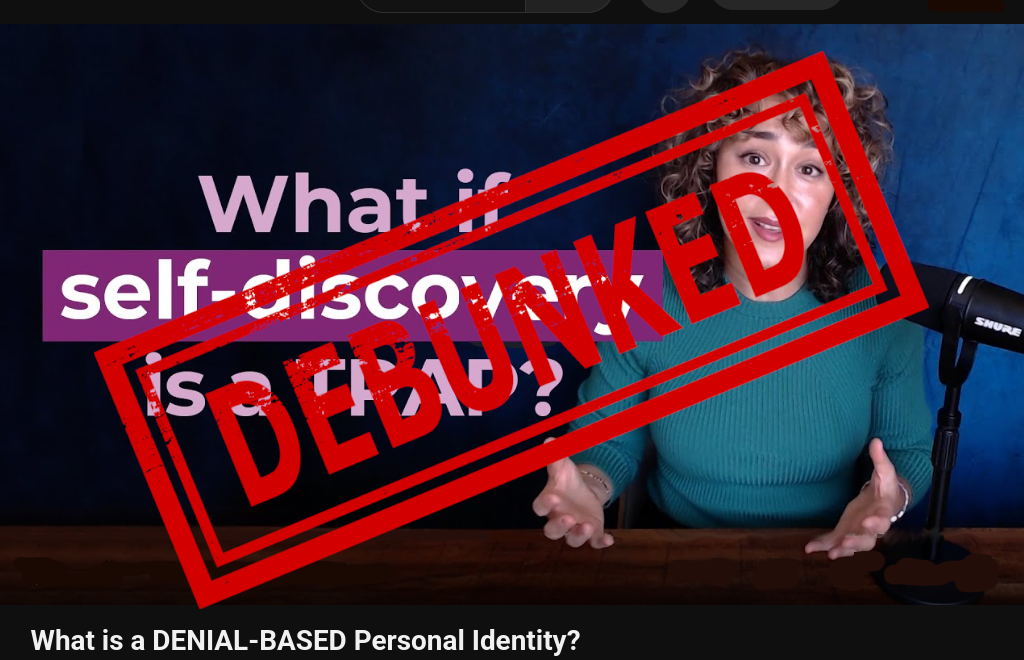
Ayad’s video “What is a DENIAL-BASED personality” marks a calculated escalation in her conversion pipeline, the moment where seduction turns to diagnosis. After four videos of philosophical foreplay and intellectual flattery, she’s primed her audience for the pathologization punch. The timing isn’t accidental. She’s spent her time establishing herself as the reasonable therapist, the deep thinker, the protector of vulnerable youth. Now she cashes in that manufactured credibility.
Notice the strategic split between this video and the next (“What is an ACCPETANCE-BASED personality”). Why does Ayad need two videos for what could be one discussion? Because successful manipulation requires careful pacing. This video creates the crisis (”denial-based identity”), leaving viewers anxious and destabilized. They’ll spend time marinating in that manufactured distress before proceeding to the next, which offers relief through her “acceptance-based” solution. It’s Problem-Reaction-Solution manipulation, a technique so effective that cults and authoritarian movements have used it for centuries [21].
The real tell comes at [10:54]: “Stay tuned because tomorrow that’s what we’ll be covering.” This isn’t just a teaser. It’s creating dependency. She’s diagnosed the “illness” but withholds the “cure,” ensuring her audience returns for the conversion therapy prescription. Classic dealer behavior: the first hit is free, but salvation costs your identity.
Consider what she’s actually promising: “an acceptance-based identity that is gender non-conforming and also works for you in the real world.” Translation: you can be quirky and dress differently, just don’t be trans. It’s conversion therapy’s eternal promise of having your cake and eating it too, as long as the cake is cisgender.
This two-part structure also serves another purpose. It creates investment. Viewers who watch this video will feel incomplete without watching the next. They’ve already committed time and emotional energy to understanding the “problem.” Sunk cost fallacy kicks in, or a sense of a cliff-hanger. They need the resolution, even if that resolution is just repackaged conversion therapy.
🚩 Red Flag: Classic Problem-Reaction-Solution manipulation. Real therapists don’t create artificial cliffhangers with people’s identities. They don’t diagnose viewers through screens. They certainly don’t promise one-size-fits-all solutions to complex identity questions.
The False Binary Trap
At [1:26], Ayad introduces her central deception: “two radically different ways to approach personal identity.” One leads to “flexibility, peace of mind and stronger connection.” The other “takes control out of your hands and leaves you vulnerable.” No legitimate psychological framework divides identity formation into such simplistic categories. This is Ayad inventing psychology from whole cloth.
Search psychological databases for “denial-based personal identity” or “acceptance-based personal identity” as clinical terms. You’ll find nothing, because Ayad made them up. She’s creating categories that sound scientific but exist nowhere in peer-reviewed literature. It’s pseudoscience wearing a lab coat, astrology pretending to be astronomy [2].
The binary itself reveals the con. Human identity formation is magnificently complex, involving neurological development, social interaction, cultural context, personal experience, and countless other factors [18]. Reducing this complexity to two options is like claiming there are only two types of weather: sunny or cloudy. It’s not just wrong; it’s absurdly reductive.
But the false binary serves a purpose. It creates the illusion of choice while eliminating actual options. You can choose Ayad’s “good” identity (accepting your assigned sex) or her “bad” identity (being trans). There’s no room for the messy, beautiful reality of human diversity. No space for the spectrum of gender experience that anthropology and sociology have documented across cultures and throughout history.
Notice too how she frames the “bad” option: it “requires an unsustainable amount of reinforcement.” This is particularly insidious because it takes a truth about conversion therapy outcomes and projects it onto trans identity. Studies consistently show that conversion therapy creates unstable identities requiring constant reinforcement to maintain [1]. Ayad describes the failure of her own approach while blaming it on trans people.
The framework also exploits our cognitive bias toward binary thinking. Humans naturally gravitate toward either/or categories, especially when stressed or confused. By presenting two clear options, Ayad bypasses critical thinking. Viewers don’t ask whether these categories are real; they just pick sides.
🚩 Red Flag: Made-up psychological categories. When someone invents terminology that appears nowhere in professional literature, they’re not doing psychology. They’re doing propaganda.
Justin the Strawman
Enter Justin at [5:18], Ayad’s carefully constructed caricature designed to conflate personality deception with gender identity. This isn’t just a bad example; it’s deliberately manipulative framing that reveals how Ayad views trans people.
Justin “tells people and tells himself that he’s a really laid-back, peaceful, zen out kind of guy” but is actually “kind of rude,” “constantly pressuring,” and “absolutely explodes” when confronted. The choice of an aggressive male character isn’t coincidental. Ayad is planting seeds, creating unconscious associations between trans identity and male aggression, deception, and instability.
But here’s what Ayad won’t tell you: Justin’s situation has nothing to do with gender identity. He’s describing personality traits, behavioral patterns, and possibly narcissistic self-deception. Gender identity operates at a fundamentally different level of human experience, involving brain structure, neurological development, and deep-seated sense of self [13][14]. Comparing Justin’s personality delusion to trans identity is like comparing lying about your height to having brown eyes. They’re completely different categories of human experience.
The strawman serves multiple functions. First, it establishes trans people as deceptive. Justin lies to himself and others, forcing them to participate in his delusion. Sound familiar? It’s the classic transphobic talking point that trans people are forcing others to lie. Ayad doesn’t say this directly, of course. She lets the parallel do the work.
Second, it frames identity as purely behavioral. Justin’s identity is “wrong” because his behavior doesn’t match his claims. This sets up the argument that trans identity is “wrong” because anatomy doesn’t match identity claims. But identity isn’t just behavior, and gender isn’t just anatomy. The brain is part of biology too, and neuroscience consistently shows that trans people’s brains align with their gender identity in measurable ways [15].
Third, it portrays anyone who questions rigid identity categories as aggressive and unstable. Justin “explodes” when confronted. The implication: trans people are similarly volatile. This is particularly vicious given that trans people face constant confrontation about their identities and typically respond with remarkable patience and resilience [20].
The most telling moment comes at [6:24]: “the words he uses to describe himself, things like easygoing, laid-back, chill, zen, well, those words actually mean something.” Ayad emphasizes that words have meaning while simultaneously inventing meaningless categories like “denial-based identity.” The projection is breathtaking.
🚩 Red Flag: Conflating unrelated concepts. Personality traits and gender identity operate in completely different domains. Using one to explain the other is like using music theory to diagnose diabetes.
The Kayla Caricature
At [7:40], Ayad introduces Kayla, her trans masculine strawman designed to pathologize transition as fantasy and delusion. Every detail is calculated to trigger disgust and dismissal in her carefully primed audience.
Notice the framing: Kayla has been “imagining herself as a guy, drawing herself as a guy, and fantasizing about becoming a guy named Kyle.” The repetition of “guy” combined with “imagining,” “drawing,” and “fantasizing” reduces gender identity to childish make-believe. This isn’t how trans people experience or describe their identities. It’s how transphobes imagine trans people think.
The name choice itself is manipulative. “Kayla/Kyle” maintains the K, suggesting superficial change rather than authentic identity. It’s a small detail that unconsciously reinforces Ayad’s argument that transition is surface-level performance rather than deep truth.
Then comes the outdated “trapped in the wrong body” narrative at [8:03]: “this convinces her that she’s a boy trapped in a girl’s body.” Most trans people today reject this framing as overly simplistic and potentially harmful. Modern understanding recognizes gender identity as an intrinsic characteristic, not a trap or mistake [17]. Ayad uses outdated language that she knows doesn’t represent current trans discourse, creating a strawman from strawman material.
The escalation at [8:16] is particularly vicious: “Kayla will find herself trapped in her own perspective.” Notice the shift from “trapped in wrong body” to “trapped in perspective.” Ayad transforms the metaphor, making the trap not societal or biological but psychological. The real prison, she implies, is trans identity itself.
The demand for validation narrative at [8:45] completes the caricature: “I’m not Kayla. I’m Kyle, and I need others in my life to agree with me.” This framing presents basic respect for identity as unreasonable demand. Would Ayad describe a married woman asking to be called by her married name as “demanding validation”? Of course not. But trans people asking for basic recognition become tyrants in her telling.
Most insidiously, Ayad claims at [8:55]: “Kayla is now in a battle with reality itself.” But whose reality? Reality includes the documented existence of gender diversity across cultures and throughout history. Reality includes brain studies showing neurological bases for gender identity. Reality includes the improved mental health outcomes when trans youth are supported [19]. Ayad’s “reality” excludes actual reality.
🚩 Red Flag: Misrepresenting trans experience. Using outdated “trapped in wrong body” narratives and presenting transition as fantasy reveals either profound ignorance or deliberate deception.
Capital T Truth vs Lowercase Science
At [10:45], Ayad unveils her ultimate authority: “capital T Truth.” But what exactly is this Truth she wields like a weapon? She never defines it, letting its capitalization carry the weight of unquestionable authority. This is philosophical authoritarianism, using typography as theology.
The concept of “capital T Truth” has a dark history in political philosophy. Fascist movements have consistently claimed ownership of absolute Truth while denouncing empirical science as degenerate or corrupted [21][22]. Mussolini explicitly praised “antiverità” (anti-truth), showing contempt for those claiming objective truth while simultaneously claiming fascism’s strength lay in transcending mundane facts. Sound familiar?
Ayad states at [10:52]: “biological sex is one of them,” meaning one of these concrete, capital-T Truths. But biological sex itself is far more complex than Ayad’s binary framework allows. Intersex conditions affect up to 1.7% of the population. Sexual differentiation involves multiple biological systems including chromosomes, hormones, internal reproductive organs, external genitalia, and yes, brain structure [9][16]. Which of these is the “True” sex? Ayad doesn’t say because acknowledging complexity would shatter her simplistic framework.
Meanwhile, actual science, the lowercase kind that requires evidence and peer review, consistently supports the validity of trans identity. Brain imaging studies show measurable differences in trans people’s neurology that align with their gender identity rather than assigned sex [13][14][15]. Genetic studies identify correlations between certain genetic markers and trans identity [17]. Endocrinological research demonstrates the role of prenatal hormone exposure in gender identity development. Not any one of these things are diagnostic, but they are indicative.
But Ayad isn’t interested in science. She’s interested in Science™, the kind that confirms her preconceptions while ignoring contradicting evidence. This is biological essentialism, the belief that social categories are determined by biology alone [11][12]. It’s the same ideology used to justify slavery (different “biological races”), women’s oppression (biological unsuitability for public life), and homosexual persecution (biological abnormality).
The irony is strong here. Ayad accuses trans people of denying reality while she denies the scientific reality of trans existence. She claims ownership of Truth while spreading demonstrable falsehoods. She demands others accept her reality while refusing to accept the reality of gender diversity documented across cultures and throughout history.
📊 Evidence Box: What Science Actually Says About Gender Identity
Neuroscience Shows:Brain structure differences align w/ gender identity, not assigned sex [13]White matter microstructure patterns match identified gender [14]Brain activation patterns correspond to gender identity [15]
Biology Demonstrates:Genetic markers correlate with trans identity [17]Prenatal hormone exposure influences gender developmentMultiple biological systems involved in sex differentiation
Psychology Confirms:Gender identity consistency from early childhood [19]Trans children’s gender identity as stable as cis children’sNot a phase, fantasy, or delusion
The Reality: Gender identity has measurable biological correlates. Trans people aren’t “denying reality” - they’re expressing neurological truth.
Brief Historical Parallel:
As a quick aside, as I have covered this in previous articles, but I really wanted to highlight this weaponization of “biological truth” and the fact that doing so has a consistent playbook. Victorian doctors manufactured “hysteria” to pathologize women’s emotions. Phrenologists measured skulls to “prove” racial hierarchy. Soviet psychiatrists diagnosed dissidents with “sluggish schizophrenia.” Each era’s oppressors wrapped their bigotry in scientific language, claimed biological authority, and dismissed lived experience as delusion. Here, we can see Ayad’s “capital T Truth” joins this ignoble tradition, using biological essentialism to deny the documented reality of gender diversity. The only difference? She has YouTube instead of medical journals.
🚩 Red Flag: Ideology disguised as objective truth. When someone claims exclusive access to “capital T Truth” without defining it or providing evidence, they’re not doing philosophy. They’re doing theology, and their god is their own prejudice.
The Word Games Projection
At [9:33], Ayad accuses trans people of “word games,” specifically “defining a term and using that same term in the definition.” Her example: “a man is anyone who identifies as a man.” This is rich coming from someone who just invented “denial-based identity” without ever defining “denial,” “based,” or how they combine into her novel framework.
The projection here is weapons-grade. Ayad’s entire series consists of word games. She redefines “gender” as metaphor while ignoring its established meanings in psychology, sociology, and medicine. She invents categories like “denial-based” and “acceptance-based” identity without operational definitions. She uses “capital T Truth” as an undefined ultimate authority. Her framework is word games all the way down.
But let’s be honest about what trans people actually say: Yes, a man is someone who identifies as a man. A woman is someone who identifies as a woman. This isn’t circular reasoning; it’s how social categories function. Who counts as an artist? Someone who identifies as and practices art. Who’s a Christian? Someone who identifies with and practices Christianity. Social identities are fundamentally about identification and participation.
Consider how we actually use gender in daily life. When you interact with someone, you don’t check their chromosomes, examine their genitals, or review their birth certificate. You respond to their presentation, their voice, their name, their own identification. The “word game” Ayad criticizes is actually how gender functions socially. Her supposedly objective alternative, defining gender purely by anatomy, is the artificial imposition.
Ayad continues at [9:42]: “the words Kayla uses actually mean something. Words like man, boy, guy, and male.” But what do they mean? Different things in different contexts. “Man” can refer to adult human males (biological), masculine-presenting people (social), people who identify as men (psychological), or legal designation (administrative). Pretending words have single, fixed meanings isn’t truth; it’s linguistic fundamentalism.
More importantly, trans people aren’t claiming to have rewritten biology wholesale. When someone says “I am a woman,” they’re not asserting they produce ova. They’re saying they’re women in all the ways that matter for social existence: identity, presentation, lived experience, and often, through medical transition, in most biological ways too. Hormones reshape body composition, fat distribution, skin texture, body hair, even body odor. Surgery can reconstruct anatomy. The only thing that doesn’t change? Gamete production. And when was the last time gamete production mattered in your coffee shop interaction?
The deepest irony is that Ayad’s entire framework depends on words not meaning what they usually mean. “Acceptance” in her usage means rejecting aspects of yourself. “Reality” excludes documented psychological and neurological phenomena. “Truth” means her personal ideology. She plays word games while accusing others of playing word games, a projection so perfect it approaches parody.
🚩 Red Flag: Projection as manipulation tactic. When someone’s primary accusation against others perfectly describes their own behavior, it’s not hypocrisy. It’s strategy.
The External Validation Con
At [1:04], Ayad claims trans identity “requires an unsustainable amount of reinforcement.” This is, perhaps, her most ambitious projection, describing the exhausting maintenance of conversion therapy outcomes while attributing it to trans identity.
Consider who actually receives constant external validation. Every time someone is called “sir” or “ma’am,” their gender is validated. Every gendered bathroom, every “ladies and gentlemen,” every pink or blue baby shower, every “boys will be boys” or “like a girl” comment reinforces cisgender identity. Cis people swim in an ocean of validation so constant they don’t even notice the water.
Research consistently shows that trans people who receive support and validation experience improved mental health outcomes [19][20]. This isn’t because trans identity requires unusual reinforcement, but because trans people face unusual invalidation. The “unsustainable reinforcement” Ayad describes is actually the effort required to maintain dignity in a hostile environment.
Meanwhile, actual conversion therapy outcomes, the “acceptance-based” identity Ayad will promote in Video 6, genuinely require unsustainable reinforcement. Studies of conversion therapy “graduates” consistently find high relapse rates, ongoing distress, and the need for constant vigilance against authentic identity expression [1][2][5]. The instability Ayad attributes to trans identity actually describes the artificial identities conversion therapy attempts to impose.
At [8:50], Ayad claims “Kayla depends on the social reinforcement of other people to keep her Kyle identity going.” But all identity depends on social reinforcement to some degree. Ayad’s identity as a therapist requires clients, credentials, and professional recognition. Her identity as an intellectual requires audiences who treat her as one. The difference isn’t that trans identity uniquely requires validation, but that trans people uniquely face systematic invalidation.
The external validation argument also ignores the internal consistency of trans identity. Studies of trans children as young as five show that their gender identity is as consistent and deeply held as that of cis children [19]. This isn’t external performance requiring constant reinforcement; it’s internal truth seeking external recognition.
Most tellingly, if trans identity truly required unsustainable external validation, we wouldn’t see trans people persisting despite massive social pressure to desist. The fact that people maintain trans identities despite family rejection, employment discrimination, and social hostility and threats of violence demonstrates remarkable internal stability, not external dependency.
🚩 Red Flag: Describing conversion therapy outcomes as trans experience. The instability and exhaustion Ayad describes aren’t features of trans identity; they’re symptoms of trying to suppress it.
The Truth: Cis people swim in validation so constant they don’t notice it. Trans people aren’t “dependent on validation” - they’re fighting for basic recognition in a hostile world.
Setting Up the ‘Solution’
Video 5’s final moments reveal its true purpose: creating desperate need for Video 6’s “cure.” Ayad has spent eleven minutes diagnosing a disease she invented, and now at [10:54] she dangles the cure just out of reach: “Stay tuned because tomorrow that’s what we’ll be covering.”
This isn’t education; it’s manipulation. Real therapists don’t create artificial suspense around mental health solutions. They don’t diagnose entire populations through YouTube videos. They certainly don’t promise one-size-fits-all answers to complex identity questions. But Ayad isn’t doing therapy; she’s doing conversion.
The promise she makes is seductive: “entirely possible to have an acceptance-based identity that is gender non-conforming and also works for you in the real world.” Translation: you can be different without being trans. You can express yourself without transitioning. You can have your authenticity cake and eat your cisgender stability too.
This is conversion therapy’s eternal false promise. Just be a masculine woman or feminine man! Express yourself through fashion and hobbies! Find identity in anything except actual gender identity! It’s the same “solution” conversion therapists have peddled for decades, repackaged with philosophical pretensions [5][7].
But notice what’s missing from Ayad’s promise: any acknowledgment that some people are actually trans. Her framework has no space for the possibility that gender identity might be real, neurologically based, and immutable. Everyone in Ayad’s universe is cisgender; some just don’t know it yet.
The two-video structure serves this agenda perfectly. This video creates the problem, generating anxiety and self-doubt. Viewers who came looking for answers about gender identity leave questioning whether their identity is “denial-based.” They spend hours or days marinating in this manufactured crisis, growing more desperate for resolution. When Video 6 arrives with its “acceptance-based” alternative, they’re primed to embrace it.
This is textbook cult recruitment. Create a crisis of identity, isolate the target from other perspectives, then offer your ideology as the only solution. Ayad has simply adapted ancient techniques for the YouTube age.
Conclusion
The capital T Truth about Sasha Ayad’s lowercase bigotry is simpler than her philosophical pretensions suggest. She’s running conversion therapy through YouTube, using made-up psychology to pathologize trans identity while promising a “cure” that’s just cisgender conformity with quirky accessories.
Her “denial-based identity” doesn’t exist in psychological literature because she invented it. Her “capital T Truth” is biological essentialism, the same ideology used to oppress every minority throughout history. Her “reality” excludes the documented reality of gender diversity across cultures, the neuroscience of gender identity, and the lived experiences of millions of trans people.
The only denial here is Ayad’s denial of medical consensus, scientific evidence, and basic human dignity. She projects conversion therapy’s instability onto trans identity, describes cisgender privilege as trans dependency, and weaponizes philosophical language to advance therapeutic abuse.
But reality, actual reality with evidence and lowercase letters, includes trans people. Brain studies confirm it [13][14][15]. Genetics support it [17]. Cross-cultural anthropology documents it. Medical outcomes validate it [19]. Trans people exist, have always existed, and will continue existing regardless of how many philosophical word games bigots play.
The tragedy is that vulnerable youth seeking understanding will find Ayad’s videos and mistake manipulation for wisdom. They’ll internalize her manufactured categories, doubt their own experiences, and potentially subject themselves to the “acceptance-based” conversion she sells as solution.
Part 6 awaits, where Ayad will complete her con with the “cure.” We already know what’s coming: be yourself but not too much, express your identity but not that identity, accept yourself by rejecting yourself. It’s conversion therapy’s greatest hits, remixed for the podcast generation.
The capital T Truth? There’s nothing truthful about denying people’s existence. There’s nothing accepting about demanding conformity. And there’s nothing therapeutic about conversion therapy, no matter how many philosophy degrees you wrap it in.
🚩 THE DENIAL DECEPTION:
What Ayad Claims vs Reality:
- ❌ “Denial-based identity” → Made-up category
- ❌ “Capital T Truth” → Biological essentialism
- ❌ “Word games” → Projection of her tactics
- ❌ “Needs constant validation” → Describes cis privilege
- ❌ “Fantasy and delusion” → Ignores neuroscience
- ❌ “Battle with reality” → Reality includes trans people
The only denial here? Ayad denying medical consensus.
References
[1] Cornell University. (2018). What does the scholarly research say about whether conversion therapy can alter sexual orientation without causing harm? What We Know Project. https://whatweknow.inequality.cornell.edu/topics/lgbt-equality/what-does-the-scholarly-research-say-about-whether-conversion-therapy-can-alter-sexual-orientation-without-causing-harm/
[2] American Psychiatric Association. (2021). Position Statement on Conversion Therapy and LGBTQ+ Patients. https://www.psychiatry.org/getattachment/3d23f2f4-1497-4537-b4de-fe32fe8761bf/Position-Conversion-Therapy.pdf
[5] Ashley, F. (2022). The Unethicality of Transgender Conversion Practices. National Center for Biotechnology Information. https://pmc.ncbi.nlm.nih.gov/articles/PMC9679588/
[7] Ozanne Foundation. (2024). ‘Conversion Therapy’ As Degrading Treatment. National Center for Biotechnology Information. https://pmc.ncbi.nlm.nih.gov/articles/PMC8902017/
[9] Eliot, L. (2021). Biological essentialism, gender ideologies, and the division of family roles. The Journal of Social Psychology. https://www.tandfonline.com/doi/full/10.1080/00224545.2021.1983508
[11] Oxford Review. (2024). Biological Essentialism – Definition and Explanation. The Oxford Review DEI Dictionary. https://oxford-review.com/the-oxford-review-dei-diversity-equity-and-inclusion-dictionary/biological-essentialism-definition-and-explanation/
[12] Verywell Mind. (2021). What Is Gender Essentialism Theory? https://www.verywellmind.com/what-is-gender-essentialism-theory-5203465
[13] van der Miesen, A. I. R., et al. (2024). Neurobiological characteristics associated with gender identity. Hormones and Behavior. https://pubmed.ncbi.nlm.nih.gov/39029340/
[14] Mueller, S. C., Guillamon, A., Zubiaurre-Elorza, L., et al. (2021). The Neuroanatomy of Transgender Identity: Mega-Analytic Findings From the ENIGMA Transgender Persons Working Group. The Journal of Sexual Medicine. https://pubmed.ncbi.nlm.nih.gov/34030966/
[15] Koenis, M. M., et al. (2022). Brain Sex in Transgender Women Is Shifted towards Gender Identity. Journal of Clinical Medicine. https://pmc.ncbi.nlm.nih.gov/articles/PMC8955456/
[16] van der Miesen, A. I. R., et al. (2024). Neurobiological characteristics associated with gender identity. Hormones and Behavior, 164. https://www.sciencedirect.com/science/article/abs/pii/S0018506X24001260
[17] Clark, S. (2025). The Science of Being Trans: New Insights Reveal Gender Identity is Rooted in Biology. Medium. https://medium.com/transforming-media/the-science-of-being-trans-05e5a7a8a2a7
[18] Worthen, M. G. F. (2022). Transgender identity: Development, management and affirmation. Current Opinion in Psychology, 48. https://www.sciencedirect.com/science/article/pii/S2352250X22001889
[19] Mental Health America. (n.d.). Affirming your loved one’s gender exploration and identity. https://mhanational.org/resources/affirming-your-loved-ones-gender-exploration-and-identity/
[20] Goldberg, A. E., et al. (2021). Measuring Satisfaction and Comfort with Gender Identity and Gender Expression Among Transgender and Gender Diverse People. Psychology of Sexual Orientation and Gender Diversity. https://pubmed.ncbi.nlm.nih.gov/33806834/
[21] Britt, L. (2025). Leonine Chameleons: Relativism and Fascism. Blog of the American Philosophical Association. https://blog.apaonline.org/2025/09/15/leonine-chameleons-relativism-and-fascism/
[22] English Stack Exchange. (2014). What’s the difference of ‘Truth with capital T” from truth with small t? https://english.stackexchange.com/questions/206145/what-s-the-difference-of-truth-with-capital-t-from-truth-with-small-t