List of Bad Arguments by Transmisic Activists
1. Claim: "There is no objective evidence that proves the condition of 'being transgender' is anything but a belief"
Logical fallacy: Appeal to ignorance (claiming something is true because it hasn't been proven false)
Why it's incorrect: This dismisses substantial scientific evidence without proper examination
Fact: Multiple studies indicate biological factors contribute to gender identity:
Research has identified potential genetic links to transgender identity.[1]
Neuroanatomical studies show transgender individuals present with "their own unique brain phenotype" rather than simply shifting along a male-female spectrum. [2]
Scientific consensus recognizes gender identity as having biological underpinnings, with evidence supporting "a biologic basis of gender identity." [3]
Gender identity is understood as "a multifactorial complex trait with a heritable polygenic component." [4]
Burden of Proof Fallacy: The person making a claim fails to provide evidence for their assertion. Instead, they shift responsibility by challenging others to disprove it
Why it’s incorrect: In this case, the claimant asserts that transgender identity is "only a belief" but provides no evidence to support this position. Rather than substantiating their claim, they place the onus on others to prove transgender identity is more than a belief. This wrongly shifts the burden of proof away from the person making the assertion.
2. Claim: Gender dysphoria diagnosis is merely based on "a person's claim to feel a certain way"
Logical fallacy: Oversimplification and misrepresentation of diagnostic criteria
Why it's incorrect: Medical diagnoses routinely incorporate patient-reported experiences alongside clinical assessment
Fact: Gender dysphoria has specific diagnostic criteria in the DSM-5 that require:
A marked incongruence between experienced/expressed gender and primary/secondary sex characteristics lasting at least six months
Significant distress or impairment in social, occupational, or other important areas of functioning [5]
Comprehensive evaluation by qualified professionals following established protocols [6]
3. Claim: Gender dysphoria in young people is "very similar" to anorexia nervosa
Logical fallacy: False equivalence
Why it's incorrect: While both involve body perception issues, they are distinct conditions with different etiologies and treatment approaches
Fact:
Though both conditions involve body dissatisfaction, they represent different clinical phenomena. [7]
Research shows gender dysphoria and eating disorders have different symptom profiles and require specialized treatment approaches. [8]
The co-occurrence of these conditions is documented, but they are not equivalent presentations. [9]
4. Claim: Gender-affirming care represents "experimental medicine" opened through affirmation of beliefs
Logical fallacy: Misrepresentation of established medical practice
Why it's incorrect: Gender-affirming care follows evidence-based standards, not experimental protocols
Fact:
Gender-affirming care is backed by "rigorous research, expert consensus, and patient-centered values." [10]
The World Professional Association for Transgender Health (WPATH) publishes evidence-based Standards of Care (SOC8) followed globally. [11]
Treatment follows a holistic approach addressing "social, mental, and medical health needs and well-being." [6]
5. Claim: Trans identity is contradictory because it's called "natural" yet requires treatment
Logical fallacy: False dichotomy
Why it's incorrect: Many natural biological variations require medical treatment (e.g., diabetes, hypothyroidism)
Fact:
Gender-affirming care follows the same medical principle as other treatments: addressing distress and improving quality of life
The goal is to "partner with TGD people to holistically address their social, mental, and medical health needs." [6]
Successful outcomes require "adequate preparation and mental health support prior to treatment" and "proper follow-up care." [12]
6. Claim: Gender-affirming care is "grotesque" for "targeting children"
Logical fallacy: Emotional appeal and misrepresentation
Why it's incorrect: This mischaracterizes evidence-based, cautious care for transgender youth
Fact:
Care for transgender youth involves comprehensive assessment and follows strict protocols
For adolescents, treatment typically begins with reversible interventions (like puberty blockers) only after thorough evaluation
Research shows gender-affirming care significantly improves mental health outcomes for transgender youth. [10]
7. Claim: Distress over body should be treated rather than affirming gender identity
Logical fallacy: False dilemma (presenting only two options when more exist)
Why it's incorrect: Affirmation is part of treating the distress, not separate from it
Fact:
Studies consistently show gender-affirming care "improved mental health and overall quality of life." [10]
The most effective approach addresses both psychological and physical aspects of gender dysphoria
Conversion practices for transgender individuals are considered "prima facie unethical" because they violate principles of equality and justice. [13]
8. Claim: Autistic girls fearing puberty have nothing in common with adult men with sexual gratification from feminine personas, yet both are "lumped together"
Logical fallacies: False equivalence and conflation of distinct concepts
Why it's incorrect: This conflates gender identity with sexual orientation and fetishism
Fact:
Gender identity is distinct from sexual orientation - "Sexual orientation is about who you want to be with. Gender identity is about who you are." [14]
Being transgender "does not imply any specific sexual orientation." [15]
While autism and gender dysphoria can co-occur, this doesn't mean all transgender people share the same experiences or motivations. [16]
Transvestic fetishism (what the commenter references) is categorically different from transgender identity
9. Claim about "closing the proximity between children and adult sexuality"
Logical fallacy: Guilt by association and insinuation without evidence
Why it's incorrect: This implies a connection between gender-affirming care and sexualization of children that doesn't exist
Fact:
Gender identity and sexuality are separate concepts with no evidence linking gender-affirming care for youth to sexualization
Medical care for transgender youth focuses on alleviating distress and improving mental health outcomes
The WPATH Standards of Care explicitly prioritize "science, compassion, and respect" in treating transgender young people. [10]
The Table: Historical Patterns of Exclusionary Rhetoric
Looking for the table? Due to the lengthy citation list, I moved it to here:
 PITT
PITT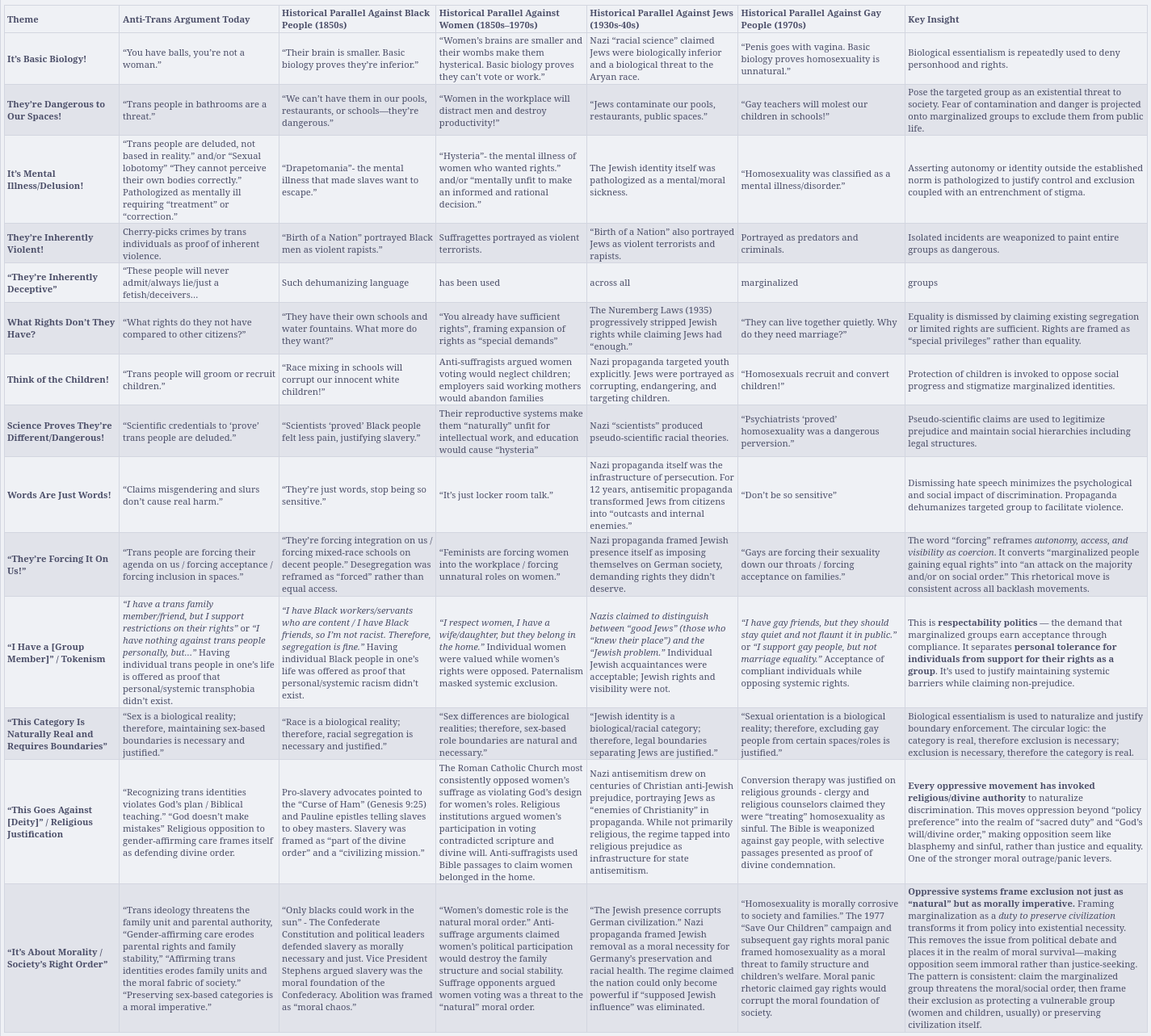
[1]Hudson Institute communications. (2018, October 3). Study reveals potential biological basis for transgender. Hudson Institute. https://hudson.org.au/news/written-in-dna-study-reveals-potential-biological-basis-for-transgender/
[2] Guillamon, A., Zubiaurre-Elorza, L., Junque, C., Gomez-Gil, E., Uribe, C., Khorashad, B. S., Khazai, B., Talaei, A., Habel, U., Votinov, M., Derntl, B., Lanzenberger, R., Seiger, R., Kranz, G. S., Kreukels, B. P. C., Cohen-Kettenis, P. T., Burke, S. M., Lambalk, N. B., Veltman, D. J., … Luders, E. (2021). The neuroanatomy of transgender identity: Mega-analytic findings from the ENIGMA transgender persons working group. The Journal of Sexual Medicine, 18(6), 1003–1019. https://pubmed.ncbi.nlm.nih.gov/34030966/
[3] Hembree, W. C., Cohen-Kettenis, P. T., Delemarre-van de Waal, H. A., Gooren, L. J., Meyer, W. J., Spack, N. P., Tangpricha, V., & Montori, V. M. (2015). Evidence supporting the biologic nature of gender identity. Endocrine Practice, 21(2), 199–204. https://pubmed.ncbi.nlm.nih.gov/25667367/
[4] Kreukels, B. P. C., Irwig, M. S., Beach, L., Chan, Y.-M., Derks, E. M., Esteva, I., Ehrenfeld, J., Den Heijer, M., Posthuma, D., Raynor, L., Tishelman, A., & Davis, L. K. (2018). The biological contributions to gender identity and gender diversity: Bringing data to the table. Behavior Genetics, 48(2), 95–108. https://pubmed.ncbi.nlm.nih.gov/29460079/
[5] Feingold, K. R., Ahmed, S. F., Anawalt, B., Boyce, A., Chrousos, G., de Herder, W. W., Dungan, K., Grossman, A., Hershman, J. M., Kaltsas, G., Koch, C., Kopp, P., Korbonits, M., McLachlan, R., Morley, J. E., New, M., Papanicolaou, D., Perreault, L., … Wilson, D. (Eds.). (2000). DSM-5 criteria for gender dysphoria. In Endotext. MDText.com. https://www.ncbi.nlm.nih.gov/books/NBK577212/table/pediat_transgender.T.dsm5_criteria_for_g/
[6] Coleman E, Radix AE, et al. Standards of Care for the Health of Transgender and Gender Diverse People, Version 8. Int J Transgend Health. 2022 Sep 6;23(Suppl 1):S1-S259. doi: 10.1080/26895269.2022.2100644. PMID: 36238954; PMCID: PMC9553112.
[7] Costa, M., Carvalho, D., & Machado, B. (2022). Anorexia nervosa and gender dysphoria: A clinical case. Psychiatria Danubina, 34(Suppl 9), S347–S350. https://pmc.ncbi.nlm.nih.gov/articles/PMC9566740/
[8] Milano, W., Sansone, A., Di Maso, V., Romanelli, F., Rania, M., & Barone, A. (2020). Gender dysphoria, eating disorders and body image: An overview. Endocrine, Metabolic & Immune Disorders - Drug Targets, 20(6), 820–827. https://pubmed.ncbi.nlm.nih.gov/31644411/
[9] Ristori J, Fisher AD, Castellini G, Sensi C, Cipriani A, Ricca V, Maggi M. Gender Dysphoria and Anorexia Nervosa Symptoms in Two Adolescents. Arch Sex Behav. 2019 Jul;48(5):1625-1631. doi: 10.1007/s10508-019-1396-7. Epub 2019 Feb 27. PMID: 30815831.
[10] World Professional Association for Transgender Health (WPATH) & US Professional Association for Transgender Health (USPATH). (2025, May 2). WPATH and USPATH response to the HHS report on gender dysphoria. https://www.wpath.org/wp-content/uploads/2025/05/WPATH-USPATH-Response-to-HHS-Report-02May2025-1.pdf
[11] World Professional Association for Transgender Health (WPATH). (2022). Standards of Care 8. https://wpath.org/publications/soc8/
[12] Giammattei, S. V. (2021). WPATH HPP MH for handouts [PowerPoint slides]. https://www.wpath.org/wp-content/uploads/2024/11/WPATH-HPP-MH-for-Handouts.pdf
[13] Ashley, F. (2022). Transporting the burden of justification: The unethicality of transgender conversion practices. Journal of Law, Medicine & Ethics, 50(3), 425–442. https://pmc.ncbi.nlm.nih.gov/articles/PMC9679588/
[14] Montgomery College. (2022). What's the difference between gender and sexuality? https://www.montgomerycollege.edu/_documents/life-at-mc/mc-pride/gender-vs-sexuality.pdf
[15] Human Rights Campaign. (n.d.). Sexual orientation and gender identity terminology and definitions. https://www.hrc.org/resources/sexual-orientation-and-gender-identity-terminology-and-definitions
[16] Williams, D., & Kallitsounaki, A. (2023). Autism spectrum disorder and gender dysphoria/incongruence: A systematic literature review and meta-analysis. Journal of Autism and Developmental Disorders, 53, 3681–3702. https://pmc.ncbi.nlm.nih.gov/articles/PMC10313553/