Is Being Transgender 'Real' or Valid?
The argument and/or question
Anti-trans activists, “gender critical” proponents, and TERFs often claim that being transgender isn't real or valid. Their arguments typically include variations of:
- “There's no such thing as being transgender – it's just confusion or mental illness”
- “You can't change your biological sex, therefore being trans isn't real”
- “Transgender identities are a new social contagion/trend/ideology”
- “It's just body dysmorphia/autism/trauma/internalized homophobia”
- “Trans people are just confused/brainwashed by the 'trans agenda'”
The underlying rationale behind these claims typically relies on:
- Oversimplifying biological sex as an immutable binary determined solely by chromosomes or genitals
- Conflating gender identity with biological sex
- Dismissing the growing body of scientific evidence supporting the biological basis of gender identity
- Cherry-picking detransition stories while ignoring the vast majority of positive outcomes
- Pointing to the supposed “newness” of transgender identities while ignoring their long historical presence
TERFs often frame their denial of transgender existence as “protecting” women or children, or as defending “biological reality.” But let's examine what the actual scientific evidence tells us.
The Answer and/or Response
Being transgender is absolutely real and valid, with substantial scientific evidence supporting this reality.
Transgender identity has a strong biological basis supported by multiple lines of scientific evidence. Research consistently shows that gender identity has neurobiological underpinnings and is not simply a choice, trend, or delusion.1
Studies examining brain structure and function have identified numerous sex-differentiated areas where transgender individuals' brains more closely resemble those of their identified gender rather than their assigned sex at birth.23 For example, transgender women (assigned male at birth) often show brain structures more similar to cisgender women in regions like the bed nucleus of the stria terminalis and other sexually dimorphic areas.4
Moreover, the effectiveness of gender-affirming care provides powerful evidence for the reality of transgender identity. Multiple long-term studies demonstrate that proper treatment – including social transition, hormone therapy, and sometimes surgeries – significantly improves mental health outcomes and quality of life for transgender individuals.567 If being transgender weren't real, such interventions wouldn't consistently produce positive results across decades of research.
Furthermore, transgender identities have existed throughout human history and across diverse cultures worldwide.8 From Two-Spirit people in Indigenous North American cultures to the Hijra in South Asia and various gender-diverse roles in Polynesian, African, and ancient civilizations, the existence of gender identities beyond the binary is well-documented. And while these examples may not always associate themselves as trans as a matter of course, many do. The point stands - the idea that being transgender is a “new trend” is simply historically inaccurate.
Discussion
When we dive deeper into the scientific evidence, it becomes even clearer that transgender identities have biological underpinnings. Multiple studies have identified genetic components associated with gender identity, suggesting that being transgender has heritable aspects similar to many other human traits.910
Dr. Milton Diamond's extensive research demonstrated that gender identity has biological roots that develop prenatally through the interaction of genes, hormones, and brain development.11 Their groundbreaking work with individuals born with certain intersex conditions showed that gender identity typically cannot be altered through rearing – it emerges from intrinsic biological factors rather than external influences.12
The “born in the wrong body” metaphor, while oversimplified, captures something fundamental: transgender people have an internal sense of gender that is at odds with their physical characteristics. This isn't a delusion or confusion – it's a mismatch between one's innate gender identity and the sex assigned at birth based on external anatomy.1314
Medical professionals worldwide recognize this reality. Major medical organizations including the American Medical Association, the American Academy of Pediatrics, the American Psychological Association, and the World Professional Association for Transgender Health all affirm the validity of transgender identities and support gender-affirming care as the appropriate treatment for gender dysphoria.1516
It's worth noting that gender identity exists on a spectrum, just as many human traits do. While some transgender people experience binary identities (male or female), others have non-binary identities that don't fit neatly into either category. This diversity reflects the complex nature of human gender and doesn't invalidate the reality of transgender experiences.1718
The “social contagion” myth has been thoroughly debunked by research. While visibility of transgender people has increased, studies show this hasn't created transgender identities – it has simply made it safer for people to come out.19 The alleged “rapid onset gender dysphoria” hypothesis has been widely criticized for methodological flaws and sampling bias.20
From a well reasoned comment, this was written:
Some background: I received the following comment challenging some aspects that I think fall into this article:
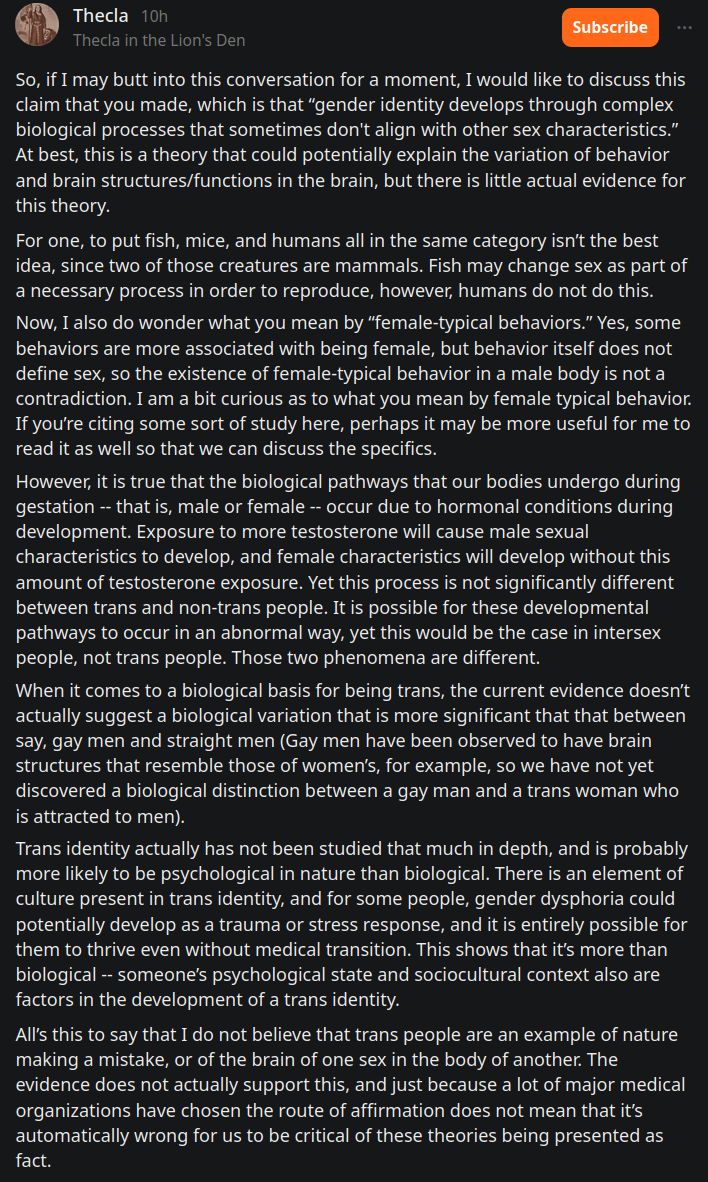
I took this in good faith, this person, though self labeled as a “gender critical feminist” (a contradiction in terms, to be sure) but was polite, rational, and seems to really want to engage in good faith. A rare thing to be sure, and one I both appreciate and respect. So I wrote this rather long response, which I thought would bring value to this section if for no other reason than to show what a more rational discourse on nuanced topics can look like.
Here is my response:
Thank you for engaging thoughtfully with these complex issues, Thecla. When I read your profile and article, I admit to being surprised that you applied the label “Gender critical feminist” to yourself. This is not the sort of reply I am used to receiving from those who adopt such a label. So I shall respond in good faith, in hopes that rational minds will prevail.
While you raise some valid methodological concerns, the scientific evidence actually paints a more nuanced picture than your analysis suggests.
On the Biological Basis
You claim transgender identity is "probably more likely to be psychological in nature than biological," but recent research contradicts this. Studies have identified specific genetic variants in sex hormone signaling pathways associated with transgender identity . As researchers note, gender dysphoria appears to have "an oligogenic component, with several genes involved" . A recent comprehensive review concluded there is "a strong biological basis for gender identity" .
Beyond Brain Imaging
While you correctly note limitations in neuroimaging studies, you overlook the stronger evidence from post-mortem brain studies, which show concrete differences in structures like the bed nucleus of the stria terminalis. Additionally, the biological evidence extends beyond brain structure to include:
- Digit ratio (2D:4D) studies suggesting different prenatal androgen exposure in transgender individuals
- Prenatal hormone exposure patterns that influence gender identity development
The Developmental Timeline Matters
An important piece of evidence you overlook is the sequential timing of sexual differentiation. Genital differentiation occurs early (weeks 7-12 of human development), while brain sexual differentiation happens much later and over a longer period, extending well into the second half of pregnancy and potentially into early postnatal life .
This timing difference provides a clear biological mechanism for how transgender identity could arise. If hormonal environments or sensitivities change between these two developmental windows, the brain could develop along a different trajectory than the genitals. This isn't speculation - it's based on established principles of developmental biology showing that "prenatal hormone exposure influences brain organization and behavior" .
The Animal Model Question
Your critique about comparing fish to humans is fair, but you dismiss mammalian studies too quickly. Research shows "prenatal hormone exposure influences brain organization and behavior" in mammals . While we can't model human gender identity in animals (as noted in ), these studies establish the biological principle that hormonal exposure affects neurodevelopment beyond genital differentiation.
Distinct from Sexual Orientation
You suggest we haven't discovered a biological distinction between gay men and trans women, but research shows "transgenderism and homosexuality are fundamentally unalike" in their neurobiology . Different brain regions and networks are involved, indicating these are distinct biological phenomena.
On Intersex vs Trans Distinctions
While you correctly note that intersex and trans experiences differ, this doesn't negate the biological basis. The same developmental processes that can create intersex variations (hormonal influences during critical periods) can affect brain development without affecting genital development. The evidence suggests "complex interactions between biological predispositions, psychological factors, and sociocultural context" .
Medical Consensus and Critical Thinking
You're right that medical consensus should be subject to critical examination. However, this consensus isn't arbitrary - it's based on decades of clinical evidence and research. Every major medical organization recognizes gender-affirming care because the evidence shows it improves outcomes and addresses "clinically-significant distress".
The Complex Reality
The evidence doesn't support a simple "brain of one sex in body of another" narrative - on this we agree. Instead, it reveals transgender identity as a developmental variation arising from complex biological processes. Brain studies show transgender individuals have unique patterns that don't align neatly with either typical male or female patterns. Hence we do not say it is because of any one aspect, but the evidence supports a biopsychosocial model of sorts.
Your emphasis on psychological and social factors isn't wrong - these clearly play important roles; however, the convergent evidence from genetics, prenatal hormone exposure markers, post-mortem brain studies, and developmental biology strongly suggests we cannot dismiss the biological components. And notably, these biological components are consistently found. The problem is that the trans population is so small that we are lucky to get the post-mortem sample sizes we have so far. And, like being gay, lesbian, or bi, there is no definitive test we can apply to prove one's sexual orientation or gender identity - and ethically speaking, nor should there be. It will take time to gain the numbers to provide a conclusive confidence in relation to the trans population. That said, we do have remarkable consistency on what we can and have measured, in the manner that we have, and when you pull back and process that in a more holistic manner, it becomes not just compelling, but remarkably consistent over time.
The most scientifically accurate view acknowledges both the biological predispositions and the psychological/social factors you highlight. This isn't about nature versus nurture, but understanding how they interact to create the diversity of human experience.
Thanks for this well reasoned and well thought out comment, it gave me the opportunity to craft this response, which I now recognize, probably should have been an article. I will use it instead to add to the data library I maintain (Q&A section).
N.B. You will notice I did not cite any papers because this was all done ad-hoc/in the moment. This did not seem the kind of debate/argument that required such. Besides, I am somewhat convinced/assuming that if they are approaching this topic with this level of understanding and nuance on these points, then they are just as well read as I am or more so, and already know these sources (or are using AI that can), and therefore they are not needed. 21
Logical Fallacies
The denial of transgender existence typically relies on several logical fallacies:
Appeal to Nature Fallacy: Claiming that because certain biological aspects of sex cannot be changed, transgender identities aren't “natural” or real. This ignores that many natural human variations exist, and that nature itself shows tremendous diversity in sex expression across species.22
Black and White Fallacy: Insisting that biological sex is a simple binary when biologists recognize it's a complex trait with multiple components (chromosomes, hormones, gonads, genitalia, etc.) that don't always align in a binary way.23
Cherry Picking: Selectively citing rare cases of detransition while ignoring the overwhelming majority of positive outcomes from transition.24
Appeal to Tradition: Arguing that because traditional societies recognized only two genders (itself historically inaccurate), transgender identities must be invalid or new.25
Hasty Generalization: Taking isolated examples of people who detransitioned and applying those experiences to all transgender people.26
Genetic Fallacy: Dismissing transgender identities because some aspects of gender theory developed relatively recently, ignoring that scientific understanding evolves over time as we gather more evidence.27
Conclusion
The claim that being transgender isn't real flies in the face of substantial scientific evidence, historical documentation, and the lived experiences of millions of people worldwide. Transgender identity has clear biological underpinnings , is consistent across cultures and throughout history, and is recognized as valid by major medical and psychiatric organizations globally.28
When TERFs and anti-trans activists deny the reality of transgender existence, they're not defending science or protecting anyone – they're ignoring evidence that contradicts their ideology and causing real harm to an already marginalized population. The consistent effectiveness of gender-affirming care in improving mental health outcomes provides powerful real-world validation that transgender identities are genuine and deserving of respect. 29
The inconvenient truth for transmisic individuals is that science is not on their side. Being transgender is as real as being left-handed or having blue eyes – a natural human variation that has always existed and always will. The only “choice” involved is whether society will recognize this reality and treat transgender people with the dignity and respect every human being deserves.
Footnotes
Kreukels, B. P., & Guillamon, A. (2016). Neuroimaging studies in people with gender incongruence. International Review of Psychiatry, 28(1), 120-128. https://pubmed.ncbi.nlm.nih.gov/26766406/ ↩
Hare, L., Bernard, P., Sánchez, F. J., Baird, P. N., Vilain, E., Kennedy, T., & Harley, V. R. (2009). Androgen receptor repeat length polymorphism associated with male-to-female transsexualism. Biological Psychiatry, 65(1), 93-96. https://www.pnas.org/doi/10.1073/pnas.0805542105 ↩
See 1 Above ↩
See 1 Above ↩
Brandt, E., Peeters, A., Verbeke, E., van Assche, E., Cleymans, S., van Veldhoven, A., Brugmann, E., Van de Velde, S., Geeraert, F., Poels, K., Vrielynck, C., Van Humbeeck, L., Dhondt, K., & T'Sjoen, G. (2022). Retrospective study of the effect of comprehensive gender-specific care for transgender adolescents and young adults. Scientific Reports, 12(1), 5551. https://pubmed.ncbi.nlm.nih.gov/35329908/ ↩
Dhejne, C., Lichtenstein, P., Boman, M., Johansson, A. L., Långström, N., & Landén, M. (2011). Long-term follow-up of transsexual persons undergoing sex reassignment surgery: cohort study in Sweden. PLoS ONE, 6(2), e16885. https://pubmed.ncbi.nlm.nih.gov/21364939/ ↩
Coleman, E., Bockting, W., Botzer, M., Cohen-Kettenis, P., DeCuypere, G., Feldman, J., … & Zucker, K. (2012). Standards of care for the health of transsexual, transgender, and gender-nonconforming people, version 7. International Journal of Transgenderism, 13(4), 165-232. https://www.sciencedirect.com/science/article/pii/S1743609515306950 ↩
Roughgarden, J. (2013). Evolution's rainbow: Diversity, gender, and sexuality in nature and people. University of California Press. ↩
See 2 Above ↩
Diamond, M. (2013). Transsexuality among twins: Identity concordance, transition, rearing, and orientation. International Journal of Transgenderism, 14(1), 24-38. https://www.hawaii.edu/PCSS/biblio/articles/2010to2014/2013-transsexuality.html ↩
Ibid. ↩
Diamond, M., & Sigmundson, H. K. (1997). Sex reassignment at birth: Long-term review and clinical implications. Archives of Pediatrics & Adolescent Medicine, 151(3), 298-304. https://pubmed.ncbi.nlm.nih.gov/9080940/ ↩
Khorashad, B. S., Manzouri, A., Feusner, J. D., Munoz-Negron, A., Savic, I., & Guillamon, A. (2021). We need valid and consistent terminology for sex and gender. Frontiers in Behavioral Neuroscience, 15, 675680. https://pubmed.ncbi.nlm.nih.gov/34030966/ ↩
Guillamon, A., Junque, C., & Gómez-Gil, E. (2016). A review of the status of brain structure research in transsexualism. Archives of Sexual Behavior, 45(7), 1615-1648. https://pubmed.ncbi.nlm.nih.gov/26766406/ ↩
See 7 Above ↩
Ashley, F. (2020). Thinking an ethics of gender exploration: Against delaying transition for transgender and gender creative youth. Clinical Child Psychology and Psychiatry, 25(2), 223-236. https://pubmed.ncbi.nlm.nih.gov/30165284/ ↩
See 13 Above ↩
See 8 Above ↩
See 5 and 10 above ↩
See 16 Above ↩
These are the citations for this note - not all inclusive/exhaustive, but a good start:
I don’t normally cite references in Notes. I do that in articles, mainly because it is quite time consuming and editing notes is not pleasant.I did my best by topic, and even with what I have at hand, I am sure I am missing some. Also, some of these citations are pulling double-duty, and this should not be considered exhaustive, comprehensive, or complete as-is. There are more, it just isn’t practical for me to list every single one.
Consider this a best effort to get you started.
Citations by Topic
On the Biological Basis
Hudson Institute of Medical Research. (2018, October 3). https://www.hudson.org.au/news/written-in-dna-study-reveals-potential-biological-basis-for-transgender/. Hudson Institute News. article on the below paper
Theisen, J. G., Sundaram, V., Filchak, M. S., Chorich, L. P., Sullivan, M. E., Knight, J., Kim, H. G., & Layman, L. C. (2019). https://pubmed.ncbi.nlm.nih.gov/30247609/. Scientific Reports, 9(1), 20099.
Augusta University. (2018). https://www.augusta.edu/research/studies/trial.php?study=1010884 Clinical Trials. ← included this as it has established a precedent is looking for trials to see if theory holds true. Not definitive in and of itself, no - but compelling in addition to the above.
There are others, this is just what came to mind
Beyond Brain Imaging
Zhou, J. N., Hofman, M. A., Gooren, L. J., & Swaab, D. F. (1995). https://pubmed.ncbi.nlm.nih.gov/7477289/. Nature, 378(6552), 68-70.
Kruijver, F. P., Zhou, J. N., Pool, C. W., Hofman, M. A., Gooren, L. J., & Swaab, D. F. (2000). https://pubmed.ncbi.nlm.nih.gov/10843193/. The Journal of Clinical Endocrinology & Metabolism, 85(5), 2034-2041.
Garcia-Falgueras, A., & Swaab, D. F. (2008). https://pubmed.ncbi.nlm.nih.gov/18980961/. Brain, 131(12), 3132-3146.
Hisasue, S. I., Sasaki, S., Tsukamoto, T., & Horie, S. (2019). https://pubmed.ncbi.nlm.nih.gov/28332875/. Endocrine Practice, 25(2), 98-104.
The Developmental Timeline
Roselli, C. E. (2018). https://pmc.ncbi.nlm.nih.gov/articles/PMC6677266/. Journal of Neuroendocrinology, 30(7), e12562.
Fisher, A. D., Ristori, J., Morelli, G., & Maggi, M. (2020). https://pubmed.ncbi.nlm.nih.gov/32204531/ International Journal of Molecular Sciences, 21(6), 2123.
Boudreau, A., Rosenheim, S., & Ataman, F. (2024). https://pmc.ncbi.nlm.nih.gov/articles/PMC11771763/. Nature Reviews Endocrinology.
The Animal Model Question
Boudreau, A., Rosenheim, S., & Ataman, F. (2024). https://pmc.ncbi.nlm.nih.gov/articles/PMC11771763/. Nature Reviews Endocrinology.
Roselli, C. E. (2018). https://pmc.ncbi.nlm.nih.gov/articles/PMC6677266/. Journal of Neuroendocrinology, 30(7), e12562.
Distinct from Sexual Orientation
Kranz, G. S., Hahn, A., Kaufmann, U., Küblböck, M., Hummer, A., Ganger, S., Seiger, R., Winkler, D., Swaab, D. F., Windischberger, C., Kasper, S., & Lanzenberger, R. (2017). https://www.nature.com/articles/s41598-017-17352-8https://www.hudson.org.au/news/written-in-dna-study-reveals-potential-biological-basis-for-transgender/. Scientific Reports, 7(1), 17954.
Brain Structure Evidence
Baldinger-Melich, P., Urquijo Castro, M. F., Seiger, R., Ruef, A., Dwyer, D. B., Kranz, G. S., Klöbl, M., Kambeitz, J., Kaufmann, L. K., Windischberger, C., Kasper, S., Falkai, P., Lanzenberger, R., & Koutsouleris, N. (2020). https://www.nature.com/articles/s41386-020-0666-3. Neuropsychopharmacology, 45(10), 1758-1765.
Mueller, S. C., Guillamon, A., Zubiaurre-Elorza, L., Junque, C., Gomez-Gil, E., Uribe, C., Khorashad, B. S., Khazai, B., Talaei, A., Habel, U., Votinov, M., Derntl, B., Lanzenberger, R., Seiger, R., Kranz, G. S., Kreukels, B. P. C., Kettenis, P. T. C., Burke, S. M., Lambalk, N. B., ... Luders, E. (2021). https://pubmed.ncbi.nlm.nih.gov/34030966/. Journal of Sexual Medicine, 18(6), 1122-1129.
Medical Consensus
GLAAD. (2025, May 26). https://glaad.org/medical-association-statements-supporting-trans-youth-healthcare-and-against-discriminatory/. GLAAD Resources.
American Medical Association. (2022, August 16). https://www.ama-assn.org/about/leadership/everyone-deserves-quality-medical-care-delivered-without-bias. AMA Leadership Viewpoints.
American Medical Association. (n.d.). https://www.ama-assn.org/press-center/ama-press-releases/ama-leading-medical-organizations-fight-transgender-americans. AMA Press Releases.
Biopsychosocial Framework
T'Sjoen, G. (2024). https://www.nature.com/articles/d41586-024-01521-7. Nature.
Fisher, A. D., Ristori, J., Morelli, G., & Maggi, M. (2020). https://pubmed.ncbi.nlm.nih.gov/32204531/ International Journal of Molecular Sciences, 21(6), 2123.
Turban, J. L. (2024). https://pubmed.ncbi.nlm.nih.gov/38582366/. ↩
See 8 above ↩
See 13 and 14 above ↩
See 5, 6, and 7, above ↩
See 8 above ↩
See 5 and 16 above ↩
See 8 and 14 above ↩
See 1, 2, 12, and 14 above ↩
See 5, 6, and 7, above ↩