From Human Sacrifice to Healthcare: How Not to Use Historical Analogies
No, Gender-Affirming Care Is Not Like Aztec Sacrifice

Hey there folks, today we are going to talk about a recent article from pittparents. You ever notice how some folks will reach so far for an analogy that they might dislocate their shoulder? Well, that's exactly what happened in an article called "Modern Sacrifices" from the PittParents folks (likely penned by Josie Alexander and/or Dina Samuels), where they try to equate gender-affirming care with – and I want to be very clear I'm not making this up – Aztec human sacrifice.1
I mean, Jesus Christ on a pogo stick, that's like comparing a paper cut to the Kennedy assassination because they both involve unwanted openings of the skin.
Now, I could just dismiss this as ridiculous and move on, but that wouldn't be helpful. Instead, let's take a look at what's actually happening here, separate fact from fiction, and maybe learn something along the way.
The Central Claim: A False Equivalence of Epic Proportions
The article's central argument hinges on an extraordinary claim: that providing gender-affirming care to transgender youth is somehow comparable to ritualistic human sacrifice in ancient civilizations.
This comparison fails spectacularly on multiple levels. Gender-affirming care is a set of evidence-based medical interventions designed to alleviate suffering, while human sacrifice involved killing people to appease deities. One aims to help people live better lives; the other ended lives. That's not a small distinction – it's the goddamn Grand Canyon of distinctions. 2
They write: ‘What difference is there between some child bravely declaring their willingness to have their heart cut out or their throat slit to appease Huitzilopochtli and some teen 'bravely' going under the knife to appease some ill-defined, ineffable Gender God? ’
The differences are, to put it mildly, substantial:
Consent and agency: Gender-affirming care requires informed consent and extensive evaluation, while sacrifice victims had little to no choice 3
Purpose: Medical care aims to improve well-being based on evidence, not appease supernatural forces
Outcome One results in improved mental health outcomes; the other resulted in death 4
Scientific basis: Gender-affirming care is based on decades of research, not supernatural beliefs 5
But sure, other than those tiny details – like one being HEALTHCARE and the other being MURDER – they're practically identical! And I'm practically identical to Dwayne "The Rock" Johnson, except for the muscles, fame, money, and charisma.
The Statistical Sleight of Hand
Let's tackle one of the most egregious claims in the article:
"When the percentage of people identifying as trans goes from 0.0015% of the entire population before the 2000s to 3.3% of high school children, to me and any other rational person that's a clear sign that something has badly gone off the rails. That's a 2250 times increase in the number of people identifying as trans in 25 years."
This statement contains more errors than a first-grade spelling bee. Let's break it down:
1. The 0.0015% figure appears to be invented. Reliable data shows that around 0.5% to 0.6% of adults identified as transgender in earlier studies, not 0.0015%.6 That's like claiming I used to be 2 centimeters tall – it makes for a dramatic growth story, but it's a complete fabrication.
Important Note: I checked the citation PittParents apparently used to support their claim of 0.0015% transgender prevalence (https://pmc.ncbi.nlm.nih.gov/articles/PMC5227946/). This study actually reports a meta-analytic estimate of 0.39% (approximately 260 times higher than their claimed 0.0015%). Even the lowest international prevalence the study mentions is 0.1%, still vastly higher than what they claimed. This is a perfect example of how they misrepresent research to manufacture a fake "epidemic."
The comparison is methodologically flawed. Comparing historical estimates of all transgender people with modern surveys of high school students specifically is comparing apples to oranges – or more accurately, comparing apples to the concept of Tuesday.
Recent data shows approximately 1.4% to 1.6% of youth ages 13-17 identify as transgender, not 3.3%.7 So even the "alarming" figure they're hand-wringing about is more than doubled. (which the study they referenced from almost ten years ago even stated “We expect that future surveys will find higher numbers of transgender people…”) And when we double a fraction of the population, we still end up with...a fraction of the population. When two mice in a cage give birth to two babies, their population doubled, overnight! Sounds scary! Sounds alarming! We need more mouse traps, maybe get a cat!
The increase reflects improved recognition and decreased stigma, similar to how left-handedness "increased" from 2% to 12% when we stopped forcing left-handed people to use their right hands.8 As social acceptance and awareness increases, more people are free to learn about and feel safe to express their identity, they are going to do so.
You know what else increased dramatically? People identifying as "not possessed by demons" after we stopped burning women as witches. Funny how that works.
The Medical Mischaracterization
The article portrays gender-affirming care as experimental mutilation with horrific outcomes, like it's some back-alley procedure performed by a guy who also sells questionable hot dogs from the same cart. Let's examine what the evidence actually says:
Gender-affirming care follows established clinical guidelines with different approaches based on age:
For prepubescent children: Social transitions only, no medical interventions9
For adolescents: Reversible puberty blockers after thorough evaluation, which simply pause puberty until a teen is old enough to make more permanent decisions10
For older adolescents: Hormone therapy only after comprehensive assessment 11
For adults: Surgical options available after meeting strict criteria12
The article's claim that youth are rushed into irreversible procedures is false. The idea that doctors are just handing out mastectomies like samples at Costco is a fantasy that exists only in their transmisic addled hyperfixated imagination. The actual protocols involve extensive evaluation, mental health support, and a step-by-step approach.13 The vast majority of transgender youth receive only reversible interventions, if any medical intervention at all.
Research consistently shows positive outcomes from gender-affirming care, including:
Decreased anxiety and depression14
Reduced suicidal ideation15
Improved quality of life16
Better social functioning17
But hey, why let peer-reviewed research get in the way of a good panic about the Aztec Gender Gods, right?
The Supreme Court Case Context
The article references "United States vs. Skmetti (Docket Number: 23-477)" and quotes Tennessee Solicitor General J. Matthew Rice. The correct case is United States v. Skrmetti (No. 23-477), which involved Tennessee's ban on gender-affirming care.18
This minor typo aside, the selective quoting creates a misleading impression of the legal arguments. It's like quoting only "To be or not to be" from Hamlet and concluding it's a play about indecision in restaurant ordering.
What they conveniently leave out is that major medical organizations filed briefs supporting gender-affirming care, 19 and that the Solicitor General's comparison to lobotomies was promptly challenged by medical experts who pointed out that gender-affirming care, unlike lobotomies, is supported by extensive peer-reviewed research. 20
Logical Fallacies on Parade
The article employs more logical fallacies than a freshman philosophy paper written at 3 AM after a keg party. Let’s examine them and an effective counter-argument that exposes the underlying fallacy:
False equivalence: Comparing medical treatment to human sacrifice
You respond: "That comparison only works if you ignore literally everything about both things. Gender-affirming care is evidence-based medicine that improves wellbeing, doesn't harm others, requires informed consent, and is regulated by medical ethics. Human sacrifice was killing people based on supernatural beliefs. The only similarity is they both involve humans. That's like saying brain surgery and boxing are the same because both involve heads."
Appeal to nature: Suggesting that medical interventions are inherently wrong because they're "unnatural" – you know, like antibiotics, eyeglasses, and indoor plumbing
When they say: "These interventions are unnatural!"
You respond: "So are eyeglasses, antibiotics, appendectomies, and the device you're using to share that opinion. 'Natural' doesn't mean 'better' – arsenic and smallpox are completely natural. What matters isn't whether something occurs in nature, but whether it improves human wellbeing. Nature gave us polio; science gave us the polio vaccine. I know which one I prefer."
Appeal to antiquity: Implying ancient humans had superior reasoning – the same folks who thought diseases were caused by evil spirits and bad air
You respond: "Ancient societies also thought epilepsy was demonic possession and that bloodletting cured disease. The 'wisdom of the ancients' argument falls apart when you consider that our ancestors died of infections we now cure with a pill. If we applied this logic consistently, we'd be treating cancer with leeches instead of chemotherapy. Medical knowledge improves over time – that's why we live longer than our ancestors did."
Post hoc fallacy: Assuming correlation equals causation in transgender identification rates – by this logic, the internet caused autism because both increased over the same time period.
You respond: "By that logic, the increase in autism diagnoses means vaccines cause autism – a thoroughly debunked claim. A more plausible explanation is that decreased stigma allows people to come out. We saw the same pattern with left-handedness, which 'increased' from 2% to 12% when we stopped forcing left-handed children to write right-handed. That wasn't a 'left-handedness contagion' – it was just allowing people to be who they already were."
Slippery slope: Suggesting that allowing gender-affirming care will lead to unspecified greater harms – what's next, letting people choose their own haircuts?!
You respond: "This argument requires showing a causal chain that doesn't exist. We've had gender-affirming care for decades without society collapsing. Similar slippery slope arguments were made about desegregation, women voting, and interracial marriage – all predicted to cause societal collapse. Instead, they just led to more equality. If your argument against a specific medical treatment is 'unspecified bad things might happen someday,' you're not making a medical or ethical argument – you're just catastrophizing."
Strawman: Misrepresenting gender-affirming care protocols to make them easier to attack – it's like describing a basketball game as "people violently throwing objects at each other's faces"
You respond: "That's misrepresenting reality. Gender-affirming care for minors follows a graduated approach: social transition and mental health support first, then possibly reversible puberty blockers for adolescents after thorough assessment, and hormones only for older teens after extensive evaluation. Surgeries aren't performed on minors except in rare cases for older adolescents after years of consistent gender identity and with parental consent, psychological evaluation, and multiple medical opinions. Attacking a version of care that doesn't exist is like criticizing restaurants for forcing customers to eat raw chicken – it's just not what happens."
Don’t fall into the rabbit hole of disproving all the bullshit they shovel, that are hoping you will, they are betting on it because that will just burn you out. They are betting on you becoming another victim of Brandolini's law.
So when you encounter these fallacies, remember: you don't need to disprove absurd claims – you need to show why the reasoning itself is flawed. The burden of proof is on the person making extraordinary claims, not on you to disprove every imaginative comparison they concoct.
Following the Money: Who Profits?
The article claims transgender youth are "beholden to Big Pharma," but fails to follow its own money trail. This is like accusing someone of stealing your wallet while you're actively picking their pocket.
Let's look at who actually profits from anti-transgender rhetoric:
Organizations opposing transgender rights have seen massive funding increases, with some anti-trans groups raising millions through fear-based fundraising. 21 The Alliance Defending Freedom, for example, has an annual budget exceeding $60 million and has been at the forefront of pushing anti-trans legislation.22 The Society for Evidence-Based Gender Medicine (SEGM), a central hub in this network, saw its revenue nearly quadruple to $800,000 in 2021, with over $350,000 coming from the Fidelity Investments Charitable Gift Fund alone.23
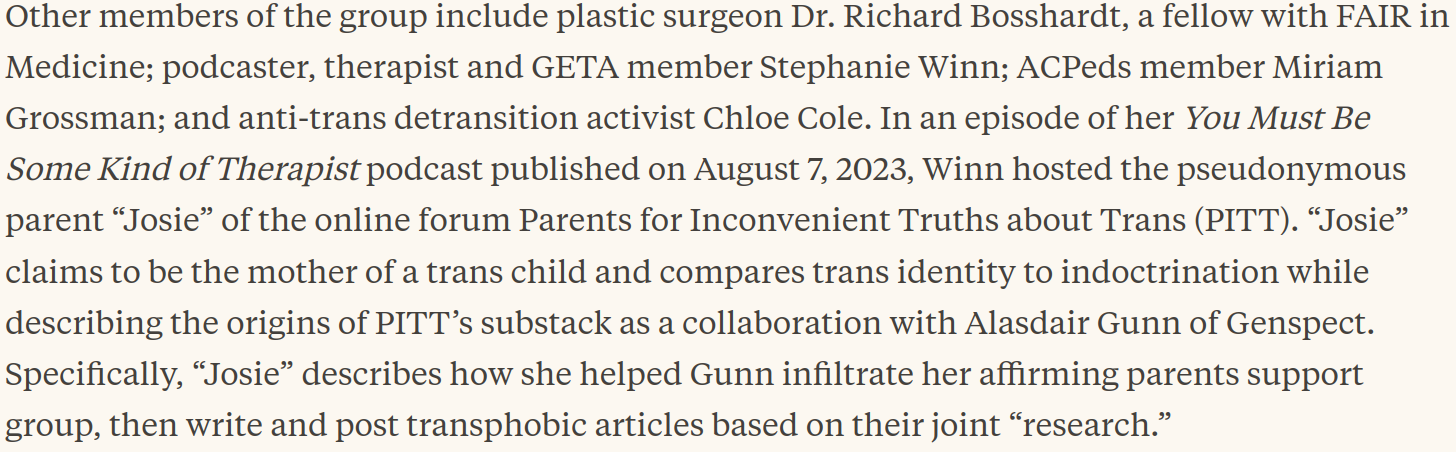
PittParents itself is directly connected to this well-funded network. As revealed in the SPLC's "Defining the Pseudoscience Network" report, PittParents founder "Josie" (Josie Alexander of PittParents) openly admitted to collaborating with Alasdair Gunn of Genspect to infiltrate affirming parent support groups and create anti-transgender content based on their "research."24 Genspect, founded by SEGM member Stella O'Malley in 2021, operates as a not-for-profit in Ireland generating revenue through donations and subscription fees.25
Several prominent authors and speakers have built lucrative careers by stoking fears about transgender people, selling books, speaking engagements, and media appearances.26 Nothing says "I'm concerned about the children" quite like a seven-figure book deal. Speaking of that, Josie and Dina, how are those pre-order book sale numbers looking for your second volume/book release?
Meanwhile, the medications used in gender-affirming care are often generic drugs that provide minimal profit margins compared to many other medications.27 The "Big Pharma" conspiracy theory simply doesn't hold up to scrutiny. If pharmaceutical companies were only motivated by profit, they'd be pushing way more expensive drugs than estrogen and testosterone, which cost pennies to produce.
The Actual Historical Context We Should Consider
If we want a meaningful historical analogy, we should look at other examples of medical and social progress that faced similar opposition:
Left-handedness was once considered deviant, sinful, or a psychiatric disorder. Children were forcibly converted to right-handedness, causing psychological trauma. When this practice ended, the rate of left-handedness "increased" dramatically – not because more people became left-handed, but because they could finally be themselves.28
If any of these arguments so far sound familiar, that is because they are.Homosexuality was pathologized in the DSM until 1973. The same arguments used against transgender care today – protecting children, preventing "contagion," avoiding "experimental" treatments – were used to justify conversion therapy for gay and lesbian youth.29
These examples provide more appropriate historical context than human sacrifice rituals. But I guess "Gender-Affirming Care Is Like Letting People Use Their Left Hand" doesn't quite generate the same pearl-clutching panic.
The Real Harm of False Analogies
When we allow bad-faith comparisons like "transgender healthcare equals human sacrifice" to go unchallenged, we enable real harm:
Transgender youth face significantly higher rates of depression, anxiety, and suicidality when denied supportive care.30 A 2021 study found that transgender youth are at a four-fold higher risk of suicide attempts compared to their cisgender peers.31
States that have banned gender-affirming care have seen increases in mental health crises among transgender youth.32 One study found that crisis calls from transgender youth increased by 76% in states that passed restrictive laws.33
Families have been forced to relocate or travel across state lines to access medically necessary care, creating financial and emotional strain.34 Some families have had to literally sell their homes to move to states where their children can receive care.
But sure, let's keep focusing on hypothetical Aztec comparisons while actual kids suffer. As George Carlin might say, "That's the kind of thing you'd expect from a civilization that thinks it's normal to have 'In God We Trust' on its money while simultaneously separating children from lifesaving healthcare."
Conclusion: A More Honest Conversation
If we want to have productive discussions about transgender healthcare, we need to start with facts, not inflammatory comparisons to human sacrifice and disinformation. The decisions being made about transgender youth's access to care should be based on medical evidence, not the conspiracy theories and the equivalent of saying, "You know who else had opinions? AZTECS! And they killed people! Checkmate, science!"
The irony is that the article ends by claiming "common sense, rationality, and virtue will win in the end." On that point, at least, I agree – though I suspect we have very different ideas about what those values would actually lead us to conclude. Because there's nothing rational about using ancient ritual murder as your go-to comparison for modern healthcare. That's like saying drinking water is dangerous because people also drown in water. It's the kind of logic that makes you want to start a GoFundMe for the author's abandoned critical thinking skills.
Here's what's truly sacrificial: politicians and pundits sacrificing the mental health of transgender kids on the altar of their political ambitions.35 Organizations sacrificing medical expertise at the bloodthirsty temple of fundraising opportunities.36 And writers sacrificing basic human decency for the chance to pen another fear-mongering article that will keep the checks coming in.
So let's be absolutely clear: When we look at the evidence – the actual medical research, the experiences of transgender people, and the consensus of major medical organizations – we find that gender-affirming care is not a sacrifice at all. It's healthcare, often life-saving healthcare, designed to help people live happier and better lives.
And the next time someone tries to compare medical care to human sacrifice, perhaps we should ask them: Who's really cutting out hearts here? The doctors providing evidence-based care to reduce suicide rates? Or the people working tirelessly to deny vulnerable young people the treatments that medical experts overwhelmingly support? 37
Because if you want to talk about sacrifice, let's talk about the kids who have died by suicide after being denied appropriate care.38 Let's talk about the families who've had to sacrifice their homes, jobs, and communities to move to states where their children can receive treatment.39 Let's talk about the very real human cost of these harmful narratives and policies.
That's not just an inconvenient truth. It's a goddamn emergency. And honestly, if caring about the lives of trans folks, both young and old, makes me a worshipper at the "Temple of the Gender Gods," then hand me a robe and sign me up – because that beats the hell out of whatever whacked-out grifting cult that thinks comparing healthcare to human sacrifice and gender-affirming care to lobotomies is a reasonable argument.
References
Alexander, Josie & Samuels, Dina. 2025. Modern Sacrifices. Substack. https://www.pittparents.com/p/modern-sacrifices ↩
American Medical Association. (2021). AMA to states: Stop interfering in health care of transgender children. https://www.ama-assn.org/press-center/press-releases/ama-states-stop-interfering-health-care-transgender-children ↩
American Academy of Pediatrics. (2018). Ensuring comprehensive care and support for transgender and gender-diverse children and adolescents. Pediatrics, 142(4), e20182162. https://doi.org/10.1542/peds.2018-2162 ↩
What We Know Project. (2018). What does the scholarly research say about the effect of gender transition on transgender well-being? Cornell University. https://whatweknow.inequality.cornell.edu/topics/lgbt-equality/what-does-the-scholarly-research-say-about-the-well-being-of-transgender-people/ ↩
WPATH. (2022). Standards of Care for the Health of Transgender and Gender Diverse People, Version 8. International Journal of Transgender Health, 23(sup1), S1-S259. ↩
Flores, A. R., Herman, J. L., Gates, G. J., & Brown, T. N. T. (2016). How many adults identify as transgender in the United States? Williams Institute, UCLA School of Law. https://williamsinstitute.law.ucla.edu/publications/trans-adults-united-states/ ↩
Herman, J. L., Flores, A. R., & O'Neill, K. K. (2022). How many adults and youth identify as transgender in the United States? Williams Institute, UCLA School of Law. https://williamsinstitute.law.ucla.edu/publications/trans-adults-united-states/ ↩
McManus, I. C. (2002). Right hand, left hand: The origins of asymmetry in brains, bodies, atoms and cultures. Harvard University Press. https://www.hup.harvard.edu/books/9780674016132 ↩
Rafferty, J., et al. (2018). See 3 above ↩
Hembree, W. C., et al. (2017). Endocrine treatment of gender-dysphoric/gender-incongruent persons: An Endocrine Society clinical practice guideline. The Journal of Clinical Endocrinology & Metabolism, 102(11), 3869-3903. https://pubmed.ncbi.nlm.nih.gov/28945902/ ↩
Olson-Kennedy, J., et al. (2018). Management of gender nonconformity in children and adolescents. UpToDate. https://www.uptodate.com/contents/management-of-transgender-and-gender-diverse-children-and-adolescents ↩
Coleman, E., et al. (2022). See 5 above ↩
Turban, J. L., et al. (2020). Pubertal suppression for transgender youth and risk of suicidal ideation. Pediatrics, 145(2), e20191725. https://doi.org/10.1542/peds.2019-1725 ↩
Tordoff, D. M., et al. (2022). Mental health outcomes in transgender and nonbinary youths receiving gender-affirming care. JAMA Network Open, 5(2), e220978. https://doi.org/10.1001/jamanetworkopen.2022.0978 ↩
Trevor Project. (2022). National survey on LGBTQ youth mental health. https://www.thetrevorproject.org/survey-2022/ ↩
Almazan, A. N., & Keuroghlian, A. S. (2021). Association between gender-affirming surgeries and mental health outcomes. JAMA Surgery, 156(7), 611-618. https://jamanetwork.com/journals/jamasurgery/fullarticle/2779429 ↩
de Vries, A. L., et al. (2014). Young adult psychological outcome after puberty suppression and gender reassignment. Pediatrics, 134(4), 696-704. https://doi.org/10.1542/peds.2013-2958 ↩
United States v. Skrmetti, No. 23-477, 598 U.S. ___ (2023). https://www.supremecourt.gov/docket/docketfiles/html/public/23-477.html ↩
American Academy of Pediatrics et al. (2023). Brief of amici curiae American Academy of Pediatrics et al. in support of the United States, United States v. Skrmetti, No. 23-477. ↩
American Psychiatric Association. (2023). APA condemns false comparisons between gender-affirming care and historical psychiatric treatments. https://www.psychiatry.org/newsroom/news-releases/apa-condemns-false-comparisons-between-gender-affirming-care-and-historical-psychiatric-treatments ↩
Southern Poverty Law Center. CAPTAIN report. https://www.splcenter.org/resources/guides/captain/ ↩
Southern Poverty Law Center. (2022). Alliance Defending Freedom. https://www.splcenter.org/fighting-hate/extremist-files/group/alliance-defending-freedom ↩
Southern Poverty Law Center. (2023). Defining the Pseudoscience Network. https://www.splcenter.org/resources/reports/defining-pseudoscience-network/ ↩
Ibid. ↩
Ibid. ↩
Jones, Imara. (2024). The Anti-Trans Hate Machine: Money, Power and A Radical Vision. Trans Lash Media. https://translash.org/podcasts/the-anti-trans-hate-machine/money-power-and-a-radical-vision/ ↩
Leveille, L. (2022). The Mechanisms of TAnon: Where it Came From. https://healthliberationnow.com/2021/07/05/the-mechanisms-of-tanon-where-it-came-from/#What_This_Means ↩
McManus, I. C. (2002). Right hand, left hand: The origins of asymmetry in brains, bodies, atoms and cultures. Harvard University Press. https://psycnet.apa.org/record/2004-20567-000 ↩
Drescher, J. (2015). Out of DSM: Depathologizing homosexuality. Behavioral Sciences, 5(4), 565-575. https://doi.org/10.3390/bs5040565 ↩
Trevor Project. (2022). National survey on LGBTQ youth mental health. https://www.thetrevorproject.org/survey-2022/ ↩
Price-Feeney, M., Green, A. E., & Dorison, S. (2020). Understanding the mental health of transgender and nonbinary youth. Journal of Adolescent Health, 66(6), 684-690. https://www.jahonline.org/article/S1054-139X(19)30922-X/fulltext ↩
Trevor Project. (2023). Crisis calls surged following anti-LGBTQ legislation. https://www.thetrevorproject.org/blog/the-trevor-project-shares-post-election-day-crisis-contact-volume-data/ ↩
Green, A. E., et al. (2022). Association of gender-affirming care bans with transgender and nonbinary youth mental health. JAMA Psychiatry, 79(12), 1247-1248. https://doi.org/10.1038/s41562-024-01979-5 ↩
Kesslen, B. (2023). ‘We cannot live here’: The families with trans children who are fleeing Republican strongholds. EL PAÍS. https://english.elpais.com/usa/2023-12-04/we-cannot-live-here-the-families-with-trans-children-who-are-fleeing-republican-strongholds.html
and
Winter, H. 2025. Southern Anti-Trans Laws Are Uprooting Families — And Leaving Them With Impossible Choices. Rolling Stone. https://www.rollingstone.com/culture/culture-features/anti-trans-legislation-the-south-trans-kids-risk-1234977946/ ↩
Human Rights Campaign. (2024). New HRC State Equality Index Shows Devastating Impact of Radical Anti-LGBTQ+ 2023 State Legislative Season. https://www.hrc.org/press-releases/new-hrc-state-equality-index-shows-devastating-impact-of-radical-anti-lgbtq-2023-state-legislative-season ↩
See 23 above ↩
See 19 Above ↩
Trevor Project. (2022). National survey on LGBTQ youth mental health. https://www.thetrevorproject.org/survey-2022/ ↩
See 31 above ↩